
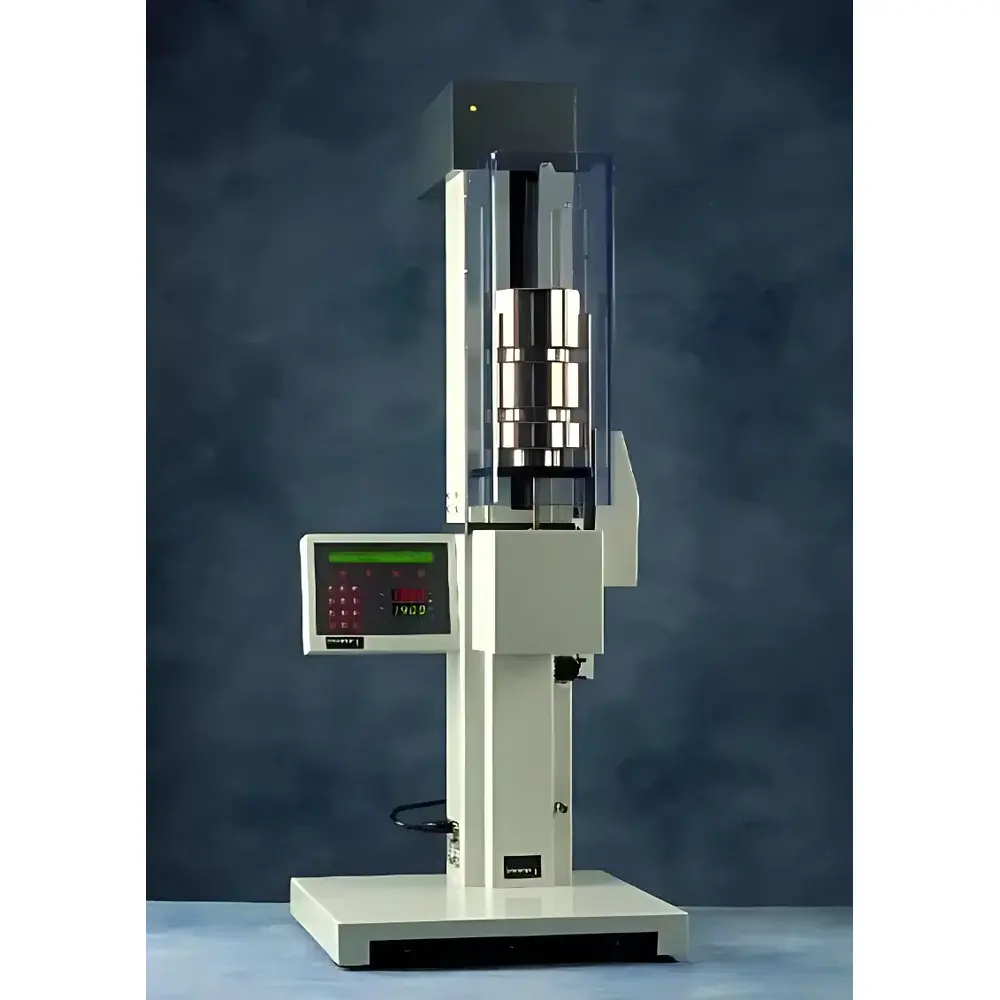
Davenport MFI-10 Automated Melt Flow Indexer
| Brand | Davenport |
|---|---|
| Origin | USA |
| Model | MFI-10 |
| Standards Compliance | ISO 1133, ASTM D1238 (Methods A & B) |
| Measurement Outputs | Melt Flow Index (MFI), Melt Flow Rate (MFR), Melt Volume Rate (MVR), Melt Density/Viscosity Derivation |
| Configurable Test Methods | Up to 10 user-defined test protocols |
| Optional Accessories | Automatic timer, motorized weight loading system, automatic specimen cutter, corrosion-resistant barrel assembly, displacement sensor |
| Display | Backlit LCD with step-by-step guided operation and audible prompts |
| Software Integration | NEXYGEN Data Analysis Software (optional) |
| System Architecture | Modular, field-upgradable platform supporting manual or fully automated operation |
Overview
The Davenport MFI-10 Automated Melt Flow Indexer is an engineered precision instrument designed for the quantitative assessment of thermoplastic polymer melt rheology under standardized thermal and mechanical conditions. It operates on the principle of extrusion plastometry: a pre-conditioned polymer sample is heated to a specified temperature in a cylindrical barrel, then forced through a calibrated die under a defined dead-load—typically applied via calibrated weights—while the extrudate mass or volume is measured over a fixed time interval. This method directly yields fundamental processability indicators including Melt Flow Index (MFI), Melt Flow Rate (MFR), and Melt Volume Rate (MVR), all traceable to ISO 1133 and ASTM D1238 (Methods A and B). The MFI-10 is purpose-built for high-integrity quality control laboratories in compounding, extrusion, injection molding, and polymer R&D environments where inter-laboratory reproducibility, regulatory audit readiness, and long-term measurement stability are critical requirements.
Key Features
- Modular architecture enabling seamless transition between manual operation and full automation—ideal for labs scaling from routine QC to multi-method compliance testing.
- Embedded real-time guidance system: backlit LCD interface delivers sequential, language-neutral procedural instructions; synchronized audible cues prompt operator actions at precise temporal milestones (e.g., loading, cutting, weighing).
- Secure protocol management: up to 10 named test configurations—including temperature setpoint, load duration, die geometry, and weight selection—can be stored, password-protected, and recalled with single-button activation.
- Factory-embedded calibration and configuration options ensure “power-on-and-run” deployment without software installation or field commissioning delays.
- Optional motorized weight loading mechanism eliminates manual handling of heavy standard masses (e.g., 2.16 kg, 5.00 kg, 10.00 kg), reducing operator fatigue and minimizing mechanical variability introduced by inconsistent loading force application.
- Integrated displacement sensor option enables continuous position tracking of the piston, supporting advanced viscosity modeling and non-standard flow curve derivation beyond basic MFR/MVR reporting.
Sample Compatibility & Compliance
The MFI-10 accommodates standard polymer forms including granules, pellets, and ground flakes across common thermoplastics such as polyethylene (PE), polypropylene (PP), polycarbonate (PC), ABS, and engineering resins like PEEK and PPS. Its barrel and die assembly conform to dimensional tolerances specified in ISO 1133-1:2011 and ASTM D1238–22, ensuring geometric fidelity critical for inter-laboratory comparability. All test outputs are compliant with GLP documentation requirements when used with NEXYGEN software, which provides electronic audit trails, user access logs, and version-controlled method files—fully aligned with FDA 21 CFR Part 11 principles for regulated environments. Routine verification using certified reference materials (e.g., NIST-traceable polystyrene standards) is supported via built-in calibration verification workflows.
Software & Data Management
NEXYGEN software—available as an optional licensed module—transforms raw timing and mass data into fully annotated reports compliant with ISO/IEC 17025 documentation frameworks. It supports automated calculation of MFI (g/10 min), MFR (g/10 min), MVR (cm³/10 min), and derived melt density. Data export is available in CSV, PDF, and XML formats, with configurable report templates meeting internal QA templates or external customer submission requirements. Audit trail functionality records every parameter change, result modification, and user login event with timestamp and operator ID—enabling full forensic reconstruction of any test sequence during internal audits or regulatory inspections.
Applications
- Batch release testing of incoming raw polymer lots against supplier specifications.
- In-process monitoring during compounding and masterbatch production to validate dispersion homogeneity and thermal history effects.
- Correlation studies linking MFR values to mechanical properties (e.g., tensile strength, impact resistance) in formulation development.
- Stability assessment of recycled polymer streams subjected to multiple extrusion cycles.
- Technical support for failure analysis investigations involving flow-related defects (e.g., weld line weakness, short shots, melt fracture).
FAQ
Does the MFI-10 meet ISO 1133 and ASTM D1238 certification requirements for accredited testing laboratories?
Yes—the instrument’s mechanical design, thermal control accuracy, die geometry, and weight calibration traceability satisfy the essential hardware requirements of both standards. When paired with NEXYGEN software and documented calibration procedures, it supports full ISO/IEC 17025 implementation.
Can test methods be locked to prevent unauthorized modification?
Yes—administrators may assign password protection to individual test protocols or globally restrict editing rights via firmware-level access controls.
Is the system compatible with LIMS integration?
NEXYGEN supports ODBC-compliant database connectivity and offers RESTful API endpoints for bidirectional data exchange with laboratory information management systems.
What maintenance intervals are recommended for long-term accuracy?
Daily visual inspection of die orifice and barrel interior; quarterly verification of temperature uniformity and weight calibration; annual full metrological validation per ISO 17025 Clause 6.4.3.
How does the MFI-10 differ functionally from the MFI-9 model?
The MFI-9 is a self-contained, microprocessor-based unit optimized for single-method, high-throughput QC with five fixed test presets. The MFI-10 adds modular expandability, programmable automation interfaces, displacement sensing capability, and native NEXYGEN interoperability—making it suitable for multi-standard, multi-user, and regulated environments.





