
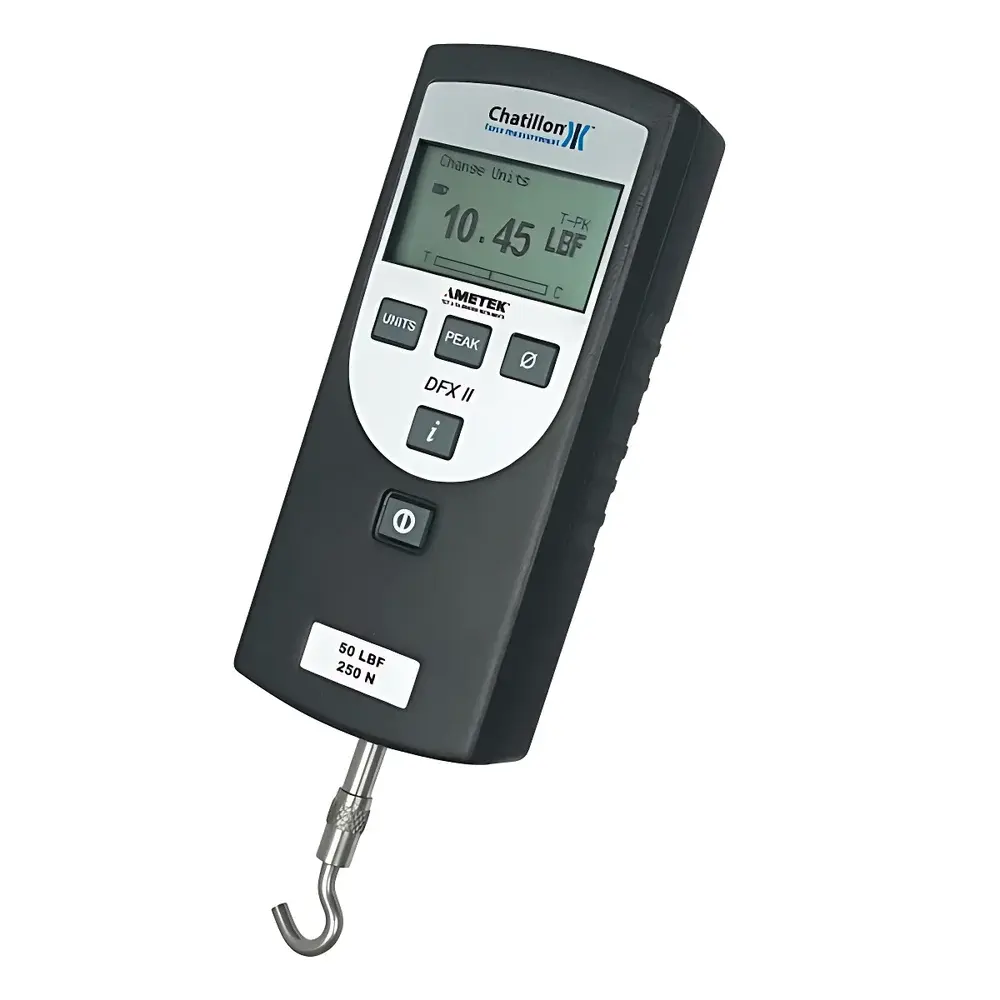
Chatillon DFX II Digital Force Gauge
| Brand | Chatillon |
|---|---|
| Origin | USA |
| Model | DFX II |
| Accuracy | ±0.3% of full scale |
| Display | Dot-matrix LCD |
| Battery Life | 70–100 hours (continuous use) |
| Force Ranges | 10 lbf, 50 lbf, 100 lbf, 200 lbf |
| Units | ozf, gf, lbf, kgf, N |
| Interface | Built-in calibration routine |
| Language Selection | Yes |
| Compliance | ASTM E4, ISO 7500-1 (Class 1), GLP-compliant data logging capability |
Overview
The Chatillon DFX II Digital Force Gauge is an entry-level, high-reliability force measurement instrument engineered for precision tensile and compressive force evaluation in quality control, product development, and routine mechanical testing environments. Utilizing a strain-gauge-based internal load cell architecture, the DFX II delivers traceable force measurements with an accuracy of ±0.3% of full scale—meeting the minimum performance criteria defined in ASTM E4 (Standard Practices for Force Verification of Testing Machines) and ISO 7500-1:2018 (Metallic materials — Calibration of static uniaxial testing machines — Part 1: Tension/compression testing machines). Designed for users requiring robust, repeatable peak-force capture without advanced programmability, the DFX II serves as a foundational tool for validating actuation forces, package integrity, ergonomic thresholds, and mechanical interface specifications across industrial, pharmaceutical, and consumer goods sectors.
Key Features
- Strain-gauge load cell with factory-calibrated linearity and hysteresis compensation, ensuring consistent repeatability across repeated cycles.
- Dot-matrix LCD display with adjustable contrast, optimized for readability under varied ambient lighting conditions—including production floor and laboratory settings.
- Four interchangeable force ranges (10 lbf, 50 lbf, 100 lbf, 200 lbf), each with dedicated hardware scaling to maintain resolution and minimize quantization error at low-force thresholds.
- Multi-unit support: real-time switching between ounce-force (ozf), gram-force (gf), pound-force (lbf), kilogram-force (kgf), and newton (N)—enabling seamless integration into international test protocols and cross-functional reporting.
- On-device calibration verification and user-initiated zeroing routines, supporting GLP-aligned maintenance workflows without external software dependency.
- Extended battery life of 70–100 hours on standard AA alkaline cells, minimizing downtime during high-throughput inspection sequences.
- Intuitive single-button navigation interface with tactile feedback—designed for glove-compatible operation and reduced operator training overhead.
Sample Compatibility & Compliance
The DFX II is compatible with standard Chatillon mechanical fixtures including MT-series motorized test stands (for controlled rate-of-load applications), manual hand-held grips (e.g., door-opening or trigger-pull adapters), and custom jigs conforming to ISO 26203-2 (Dynamic force measurement—Part 2: Verification of dynamic force-measuring systems). When mounted on an MT test stand, the gauge supports quasi-static pull-off tests such as aerosol cap removal force, seal burst strength, and snap-fit engagement validation per ASTM D903 and ISO 11339. Its mechanical design complies with IP54-rated ingress protection against dust and incidental water splashing, suitable for non-hazardous industrial environments. All firmware and calibration records adhere to basic GLP documentation requirements, including timestamped calibration events and operator ID fields where integrated with external LIMS.
Software & Data Management
While the DFX II operates autonomously without mandatory PC connectivity, optional RS-232 or USB-to-serial interface modules enable direct data streaming to host systems running Windows-based acquisition software (e.g., NexygenPlus or third-party LabVIEW VIs). Captured peak force values, timestamps, and unit selections are exportable in CSV format for statistical process control (SPC) analysis. The device stores up to 100 sequential readings internally—sufficient for shift-level sampling without real-time transfer. Audit trails include automatic logging of zeroing actions and range changes, satisfying FDA 21 CFR Part 11 foundational requirements when paired with appropriate electronic signature controls at the host application layer.
Applications
- Consumer product safety validation: button activation force, lid opening resistance, hinge torque threshold assessment.
- Pharmaceutical packaging: blister pack peel strength, syringe plunger break-loose force, vial stopper removal force per USP <1207>.
- Automotive component testing: seatbelt buckle engagement force, HVAC vent actuator resistance, interior trim retention force.
- Medical device QA: catheter kink resistance, surgical stapler jaw compression force, infusion pump occlusion detection calibration.
- Ergonomic design verification: keyboard key actuation force, touch-screen stylus pressure sensitivity, wheelchair brake lever effort.
FAQ
Does the DFX II support real-time analog output for integration with PLCs or DAQ systems?
No—the DFX II provides digital serial output only. Analog voltage or current output requires external signal conditioning hardware.
Can the DFX II perform continuous real-time force monitoring (not just peak capture)?
It displays live force values but does not buffer or stream continuous waveform data; it is optimized for peak-hold and hold-to-read operations.
Is NIST-traceable calibration certification included with purchase?
A certificate of conformance is supplied; NIST-traceable calibration with uncertainty budget requires optional add-on service through authorized Chatillon calibration centers.
What is the recommended recalibration interval under normal lab use?
Annual recalibration is advised per ISO/IEC 17025 guidelines; more frequent verification is recommended if subjected to shock loading or >80% of full-scale use.
Are replacement load cells field-serviceable?
Load cells are not user-replaceable; units requiring sensor replacement must be returned to an authorized service center for factory recalibration and revalidation.



