
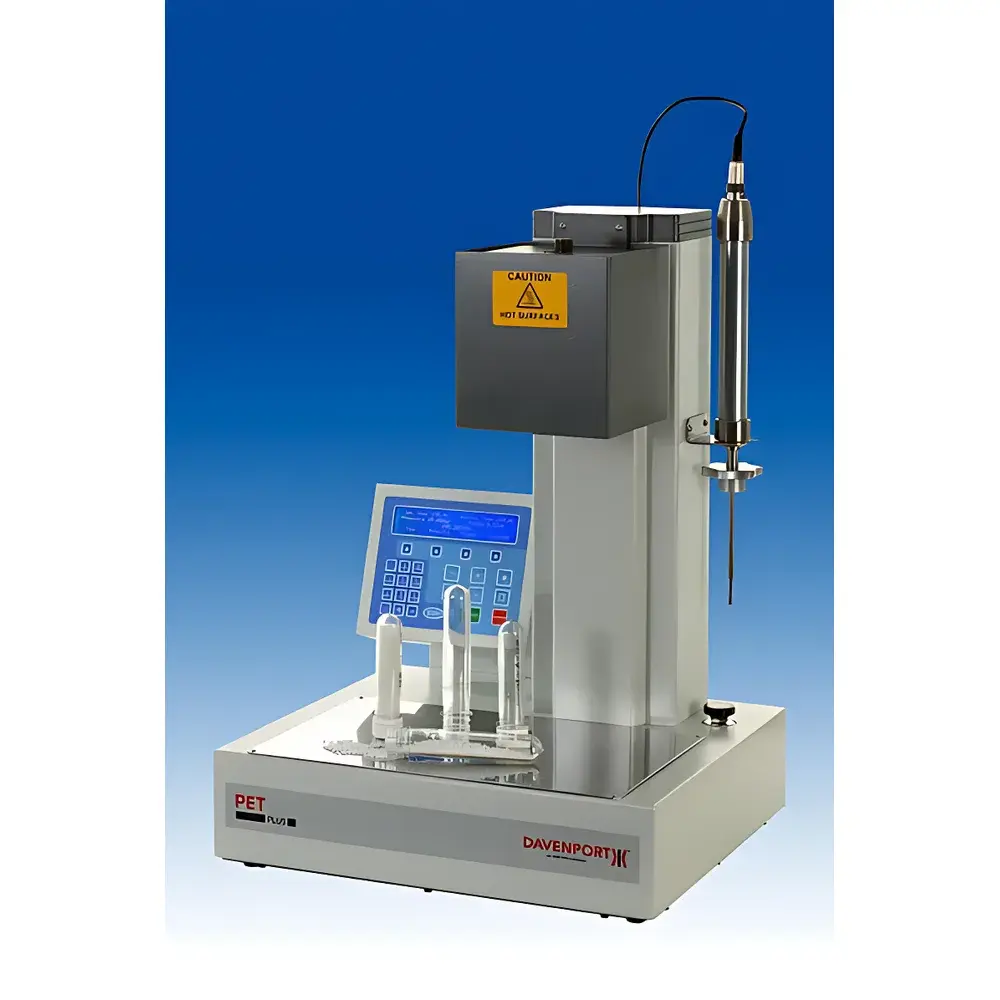
Davenport PETPlus Solvent-Free Intrinsic Viscosity and Melt Viscosity Analyzer
| Brand | Davenport |
|---|---|
| Origin | USA |
| Manufacturer Type | Authorized Distributor |
| Product Origin | Imported |
| Model | PETPlus |
| Pricing | Available Upon Request |
Overview
The Davenport PETPlus is a purpose-engineered, solvent-free analytical instrument designed specifically for the rapid, accurate, and safe determination of intrinsic viscosity (IV) and melt viscosity (MV) of polyethylene terephthalate (PET) and other hygroscopic, semi-crystalline, or insoluble thermoplastic polymers. Unlike conventional capillary or solution-based viscometry methods—such as ASTM D4603 or ISO 1628-5—the PETPlus employs a proprietary thermal-mechanical measurement principle grounded in controlled melt-state rheology. It subjects a precisely weighed PET sample to standardized heating and shear conditions within an inert atmosphere, enabling direct correlation between melt flow behavior and molecular weight distribution. This eliminates dependence on hazardous solvents (e.g., phenol/1,1,2,2-tetrachloroethane), thereby removing associated occupational exposure risks, waste disposal liabilities, and long-term solvent procurement costs. The system complies with core principles outlined in USP , ISO 1133-1 (for melt flow index context), and supports GLP-compliant workflows through traceable calibration and audit-ready data handling.
Key Features
- Solvent-free operation: Fully eliminates requirement for toxic, high-boiling-point solvents—reducing EHS risk and regulatory burden.
- Dual-parameter output: Simultaneous reporting of intrinsic viscosity (dL/g) and melt viscosity (Pa·s) under standardized temperature and shear profiles.
- Hygroscopic sample compatibility: Integrated pre-drying module and moisture-resistant sample chamber enable reliable analysis of PET pellets with residual moisture up to 0.5 wt%.
- Modular architecture: Operates autonomously via built-in touchscreen interface with real-time graphing, or integrates seamlessly with NEXYGENPlus PET software for advanced statistical analysis and method validation.
- ASTM- and ISO-aligned methodology: Measurement protocol aligns with fundamental rheological definitions in ASTM D3835 and ISO 6721-6, ensuring cross-laboratory reproducibility.
- Robust thermal control: Precision ±0.1 °C PID-controlled heating block with nitrogen purge capability ensures stable melt-state conditions during viscosity derivation.
Sample Compatibility & Compliance
The PETPlus is validated for use with virgin and recycled PET resins, including bottle-grade, fiber-grade, and engineering-grade formulations. It accommodates crystalline, partially amorphous, and hydrolytically degraded samples without dissolution pretreatment. The instrument meets essential requirements for regulated environments: data integrity conforms to FDA 21 CFR Part 11 when used with NEXYGENPlus PET (including electronic signatures, audit trails, and user access controls); hardware design adheres to IEC 61010-1 safety standards; and test reports may be structured to support ISO/IEC 17025 accreditation documentation. No solvent-related SDS management or VOC emission reporting is required.
Software & Data Management
NEXYGENPlus PET provides full lifecycle data governance—from method creation and instrument calibration to report generation and trend analysis. Each test generates timestamped, user-attributed records containing raw torque/time curves, derived IV/MV values, thermal ramp profiles, and system diagnostic logs. All data are stored in encrypted SQLite databases with configurable backup intervals and export options (CSV, PDF, XML). Software validation packages—including IQ/OQ documentation, change control logs, and version history—are available for GMP-regulated facilities. Audit trail functionality captures every data modification event, satisfying ALCOA+ (Attributable, Legible, Contemporaneous, Original, Accurate, Complete, Consistent, Enduring, Available) data integrity criteria.
Applications
- Quality control of PET resin batches in polymer manufacturing plants.
- Stability assessment of PET during solid-state polymerization (SSP) and drying processes.
- R&D screening of catalyst systems, chain extenders, or reclamation additives affecting molecular weight.
- Regulatory submission support for medical device packaging materials requiring IV verification per ISO 10993-1.
- Failure analysis of PET components exhibiting premature embrittlement or processing instability.
- Validation of recycling process efficacy by tracking IV decay across mechanical or chemical recycling cycles.
FAQ
Does the PETPlus require calibration with certified reference standards?
Yes—annual calibration using NIST-traceable PET reference materials (e.g., NIST SRM 2892) is recommended; factory-certified calibration kits are available.
Can the PETPlus measure other polyesters besides PET?
It is optimized for PET but has demonstrated empirical utility with PBT and PEN; method development and validation are required for non-PET polymers.
What sample mass is required per test?
Typical range is 0.8–1.2 g of uniformly sized pellets or flakes; automated mass verification is integrated into the loading sequence.
Is nitrogen purge mandatory?
Nitrogen blanketing is strongly recommended to prevent oxidative degradation during melt-phase measurement; optional argon or dry air purges may be configured.
How does PETPlus-derived IV correlate with solution-based ASTM D4603 results?
Empirical correlation studies show R² > 0.98 across IV ranges of 0.6–1.2 dL/g when using matched calibration models; correlation coefficients are embedded in NEXYGENPlus PET’s method templates.



