
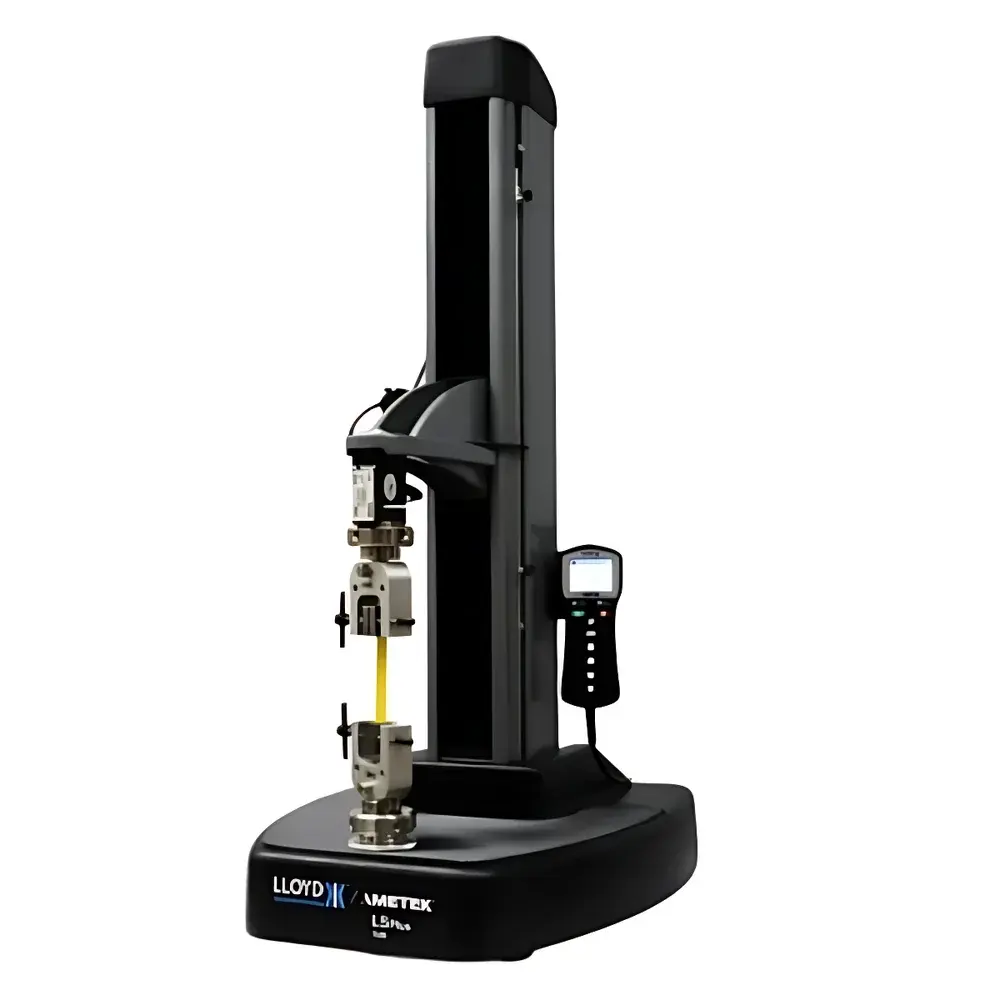
LLOYD LSPlus Series Universal Testing Machine
| Brand | LLOYD |
|---|---|
| Origin | Denmark |
| Model | LSPlus Series |
| Instrument Type | Electromechanical Tensile and Compression Testing Machine |
| Maximum Test Force | 5000 kN |
| Speed Range | 0.001–2032 mm/min |
| Force Accuracy | ±0.5% of reading |
| Crosshead Travel | 800 mm |
| Displacement Resolution | 0.00004 mm |
Overview
The LLOYD LSPlus Series Universal Testing Machine is an electromechanical static testing system engineered for high-precision mechanical property evaluation of materials across research, quality control, and regulatory compliance environments. Based on the proven LS platform, the LSPlus series incorporates upgraded drive architecture, enhanced load frame rigidity, and refined motion control algorithms to deliver improved force linearity, speed stability, and long-term repeatability. It operates on the fundamental principle of controlled uniaxial loading—applying tensile, compressive, flexural, peel, shear, or puncture forces to specimens while continuously measuring load and displacement in accordance with standardized test methods (e.g., ASTM E4, ISO 7500-1, EN 10002-2). Designed for laboratories requiring traceable, audit-ready results, the LSPlus meets the mechanical performance requirements for GLP-compliant material characterization and supports full alignment with ISO/IEC 17025 calibration protocols.
Key Features
- High-capacity electromechanical actuation system rated up to 5000 kN, enabling structural-scale testing of composites, metal alloys, civil engineering specimens, and orthopedic implants.
- Precision-controlled crosshead speed range from 0.001 mm/min (quasi-static creep/stress relaxation) to 2032 mm/min (high-speed return and rapid cycling), maintaining ±0.5% force accuracy across the full dynamic range.
- Modular YLC-series interchangeable load cells with verified traceability to national standards; each sensor calibrated to ±0.5% of reading over 0.1–100% of capacity, supporting multi-range testing without recalibration.
- Ultra-fine displacement resolution of 0.00004 mm (40 nm), achieved via high-resolution optical encoder feedback integrated into the servo-motor drive train—critical for low-strain modulus determination and micro-deformation analysis.
- 800 mm vertical travel accommodates large-format specimens including laminated panels, extruded profiles, and packaged consumer goods, while maintaining column parallelism within 5 µm/m over full stroke.
- Rigid four-column load frame with preloaded ball screws and dual-axis crosshead guidance ensures minimal deflection (<0.02 mm under maximum load), preserving measurement integrity during high-force compression and bending tests.
Sample Compatibility & Compliance
The LSPlus series accommodates a broad spectrum of specimen geometries and mechanical behaviors—from brittle ceramics and elastomeric polymers to viscoelastic hydrogels and fiber-reinforced composites. Standardized grips (pneumatic, wedge, hydraulic, and custom tooling) enable secure clamping of flat, round, irregular, or soft-surface samples without slippage or premature failure. The system complies with key international testing standards including ASTM D638 (tensile plastics), ASTM D790 (flexural properties), ISO 37 (rubber tensile), ISO 1133 (melt flow index correlation), and ISO 1421 (rubber tear resistance). For regulated industries, NEXYGENPlus software provides 21 CFR Part 11–compliant electronic signatures, audit trails, and user-access controls—supporting FDA submissions, medical device validation (ISO 13485), and pharmaceutical packaging qualification (USP ).
Software & Data Management
NEXYGENPlus is the native test control and analysis suite for the LSPlus platform. It delivers real-time synchronized acquisition of load, displacement, strain (via optional extensometers), and environmental parameters (temperature, humidity). All test methods are pre-configured per ASTM, ISO, and DIN standards, with customizable pass/fail criteria, automatic report generation (PDF, HTML, XML), and direct export to Excel and Word for integration into enterprise QA/QC workflows. Data integrity is ensured through cryptographic hashing of raw datasets, timestamped operator logs, and immutable audit trails that record every parameter change, calibration event, and result modification—fully compliant with ISO/IEC 17025 clause 7.7 and GLP Principle 5.
Applications
- Mechanical validation of polymer blends, thermoplastics, and biodegradable films in packaging R&D.
- Tensile strength and elongation-at-break assessment of surgical sutures, catheter tubing, and wound dressings per ISO 10993-12.
- Compression testing of orthopedic bone cement, dental composites, and spinal interbody devices under ISO 5833 and ASTM F451.
- Peel adhesion quantification of pressure-sensitive adhesives used in transdermal patches and diagnostic biosensors.
- Flexural modulus and yield behavior analysis of wood-based panels, fiberboard, and engineered timber products per ASTM D1037.
- Dynamic fatigue profiling of elastomeric seals and gaskets subjected to cyclic loading at variable temperatures.
FAQ
What is the maximum force capacity of the LSPlus series, and how is it verified?
The LSPlus series is available in configurations up to 5000 kN. Force verification follows ISO 7500-1 Class 0.5 procedures using NIST-traceable reference load cells, with annual recalibration recommended per ISO/IEC 17025 requirements.
Can the LSPlus perform tests beyond tensile and compression?
Yes—it supports flexure, shear, peel, tear, puncture, and creep/stress relaxation via interchangeable fixtures and programmable test sequences in NEXYGENPlus.
Is displacement resolution affected by test speed or load level?
No—the 0.00004 mm resolution is maintained across the full speed range and load spectrum due to the closed-loop optical encoder feedback system independent of motor torque or mechanical amplification.
How does the LSPlus ensure data integrity for regulated submissions?
NEXYGENPlus implements role-based access control, electronic signatures, tamper-evident audit logs, and encrypted data storage—all aligned with 21 CFR Part 11 and Annex 11 requirements.
Are third-party extensometers supported?
Yes—the system features analog and digital input channels compatible with contact and non-contact extensometers from major vendors (e.g., MTS, Zwick, Instron), with automatic scaling and unit conversion in software.



