
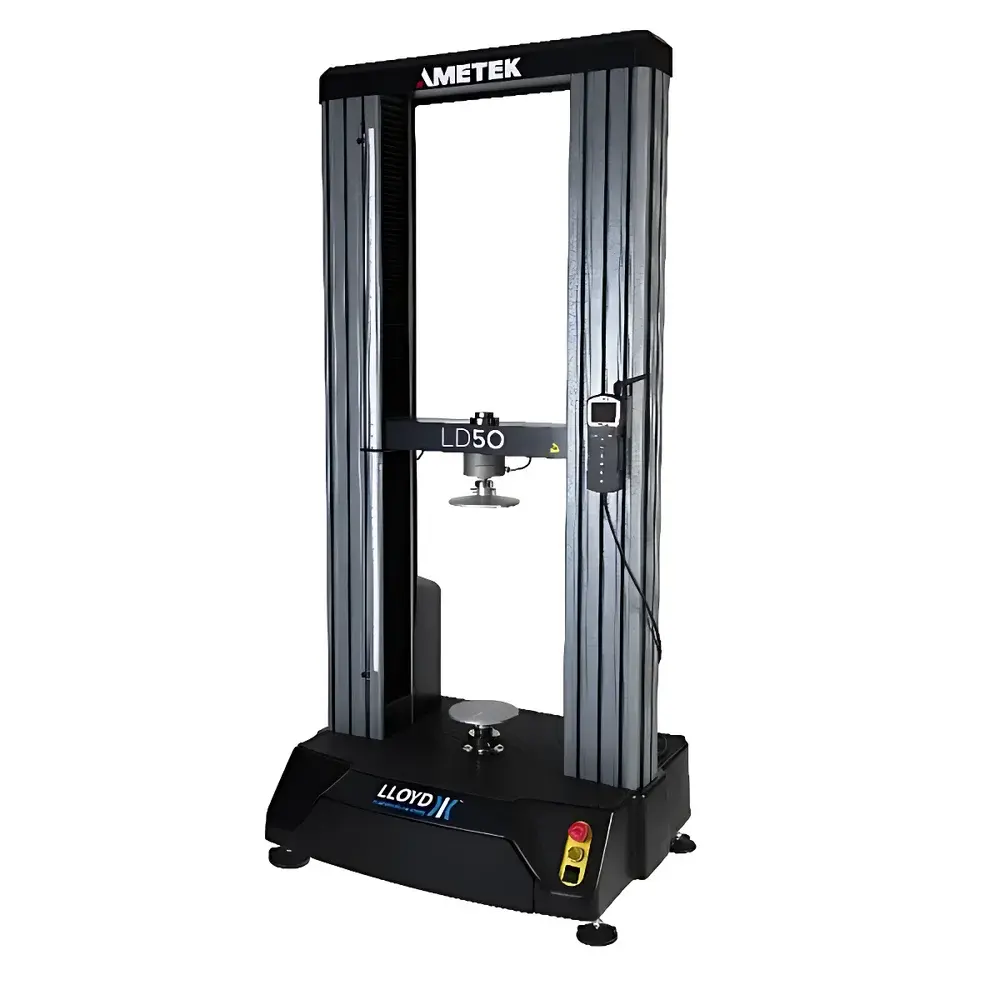
Lloyd LD10 Dual-Column Universal Testing Machine
| Brand | Lloyd |
|---|---|
| Origin | USA |
| Model | LD10 |
| Maximum Load Capacity | 10 kN (2248 lbf) |
| Column Spacing | 452 mm (17.8 in) |
| Crosshead Travel (Standard) | 1070 mm (42 in) |
| Crosshead Travel (Extended) | 1669 mm (65.7 in) |
| Drive System | AC Servo Motor with Preloaded Ball Screw |
| Load Cell | Interchangeable Spoke-Type Sensor |
| Compliance | CE Certified |
| Software | NEXYGENPlus with Built-in Standards Library |
| Frame Stiffness | High-Rigidity Dual-Column Architecture |
| Ease of Use | Intuitive Setup, Low Maintenance |
Overview
The Lloyd LD10 Dual-Column Universal Testing Machine is an electromechanical static testing system engineered for precision mechanical property evaluation of materials and components under tension, compression, flexure, peel, shear, and cyclic loading conditions. Based on the fundamental principles of force-displacement transduction and closed-loop servo control, the LD10 employs a high-rigidity dual-column frame architecture to minimize deflection and ensure axial alignment during high-fidelity mechanical testing. Its 10 kN (2248 lbf) load capacity positions it optimally for mid-range applications in quality assurance laboratories, R&D facilities, and contract testing organizations—particularly where specimen geometry demands extended vertical travel or wide lateral access. The system integrates a preloaded ball screw transmission driven by an AC servo motor, delivering consistent crosshead velocity control across its full speed range (0.001–1000 mm/min), while maintaining traceable displacement resolution and minimal backlash.
Key Features
- High-stiffness dual-column steel frame with 452 mm (17.8 in) column spacing—optimized for large or irregularly shaped specimens and multi-grip configurations.
- Standard crosshead travel of 1070 mm (42 in); extended travel option up to 1669 mm (65.7 in) for elongation-sensitive or high-aspect-ratio samples.
- Interchangeable spoke-type load cells calibrated to ISO 7500-1 Class 0.5 accuracy, supporting rapid sensor swapping without recalibration downtime.
- AC servo-driven actuation with integrated encoder feedback ensures repeatable speed control, high torque at low velocities, and thermal stability over extended test durations.
- CE-compliant design meeting essential requirements of the Machinery Directive 2006/42/EC and Electromagnetic Compatibility Directive 2014/30/EU.
- Modular hardware architecture enabling future upgrades—including environmental chamber integration, video extensometry, or digital image correlation (DIC) compatibility.
Sample Compatibility & Compliance
The LD10 accommodates a broad spectrum of specimen geometries—from thin polymer films and metallic foils to structural composites and biomedical implants—thanks to its expansive test envelope and configurable grip systems (pneumatic, hydraulic, wedge, and custom fixtures). It supports standardized test methods aligned with ASTM E4, ASTM E8/E8M (tensile), ASTM D638/D695 (plastics), ISO 6892-1, ISO 178, and EN 10002-1. All mechanical validations are performed per ISO 7500-1 for load measurement and ISO 9513 for extensometer calibration. The system is suitable for GLP- and GMP-regulated environments when configured with audit-trail-enabled software options and documented IQ/OQ protocols.
Software & Data Management
NEXYGENPlus software serves as the embedded control and analysis platform, providing real-time data acquisition at up to 10 kHz sampling rate. It includes over 200 preconfigured test methods compliant with international standards, fully editable templates, and customizable pass/fail criteria. Raw data exports natively to CSV, Excel (.xlsx), and Word (.docx) formats—enabling seamless integration into enterprise LIMS or ERP workflows. The software supports 21 CFR Part 11-compliant user authentication, electronic signatures, and immutable audit trails when deployed with optional security modules. Test reports include full metadata: operator ID, timestamp, environmental conditions (if logged), calibration history, and statistical summaries (mean, SD, CV%, confidence intervals).
Applications
- Quality control of elastomers, thermoplastics, adhesives, and packaging materials per ASTM D412, D882, and ISO 1133.
- Mechanical characterization of medical device components—including suture tensile strength (ISO 10993-12), catheter kink resistance (ISO 11070), and orthopedic implant fixation interfaces.
- Automotive component validation: gasket compression set, brake pad shear, and composite panel flexural modulus (ASTM D7264).
- Academic and industrial research on novel alloys, fiber-reinforced polymers, and bio-based composites requiring controlled strain-rate protocols and hysteresis loop analysis.
- Regulatory submission support for FDA 510(k), CE Marking, and IEC 60601-1 mechanical safety testing documentation.
FAQ
What load cell accuracy class does the LD10 support?
The LD10 accepts interchangeable spoke-type load cells certified to ISO 7500-1 Class 0.5, with optional Class 0.25 sensors available for metrology-grade applications.
Can the LD10 be integrated with environmental chambers?
Yes—the system features standardized mounting interfaces and analog/digital I/O ports compatible with major chamber manufacturers (e.g., ESPEC, Weiss, Binder) for temperature- and humidity-controlled testing.
Is NEXYGENPlus validated for use in regulated industries?
When configured with 21 CFR Part 11 modules and operated under documented SOPs, NEXYGENPlus meets ALCOA+ data integrity principles and supports inspection readiness for FDA, EMA, and MHRA audits.
Does the LD10 require annual recalibration?
Per ISO/IEC 17025 guidelines, load cell and displacement system verification should be performed at least annually—or after any impact event, mechanical repair, or relocation—and documented using traceable reference standards.
How is mechanical safety ensured during operation?
The LD10 incorporates dual-channel emergency stop circuitry, light curtain interlocks (optional), overload protection via hardware limit switches, and programmable soft limits in NEXYGENPlus to prevent overtravel or overforce events.



