
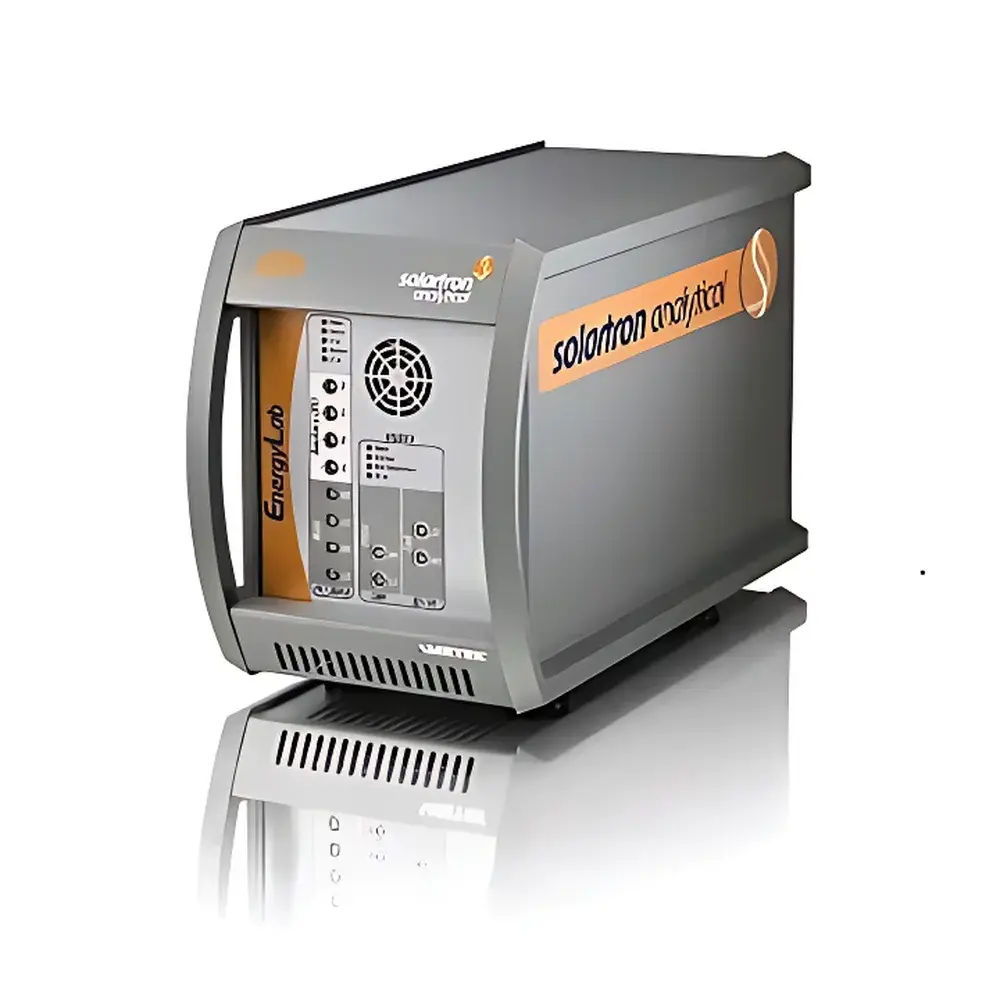
Solartron Analytical Energylab XM Electrochemical Workstation
| Brand | Solartron Analytical |
|---|---|
| Origin | United Kingdom |
| Model | Energylab XM |
| Channel Count | Single-Channel |
| Current Range | ±2 A |
| Current Accuracy | ±0.2% |
| Potential Accuracy | ±0.2% |
| Potentiostatic Range | ±8 V |
| EIS Frequency Range | 10 µHz – 1 MHz |
| Low-Impedance Measurement Capability | Down to 10 µΩ |
| Current Resolution | 100 aA |
| Voltage Resolution | 1 µV |
| Sampling Rate | Up to 1 MS/s (DC), 40 MS/s (FRA) |
| Auxiliary Differential Inputs | 4-channel |
| Compliance | ASTM G5, G59, G102 |
Overview
The Solartron Analytical Energylab XM Electrochemical Workstation is a purpose-built, single-channel potentiostat/galvanostat and frequency response analyzer (FRA) engineered for high-fidelity electrochemical characterization of next-generation energy storage and conversion devices. Based on the modular Apps-XM platform, it implements a dual-mode architecture—switching automatically between standard and amplified operation—to deliver optimal signal-to-noise performance across an exceptionally wide dynamic range. Its core measurement principle combines precision analog front-end design with real-time digital signal processing, enabling both high-speed transient capture (e.g., pulse voltammetry at 1 µs resolution) and ultra-low-frequency impedance spectroscopy (down to 10 µHz) with phase coherence and minimal harmonic distortion. The system supports true four-terminal (Kelvin) measurements and differential auxiliary voltage inputs, ensuring accurate decoupling of electrode-specific potentials in multi-electrode configurations such as full-cell battery stacks or segmented fuel cell membranes. Designed for laboratory environments where space, reproducibility, and traceable metrology are critical, the Energylab XM undergoes individual multi-point calibration against NIST-traceable standards prior to shipment—guaranteeing compliance with GLP and GMP-aligned instrument qualification protocols.
Key Features
- Integrated ±2 A current amplifier with auto-ranging and seamless mode switching between standard and amplified operation
- Ultra-low impedance measurement capability: validated down to 10 µΩ with <0.2% accuracy and <100 aA current resolution
- High-speed data acquisition: up to 1 MS/s for DC techniques (CV, LSV, pulse voltammetry); 40 MS/s oversampling for FRA
- Dual-domain waveform generation: 64 MS/s interpolated linear sweeps and smooth analog CV profiles—even at scan rates exceeding 25 kV/s
- Four independent differential auxiliary input channels synchronized with RE, WE, and CE for simultaneous anode/cathode/full-cell EIS
- True floating architecture supporting ±100 V stack-level polarization (with optional external modules) and galvanic isolation up to 1 kV
- Active shielding and guarded inputs ensure input bias current <10 pA and input impedance >100 GΩ
Sample Compatibility & Compliance
The Energylab XM is optimized for electrochemical systems requiring micro-ohmic sensitivity and millisecond-scale temporal resolution—including lithium-ion and solid-state batteries, PEM and SOFC fuel cells, supercapacitors, and redox-flow electrolytes. It supports 2-, 3-, and 4-electrode configurations with floating ground reference, enabling direct measurement of individual electrodes within multi-cell stacks (up to 100 V total stack voltage). All hardware and firmware comply with international standards for electrochemical testing: ASTM G5 (potentiodynamic polarization), G59 (potentiostatic polarization), G102 (electrochemical impedance calculation), ISO 16773 (EIS for corrosion coatings), IEC 62660-2 (Li-ion battery impedance validation), and USP <1058> for analytical instrument qualification. Built-in audit trail, electronic signatures, and configurable user access levels support FDA 21 CFR Part 11 compliance when deployed in regulated QC/QA environments.
Software & Data Management
The included ModuLab XM software provides a unified, scriptable interface for experiment design, real-time visualization, and post-acquisition analysis. Users define complex multi-step protocols—including preconditioning, cycling, EIS, and pulse sequences—with graphical waveform preview and live connection diagram validation prior to execution. All experiments generate timestamped, metadata-rich datasets compliant with HDF5 format for long-term archival and third-party interoperability. Advanced features include automatic harmonic analysis, Kramers–Kronig validation, equivalent circuit fitting with confidence interval estimation, and batch processing of impedance spectra using customizable templates. Software logging records all parameter changes, hardware events, and operator actions—enabling full traceability required under GLP/GMP audits. Remote monitoring and scheduled unattended operation are supported via secure TCP/IP interface.
Applications
- Lithium-ion battery R&D: SEI growth kinetics, cathode/anode impedance deconvolution, fast-charging degradation profiling
- Fuel cell membrane electrode assembly (MEA) characterization: proton conductivity mapping, catalyst layer charge transfer resistance
- Supercapacitor aging studies: ESR evolution, pore accessibility tracking via low-frequency capacitance dispersion
- Corrosion science: localized pitting detection via high-resolution EIS and noise analysis
- Photoelectrochemical systems: transient photocurrent/photovoltage decay under modulated illumination
- Electrochromic device optimization: ion insertion kinetics and interfacial capacitance hysteresis quantification
FAQ
Can the Energylab XM perform simultaneous EIS on individual electrodes within a battery stack?
Yes—it supports synchronized multi-channel impedance acquisition using its four differential auxiliary inputs, enabling concurrent measurement of anode, cathode, separator, and full-cell impedance without physical disassembly.
What is the lowest measurable impedance value with guaranteed accuracy?
The system achieves validated accuracy down to 10 µΩ under controlled 4-wire conditions, with <0.2% magnitude error and <0.3° phase error at 1 kHz.
Is external amplification supported for currents beyond ±2 A?
Yes—the XM architecture accepts externally triggered high-current amplifiers (up to ±100 A) with automatic gain synchronization and seamless software integration.
Does the system meet regulatory requirements for pharmaceutical or medical device battery testing?
When configured with appropriate IQ/OQ documentation packages and operated under defined SOPs, it satisfies USP <1058>, ICH Q2(R2), and ISO 17025 traceability requirements.
How is calibration traceability maintained over time?
Each unit ships with a factory certificate referencing NIST-traceable standards; users may perform in-house verification using Solartron’s certified calibration kits (e.g., SR1000 series) and documented procedures.





