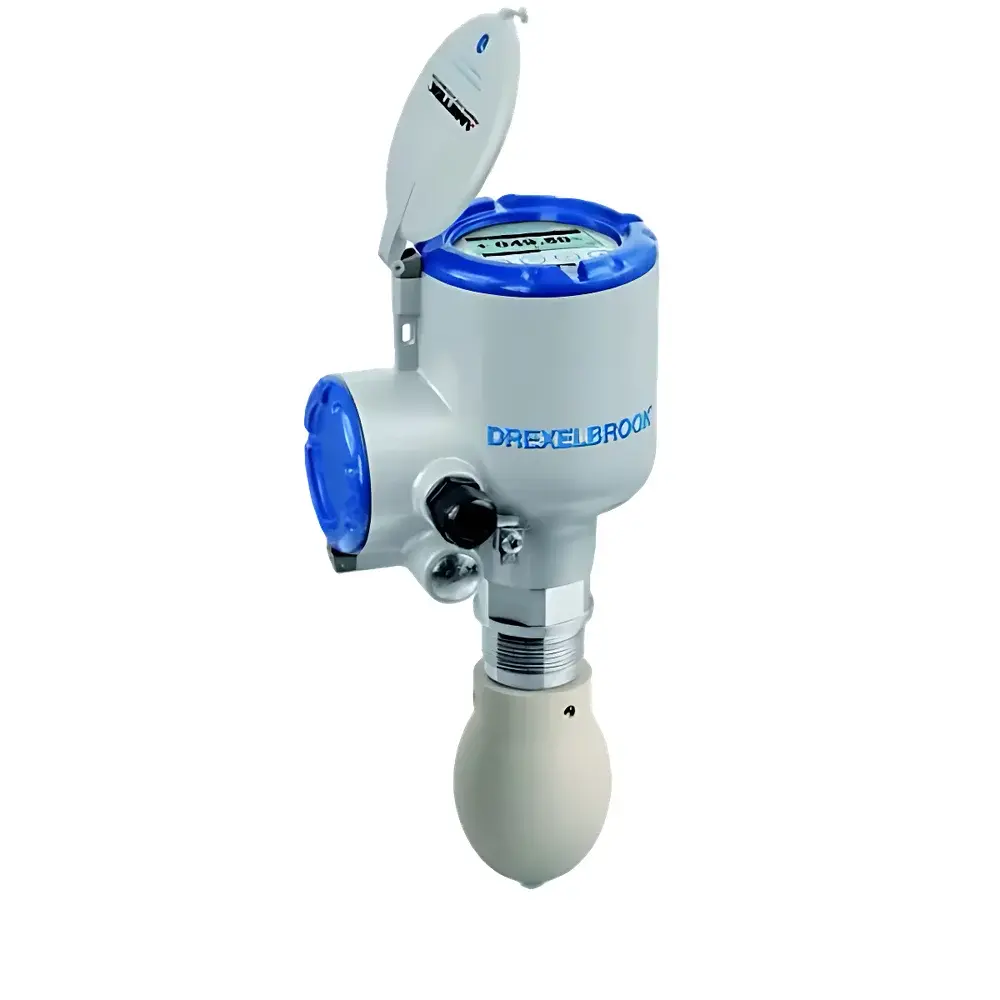
Drexelbrook DR5400 Series FMCW Radar Level Transmitter
| Brand | Drexelbrook |
|---|---|
| Origin | Shanghai, China |
| Model | DR5400 Series |
| Measurement Principle | FMCW (Frequency-Modulated Continuous Wave) Radar |
| Output Signal | 2-wire 4–20 mA with HART® Protocol |
| Max. Measuring Range | 30 m |
| Accuracy | ±5 mm (standard), ±10 mm (extended range) |
| Beam Angle | as low as 6° |
| Antenna Options | 316L Stainless Steel Horn or PP/PTFE Rod Antenna (extendable) |
| Process Temperature | –40 °C to +250 °C |
| Process Pressure | –0.1 MPa to +4 MPa |
| Enclosure Rating | IP66/IP67 |
Overview
The Drexelbrook DR5400 Series is an industrial-grade, two-wire FMCW (Frequency-Modulated Continuous Wave) radar level transmitter engineered for high-reliability continuous level measurement in demanding process environments. Unlike pulse radar technology, FMCW radar operates by transmitting a continuously frequency-modulated signal and analyzing the beat frequency between the transmitted and reflected waves—enabling superior signal-to-noise ratio, enhanced immunity to vapor, dust, and foam, and improved resolution at long ranges. Designed specifically for liquid and slurry applications in tanks, silos, and reactors, the DR5400 delivers stable, non-contact measurement under varying dielectric conditions (εr ≥ 1.8), including corrosive, high-temperature, and high-pressure service. Its compact electronics housing and modular antenna configuration support flexible installation in confined or hazardous areas without requiring recalibration after field adjustment.
Key Features
- FMCW radar technology ensures high measurement stability and repeatability—even in turbulent surfaces, condensing vapors, or low-dielectric media.
- Two-wire 4–20 mA analog output with integrated HART® 7 protocol enables seamless integration into legacy DCS/PLC systems while supporting remote configuration, diagnostics, and firmware updates.
- Selectable antenna types: 316L stainless steel horn antenna for general-purpose and high-temperature applications; chemically resistant PP or PTFE rod antenna for aggressive chemical environments and extended insertion lengths.
- Advanced empty-tank analysis algorithm dynamically identifies and suppresses false echoes from tank walls, agitators, ladders, or heating coils—eliminating manual echo mapping during commissioning.
- Robust mechanical design rated IP66/IP67 and compliant with ATEX/IECEx Category II 1G Ex ia IIC T6 Ga (optional) for use in Zone 0/1 hazardous locations.
- SIL2 capability certified per IEC 61508:2010 (Parts 1–3) for the full measurement loop—including transmitter electronics, antenna assembly, and process connection interface—supporting safety instrumented systems (SIS) integration where required.
Sample Compatibility & Compliance
The DR5400 is suitable for continuous level monitoring of liquids, emulsions, and homogeneous slurries across chemical, petrochemical, pharmaceutical, water/wastewater, and food & beverage industries. It performs reliably in media with dielectric constants as low as 1.8 (e.g., hydrocarbons, solvents, LNG), and maintains accuracy despite changes in temperature, pressure, or vapor composition. The device complies with electromagnetic compatibility standards EN 61326-1 (industrial environment), functional safety requirements IEC 61508 (SIL2), and process instrumentation directives including PED 2014/68/EU (for pressure-rated variants). Optional certifications include FDA-compliant wetted materials (316L, PTFE) and USP Class VI testing for pharmaceutical applications.
Software & Data Management
Configuration and diagnostics are performed via Drexelbrook’s PC-based DREXView™ software or through HART-compatible handheld communicators. The transmitter supports full audit trail logging (per FDA 21 CFR Part 11 requirements when used with validated host systems), including parameter change history, calibration events, and diagnostic alerts. Real-time signal strength visualization, echo curve analysis, and adaptive gain control allow users to verify installation integrity and optimize performance without physical access to the sensor. All configuration data is retained during power loss, and firmware upgrades can be deployed remotely via HART or Modbus RTU (with optional interface module).
Applications
- Level monitoring of sulfuric acid, caustic soda, and other aggressive chemicals in lined or unlined carbon steel tanks.
- Interface level detection in dual-phase separators (e.g., oil/water) where density differences limit differential pressure solutions.
- High-temperature condensate return tanks operating up to 250 °C and vacuum conditions down to –0.1 MPa.
- Batch reactor level control in GMP-compliant pharmaceutical manufacturing, with traceable configuration and SIL2 validation support.
- Wastewater equalization basins subject to heavy vapor loading, foam generation, and seasonal ambient temperature swings.
FAQ
What is the minimum dielectric constant this transmitter can measure accurately?
The DR5400 achieves reliable detection down to εr = 1.8, making it suitable for light hydrocarbons, propane, butane, and organic solvents.
Can the DR5400 be used in vacuum applications?
Yes—its pressure rating extends to –0.1 MPa (absolute), enabling use in vacuum distillation columns and degassing vessels.
Is the PTFE rod antenna FDA-compliant?
Yes—wetted PTFE components meet USP Class VI and FDA 21 CFR 177.1550 for repeated contact with food and pharmaceutical products.
Does the device require periodic recalibration?
No—FMCW radar is inherently stable and drift-free; only verification against a known reference is recommended per site-specific QA protocols (e.g., ISO 9001 or ASTM E2911).
How does empty-tank analysis improve measurement reliability?
It automatically identifies and filters fixed-path echoes from internal structures during commissioning—reducing setup time and eliminating operator-dependent echo suppression settings.
Related Products