
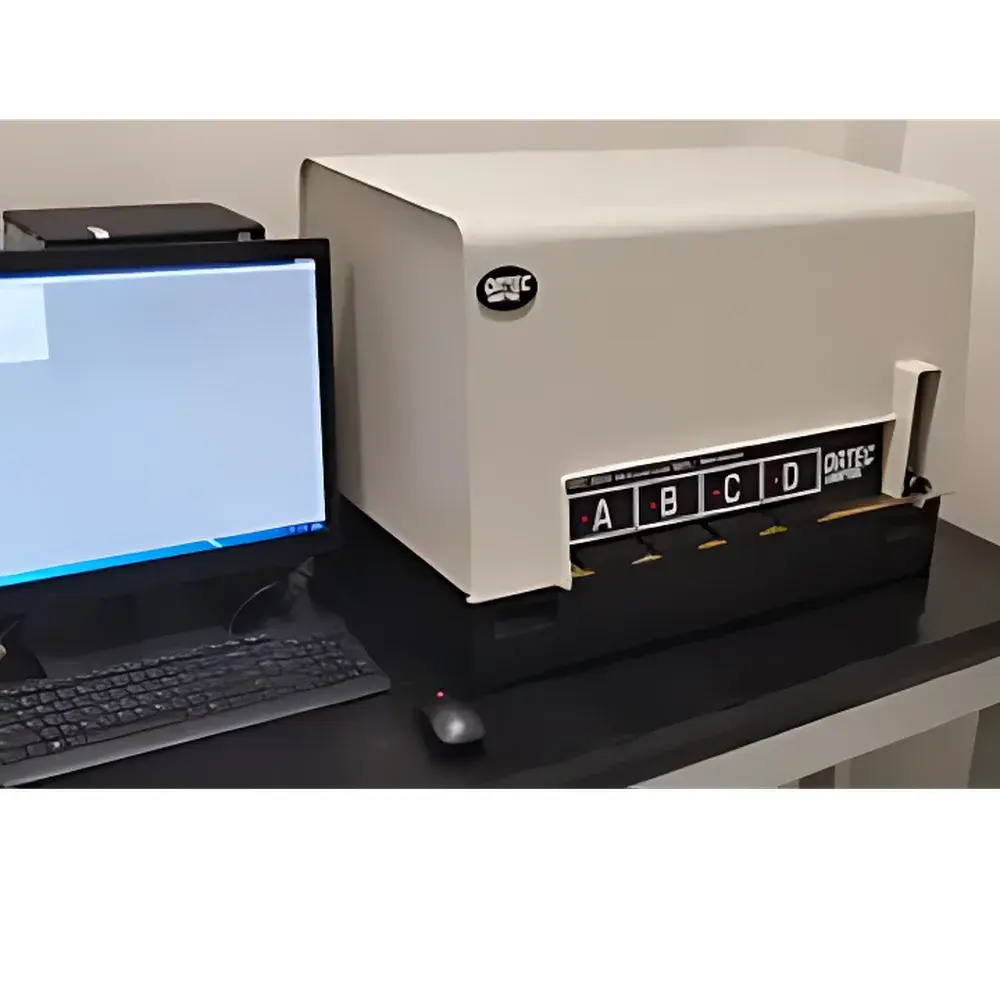
ORTEC MPC-9604 Low-Background Alpha/Beta Counter
| Brand | ORTEC |
|---|---|
| Origin | USA |
| Manufacturer Type | Authorized Distributor |
| Origin Category | Imported |
| Model | MPC-9604 |
| Instrument Type | Laboratory-Based Activity Meter |
| Sample Form | Solid |
| Detector Type | Flow-Through Proportional Counter |
| Radiation Types Measured | Alpha and Beta Particles |
| Configuration | 4-Channel Standard (Modular, Expandable to 48 Channels) |
| Shielding | 4-inch Low-Background Lead |
| Sample Holder | 2-inch Diameter Standard Planchet |
| Radon Progeny Compensation | Integrated Air Filtration System |
| Gas Safety | GasPro™ Fail-Safe Gas Monitoring and Loss Detection |
| Detector Window | Field-Replacable Mylar® Window |
| Architecture | Fully Independent Channel Operation, No Cross-Talk |
Overview
The ORTEC MPC-9604 is a high-sensitivity, low-background alpha/beta counting system engineered for precise quantification of radionuclides in solid environmental and regulatory compliance samples. It operates on the principle of gas ionization detection within flow-through proportional counters, where alpha and beta emissions ionize a precisely controlled P-10 gas mixture (90% argon, 10% methane), generating charge pulses proportional to particle energy and type. The system’s ultra-low background performance is achieved through a 10-cm-thick, ASTM-certified low-activity lead shield—cast from ancient lead recovered from sunken Roman ships—to minimize cosmogenic and terrestrial gamma interference. Its four independent, identically configured 2.25-inch-diameter flow-through proportional detectors operate simultaneously yet electrically and physically isolated, eliminating crosstalk and enabling true parallel sample analysis without statistical coupling. Designed for routine use in EPA-accredited laboratories, nuclear decommissioning facilities, and IAEA-participating monitoring networks, the MPC-9604 meets the foundational requirements of ISO/IEC 17025 for measurement uncertainty control and supports traceability to NIST-traceable standards.
Key Features
- Four fully independent flow-through proportional detectors with field-replaceable 1.5-µm Mylar® entrance windows—optimized for high alpha transmission (>85% at 5.3 MeV) and robust against humidity-induced degradation.
- Integrated Radon Progeny Compensation System: Dual-stage HEPA/activated carbon filtration combined with real-time airborne 218Po/214Po decay correction algorithms to suppress background fluctuations caused by ambient radon progeny deposition.
- GasPro™ Intelligent Gas Management: Monitors gas pressure, flow rate, and composition in real time; triggers automatic shutdown and audible alert upon deviation >±5% from setpoint or gas loss exceeding 15 mL/min—ensuring detector stability and data integrity per ANSI N42.22.
- Modular chassis architecture supporting seamless expansion from 4 to 48 counting channels via standardized detector trays and daisy-chained HV/data buses—enabling scalable throughput without software reconfiguration.
- Low-background mechanical design: All internal components—including sample trays, shielding liners, and gas manifolds—are fabricated from electroformed copper and oxygen-free high-conductivity (OFHC) copper to suppress intrinsic radioactivity from uranium/thorium decay chains.
Sample Compatibility & Compliance
The MPC-9604 accepts standard 50.8-mm (2-inch) planchets holding dry, ashed, or resin-bound solid samples—including air filters, soil digests, swipe tests, vegetation ash, and filter papers. Sample geometry is standardized to ensure reproducible solid-angle efficiency across all channels. The system complies with U.S. EPA Method 900 series (e.g., 900.0, 900.1), ASTM D3648-22 (Standard Test Methods for Alpha and Beta Radioactivity in Water), and ISO 11704:2021 (Radiological protection — Measurement of radioactivity in environmental samples — Alpha- and beta-emitting radionuclides). Its audit-ready firmware logs all operational parameters—including gas composition history, HV drift, background counts/hour, and chamber temperature—with timestamped records compliant with FDA 21 CFR Part 11 and GLP data integrity requirements.
Software & Data Management
Acquisition and analysis are performed using ORTEC’s GammaVision®-compatible Counting Suite v5.2, a validated Windows-based platform supporting dual-channel pulse-height discrimination (PHD) for simultaneous alpha/beta separation without spectral overlap. The software implements dead-time correction per channel using the live-time clock method, applies energy-dependent efficiency calibrations derived from NIST-traceable 241Am, 90Sr/90Y, and 230Th standards, and exports results in ASTM E1452-compliant .CSV and .XML formats. All raw spectra and metadata are stored in encrypted SQLite databases with SHA-256 hash verification, supporting full electronic record retention for regulatory audits.
Applications
- Environmental surveillance: Routine monitoring of alpha-emitting transuranics (e.g., 239Pu, 240Pu, 241Am) and beta-emitting fission products (e.g., 90Sr, 137Cs) in soil, sediment, and air particulate filters per EPA Region IV protocols.
- Nuclear facility decommissioning: Clearance-level screening of concrete cores, metal swipes, and insulation debris under DOE Order 458.1 and IAEA RS-G-1.7.
- Drinking water compliance: Quantification of gross alpha/beta activity in filtered and evaporated water concentrates per WHO Guidelines and EU Directive 2013/51/EURATOM.
- Radioecological research: Long-term trend analysis of 210Po and 210Pb in biota and sediment cores requiring sub-0.05 dpm detection limits over 100-hour count cycles.
FAQ
What sample preparation methods are recommended for optimal alpha/beta separation?
Dry ashing at 450°C followed by nitric acid leaching and electrodeposition onto stainless steel planchets yields the highest alpha resolution; beta-only samples may be measured as direct deposits or on cellulose filters.
Does the MPC-9604 support automated sample changers?
Yes—optional robotic sample handlers (Model SC-48) integrate via RS-485 and are supported natively in Counting Suite v5.2 for unattended 24/7 operation.
How is background stability verified during extended runs?
The system performs hourly background checks using shielded blank planchets and applies moving-average trending with ±3σ outlier rejection per ISO/IEC 17025 Annex A.3.
Can calibration certificates be issued with NIST traceability?
All factory calibrations include NIST-traceable uncertainty budgets per ISO/IEC 17025:2017 Clause 6.5, with certificate validity aligned to annual metrological verification schedules.







