
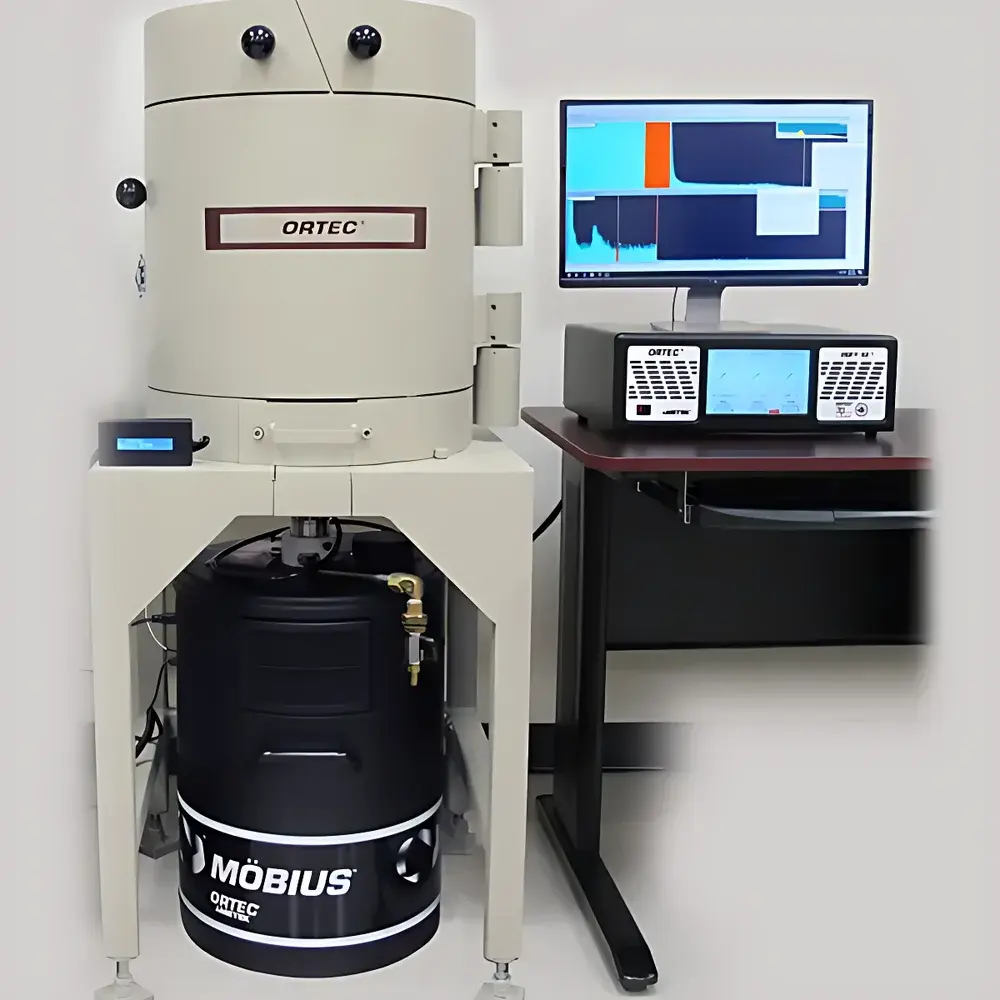
ORTEC GMX Series N-Type Coaxial High-Purity Germanium (HPGe) Gamma Spectrometer
| Brand | ORTEC |
|---|---|
| Origin | USA |
| Manufacturer Type | Authorized Distributor |
| Product Origin | Imported |
| Model | GMX |
| Instrument Type | Laboratory Gamma-Ray Spectrometer |
| Detector Type | N-Type Coaxial High-Purity Germanium (HPGe) |
| Radiation Type | Gamma Rays |
| Energy Range | 3 keV – 10 MeV |
| Energy Resolution | 1.8–2.5 keV FWHM at 1332 keV (dependent on relative efficiency) |
Overview
The ORTEC GMX Series N-Type Coaxial High-Purity Germanium (HPGe) Gamma Spectrometer is engineered for high-resolution, low-background gamma-ray spectroscopy in laboratory-based environmental monitoring, nuclear safeguards, radioecology, and regulatory compliance applications. Utilizing cryogenically cooled N-type HPGe crystal technology, the GMX detector operates on the principle of direct charge collection from gamma-ray interactions within an ultra-pure germanium lattice—enabling superior energy resolution, peak symmetry, and long-term spectral stability. Its defining innovation lies in the 0.3 µm boron ion-implanted entrance contact, which replaces conventional 500–1000 µm thick Be or Al windows. This ultra-thin contact extends the effective low-energy response down to ~3 keV—critical for measuring soft X-rays and low-energy gamma emissions from isotopes such as 241Am, 55Fe, and 125I—while maintaining mechanical robustness and thermal cycling resilience. Unlike P-type detectors, N-type HPGe exhibits inherent resistance to fast neutron-induced lattice damage, making it suitable for mixed-field environments including reactor monitoring and spent fuel assay.
Key Features
- Ultra-thin 0.3 µm boron ion-implanted contact enabling full spectral response from 3 keV onward
- N-type HPGe crystal architecture with demonstrated resistance to fast neutron damage (up to 1×10¹² n/cm2 typical)
- Standard relative efficiency up to 100% (based on 3″×3″ NaI reference); custom configurations available
- SMART Bias (-SMN) integrated high-voltage module with real-time system diagnostics, tamper-evident checksum logging, and ABS-encapsulated moisture-resistant housing
- Integrated Cryogenic System (-ICS-E): closed-cycle cooling with immediate re-cooling post-warm-up—eliminating the typical 72-hour cooldown delay associated with standard dewar-based systems
- Remote preamplifier (-HJ) and ultra-high-count-rate transistor-reset preamp (-PL), capable of >1 Mcps at 1 MeV without feedback resistor limitations
- Environmental hardening options: -HE ruggedized carbon-fiber endcap with desiccant monitoring, IP65-rated electronics enclosure
- Low-background endcap options (-RB, -LB-C, -XLB-C): carbon-fiber construction with Z ≈ 6, minimizing intrinsic continuum and escape peaks below 10 keV
- Flexible mechanical integration: PopTop, Streamline, and mechanical cooler-compatible packaging; Be, Al (-A), or carbon-fiber (-CW) window variants
Sample Compatibility & Compliance
The GMX spectrometer supports a wide range of sample geometries—including Marinelli beakers, petri dishes, filter papers, soil cores, and air particulate filters—when used with appropriate shielding (e.g., 10 cm Pb + 1 mm Cu graded shielding). Its low-energy capability enables compliant measurement of radionuclides regulated under EPA Method 901.1, ASTM D3648, ISO 11704, and IAEA Technical Reports Series No. 295. The SMART-1 bias module provides audit-ready voltage logging and cryptographic checksum reporting, supporting GLP/GMP traceability and FDA 21 CFR Part 11 requirements for electronic records. All GMX configurations meet ANSI N42.14 and IEC 61452 standards for gamma spectrometer performance verification and calibration stability.
Software & Data Management
GMX systems are fully compatible with ORTEC’s GammaVision® software suite—validated for ISO/IEC 17025 laboratories and compliant with NIST-traceable calibration protocols. GammaVision supports automated peak search, nuclide identification (using IAEA NuDat 3.0 and ENSDF libraries), MDA calculation per MARLAP guidelines, and uncertainty propagation per GUM (JCGM 100:2008). Data export formats include ASCII, CSV, and native .CNF for interoperability with third-party analysis platforms (e.g., Genie 2000, Canberra’s Analyst). Optional SMART-1 telemetry integration enables remote health monitoring, predictive maintenance alerts, and time-stamped HV log archiving—essential for unattended environmental monitoring stations operating under DOE Order 458.1 or EURATOM safeguards agreements.
Applications
- Environmental radioactivity screening: soil, sediment, water, and biota samples per EPA 900 series methods
- Nuclear forensics and non-proliferation: isotopic ratio analysis of uranium/plutonium bearing materials
- Decommissioning and waste characterization: alpha-emitter surrogate quantification via low-energy X-ray lines (e.g., 237Np L-lines)
- Medical isotope purity testing: 99mTc, 177Lu, and 225Ac impurity profiling
- Low-background physics experiments: dark matter detector material screening and cosmic-ray induced activation studies
- Regulatory compliance: routine QA/QC for NORM/TENORM facilities, uranium mill tailings, and phosphate processing plants
FAQ
What is the lowest detectable energy with the GMX detector?
The GMX achieves usable spectral response down to approximately 3 keV, enabled by its 0.3 µm ion-implanted contact and optimized FET preamplifier coupling.
Can the GMX be used in high-radiation fields?
Yes—the N-type HPGe crystal demonstrates superior resistance to fast neutron damage compared to P-type counterparts; optional user-repairable neutron damage recovery protocols are available.
Is the SMART-1 bias module required for regulatory audits?
While not universally mandated, SMART-1 provides hardware-enforced HV logging and cryptographic checksums that satisfy FDA 21 CFR Part 11 and ISO/IEC 17025 data integrity requirements for accredited labs.
How does the ICS-E cooling system reduce operational downtime?
Unlike liquid nitrogen dewars requiring 72+ hours to re-cool after warm-up, the ICS-E achieves stable 77 K operation within minutes—preserving measurement continuity during scheduled maintenance or power interruptions.
What window material is recommended for sub-10 keV measurements?
Carbon-fiber window (-CW) or low-background carbon-fiber endcap (-XLB-C) is preferred for optimal transmission below 10 keV; beryllium windows introduce both toxicity concerns and higher background continuum.
Related Products







