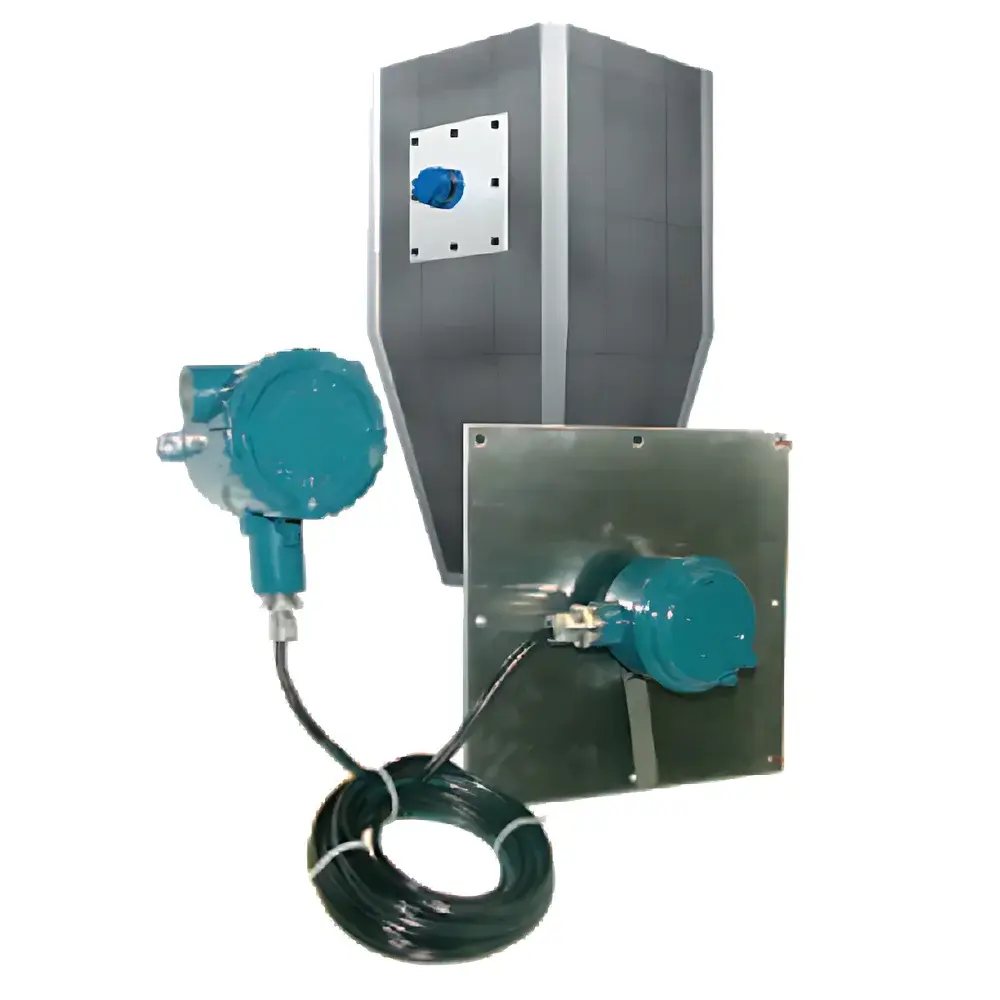
Drexelbrook ThePoint Flat-Plate RF Admittance Level Switch
| Brand | Drexelbrook |
|---|---|
| Origin | Shanghai, China |
| Manufacturer Type | Authorized Distributor |
| Product Category | Domestic (China-Made) |
| Model | ThePoint Flat-Plate RF Admittance Level Switch |
| Product Type | Point Level Switch |
| Installation | Threaded Mounting |
| Calibration | Field-Adjustable Zero/Full-Scale via Potentiometers |
| Sensor Type | Capacitive RF Admittance Probe |
| Compliance | Designed for IEC 61508 SIL 2 capable systems (when integrated with certified safety logic solvers) |
| Enclosure Rating | IP66/IP67 |
| Process Temperature Range | –40 °C to +85 °C |
| Process Pressure Rating | Up to 10 bar (g) |
| Output | SPDT Relay (Form C), 5 A @ 250 VAC |
| Power Supply | 20–265 VAC/VDC, 50/60 Hz |
| RF Frequency | 1 MHz nominal |
| Shielding | Integrated Cote-Shield™ Anti-Fouling Coating |
Overview
The Drexelbrook ThePoint Flat-Plate RF Admittance Level Switch is an intrinsically robust point-level detection device engineered for reliable on/off level signaling in demanding industrial bulk solids and viscous liquid applications. It operates on the principle of radio-frequency (RF) admittance measurement—a refined extension of traditional capacitance technology—where a high-frequency AC signal (typically 1 MHz) is applied between the sensing electrode and vessel wall (or reference ground). Changes in the complex admittance (Y = G + jB, where G is conductance and B is susceptance) caused by material contact are detected with high sensitivity and immunity to buildup, temperature drift, and humidity effects. Unlike simple capacitance switches, RF admittance technology incorporates a guard electrode and phase-sensitive demodulation to actively compensate for coating-induced parasitic capacitance, enabling stable operation even in environments subject to heavy adhesion, bridging, or mechanical impact from large lumps.
Key Features
- Flat-plate electrode geometry optimized for resistance to mechanical impact—specifically engineered for blocky, abrasive, or free-falling bulk solids where conventional rod or cable probes risk damage.
- Cote-Shield™ proprietary anti-fouling coating applied directly to the sensing surface, significantly reducing dielectric buildup from sticky, hygroscopic, or cohesive media such as wet clay, polymer flakes, sugar, or activated carbon.
- True field-configurable calibration: independent zero (empty) and span (full) adjustments via front-panel potentiometers—no external software or handheld communicator required.
- Modular, two-piece construction (electronics housing + remotely mounted sensor) eliminates process-side electronics, enabling maintenance-free operation and extended service life in high-temperature or corrosive zones.
- Threaded mounting interface (standard NPT or metric threads) supports rapid installation into existing vessel nozzles without welding or flange modification.
- Wide universal power input (20–265 VAC/VDC) ensures compatibility with diverse plant electrical infrastructures, including safety-critical 24 VDC control loops.
Sample Compatibility & Compliance
The ThePoint switch is validated for use across non-conductive, semi-conductive, and conductive materials—including powders, granules, pellets, slurries, and emulsions—with dielectric constants ranging from εr ≈ 1.5 (e.g., polyethylene pellets) to >30 (e.g., wet biomass or mineral suspensions). Its design conforms to electromagnetic compatibility requirements per EN 61326-1 (industrial environment), and its intrinsic safety suitability is documented per IEC 61000-6-2/6-4. When deployed within a functional safety architecture, the device supports SIL 2 capability per IEC 61508 when paired with certified logic solvers and appropriate proof-test procedures. It meets dust-tight and water-jet resistant performance per IP66/IP67, and its wetted materials (316 stainless steel housing, PTFE-insulated electrode, Cote-Shield™ topcoat) comply with FDA 21 CFR 177.2400 for incidental food contact where applicable.
Software & Data Management
As a hardwired, relay-output point-level switch, the ThePoint requires no embedded firmware, configuration software, or network connectivity. All operational parameters are set manually via analog potentiometers, eliminating cybersecurity attack surfaces and ensuring deterministic response times (<100 ms typical). For integration into modern DCS or SIS platforms, the SPDT relay output provides fail-safe dry-contact signaling compatible with standard 4–20 mA input cards (via external loop-powered interface) or direct connection to PLC digital input modules. Audit trails and calibration records are maintained manually per site-specific GLP/GMP documentation protocols; no electronic logging or 21 CFR Part 11 compliance features are included—consistent with its role as a stand-alone, safety-oriented final element.
Applications
- High-impact silo and hopper level alarms in mining, cement, and aggregate handling—preventing overfill during chute-fed loading operations.
- Batch vessel high-level cutoff for adhesive polymers, pharmaceutical excipients, or food-grade starches prone to crust formation.
- Low-level detection in screw feeders and pneumatic conveying receivers where material bridging may mask true empty conditions.
- Interface detection in dual-density slurry tanks (e.g., fly ash/water separation) where conductivity gradients necessitate admittance-based discrimination.
- Redundant backup switching in safety instrumented functions (SIFs) meeting IEC 61511 requirements for SIL-rated shutdown sequences.
FAQ
What materials can ThePoint reliably detect in the presence of heavy buildup?
The combination of Cote-Shield™ coating and guard-driven RF admittance measurement enables reliable detection of materials with dielectric constants ≥2.0—even after prolonged exposure to sticky substances like wet sawdust, PVC resin, or hydrated lime.
Is explosion-proof certification available for hazardous area installation?
ThePoint is available in ATEX/IECEx-certified variants (II 2G Ex db IIC T6 Gb / II 2D Ex tb IIIC T85°C Db) for Zone 1/21 applications; consult factory for model-specific certification documentation.
Can it be installed vertically or horizontally?
Yes—flat-plate orientation allows flexible mounting in either plane; however, vertical installation is recommended for optimal self-cleaning action and reduced accumulation at the electrode edge.
Does it require periodic recalibration during service life?
No routine recalibration is required under stable process conditions; however, annual verification against known empty/full states is recommended per ISO 9001 preventive maintenance schedules.
How does it differ from a standard capacitive level switch?
Unlike basic capacitance switches, ThePoint employs phase-sensitive RF admittance analysis with active guarding to reject false signals from coating, humidity, and temperature-induced drift—delivering higher long-term stability in challenging environments.
Related Products