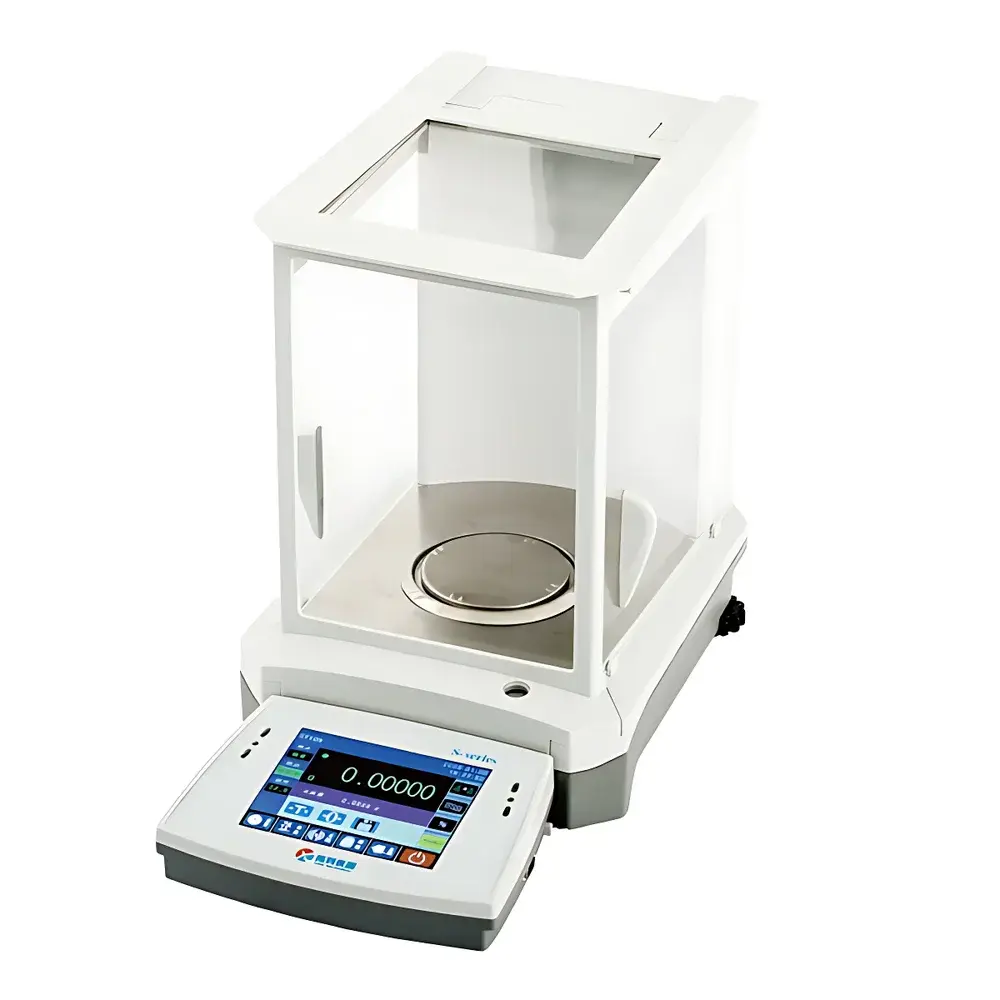
Yoke SY Series 0.001 g Precision Balance
| Brand | Yoke |
|---|---|
| Origin | Shanghai, China |
| Manufacturer Type | Direct Manufacturer |
| Product Category | Domestic |
| Model | SY Series |
| Instrument Type | Precision Balance |
| Capacity Range | 200–500 g |
| Readability | 0.001 g (1 mg) |
| Maximum Capacity | 500 g |
| Measurement Accuracy | ±1 mg |
| Repeatability | ±1 mg |
| Display | 5.6″ TFT 262k-color LCD |
| Power Supply | DC 18 V / 3 A |
| Interface | RS232 & USB |
| Calibration Method | External |
| Pan Size | 90 mm (standard), 120 mm (SY1003) |
| Software | SUPERTEXT 1.0 |
| Key Functions | Animal Weighing, Density Determination, Formulation Weighing, Accumulation, Checkweighing, Percentage Weighing, Counting, Target Weighing |
| Construction | Stainless steel top cover, metal base, plastic upper housing, stainless steel weighing pan, removable glass draft shield, dust cover |
| Circuit Isolation | Fully isolated display module, CPU digital processing unit, and mechanical load cell to minimize electromagnetic and thermal interference |
Overview
The Yoke SY Series 0.001 g Precision Balance is an entry-level analytical-grade instrument engineered for laboratories requiring reliable, repeatable mass measurements at the milligram level. Designed in accordance with fundamental principles of electromagnetic force compensation (EMFC) transduction, the SY Series employs a high-stability load cell integrated with temperature-compensated signal conditioning circuitry to deliver consistent performance across ambient fluctuations typical in QC labs, educational institutions, and R&D environments. With standard readability of 1 mg and capacities ranging from 200 g to 500 g (up to 1000 g in SY1003 variant), this balance meets ISO/IEC 17025-relevant requirements for routine calibration traceability and supports GLP-compliant documentation workflows when paired with validated software.
Key Features
- 5.6-inch TFT color display with 262,144-color resolution and intuitive graphical user interface supporting multi-language operation (English, Spanish, French, German, Chinese)
- Fully isolated architecture: independent physical separation between display electronics, microprocessor-based digital signal processor (DSP), and mechanical sensing module minimizes cross-talk and thermal drift
- Robust mechanical construction featuring stainless steel top cover, precision-machined metal base, corrosion-resistant stainless steel weighing pan, and removable tempered-glass draft shield for optimal environmental control
- Dual communication interfaces—RS232 and USB—enabling seamless integration with laboratory information management systems (LIMS), electronic lab notebooks (ELN), and statistical process control (SPC) platforms
- Comprehensive internal memory capable of storing up to 1,000 measurement records with timestamp, operator ID, and contextual metadata (subject to SUPERTEXT 1.0 configuration)
- Multi-user access control with configurable permission levels, supporting audit-ready operation in regulated environments
Sample Compatibility & Compliance
The SY Series accommodates standard solid and granular samples within its 90 mm (or 120 mm for SY1003) stainless steel pan. Its draft shield design complies with ISO 9001 and ISO/IEC 17025 recommendations for minimizing air current influence during static weighing. While not certified for USP or ASTM E898-22 Class I/II applications, the balance satisfies general-purpose metrological requirements under OIML R76-1 (2018) for Class II precision instruments. External calibration using certified weights (e.g., ASTM E456-22 Grade F1 or better) ensures traceability to national standards such as NIST SRM or BIPM reference materials.
Software & Data Management
Pre-installed SUPERTEXT 1.0 software provides full remote control, real-time data streaming, and automated report generation. It supports 12 built-in weighing modes—including animal weighing (dynamic averaging), density determination (with auxiliary sinker), formulation (sequential target dosing), accumulation (batch totalization), checkweighing (tolerance band alerts), percentage calculation, piece counting (average piece weight derivation), and target setting (go/no-go feedback). All operations generate CSV- or Excel-compatible logs with embedded timestamps, operator identifiers, and instrument serial numbers—facilitating 21 CFR Part 11 compliance when deployed on validated Windows OS environments with appropriate audit trail configurations.
Applications
- Quality control laboratories performing raw material verification, finished product release testing, and stability study sample preparation
- Educational institutions conducting gravimetric analysis, stoichiometric experiments, and calibration training
- Pharmaceutical manufacturing units executing non-critical excipient dispensing and packaging line checkweighing
- Food and beverage labs verifying ingredient batch consistency and net content compliance per FDA 21 CFR 101.105
- Environmental testing facilities preparing standardized soil or sediment aliquots for ICP-MS or GC-MS analysis
- Materials science research groups measuring polymer powder densities or catalyst loading ratios
FAQ
What calibration standards are recommended for external calibration of the SY Series?
Certified weights conforming to ASTM E456-22 Grade F1 or OIML R111 Class M2 are recommended for routine verification; calibration must be performed at ambient temperature (20 ± 2 °C) and relative humidity below 70 % RH.
Is internal calibration available on the SY Series?
No—the SY Series relies exclusively on external calibration; no motorized internal weight mechanism is integrated.
Can the balance interface with LIMS via RS232 without proprietary software?
Yes—ASCII-based command protocols (e.g., “S” for stable weight readout, “U” for unit toggle) are documented in the technical manual and support direct integration using third-party middleware or custom Python/Node.js scripts.
Does the device meet IP rating requirements for dust or moisture resistance?
The SY Series has no formal IP rating; however, the sealed enclosure and optional dust cover provide protection against particulate ingress in cleanroom-adjacent settings (ISO Class 8 / Class 100,000).
How is measurement uncertainty estimated for SY Series instruments?
Uncertainty budgeting should include contributions from readability (±0.5 mg), repeatability (±1 mg), eccentricity error (±0.5 mg), linearity deviation (±1 mg), and temperature coefficient (±0.5 mg/°C), following EURACHEM/CITAC Guide CG4 methodology.