
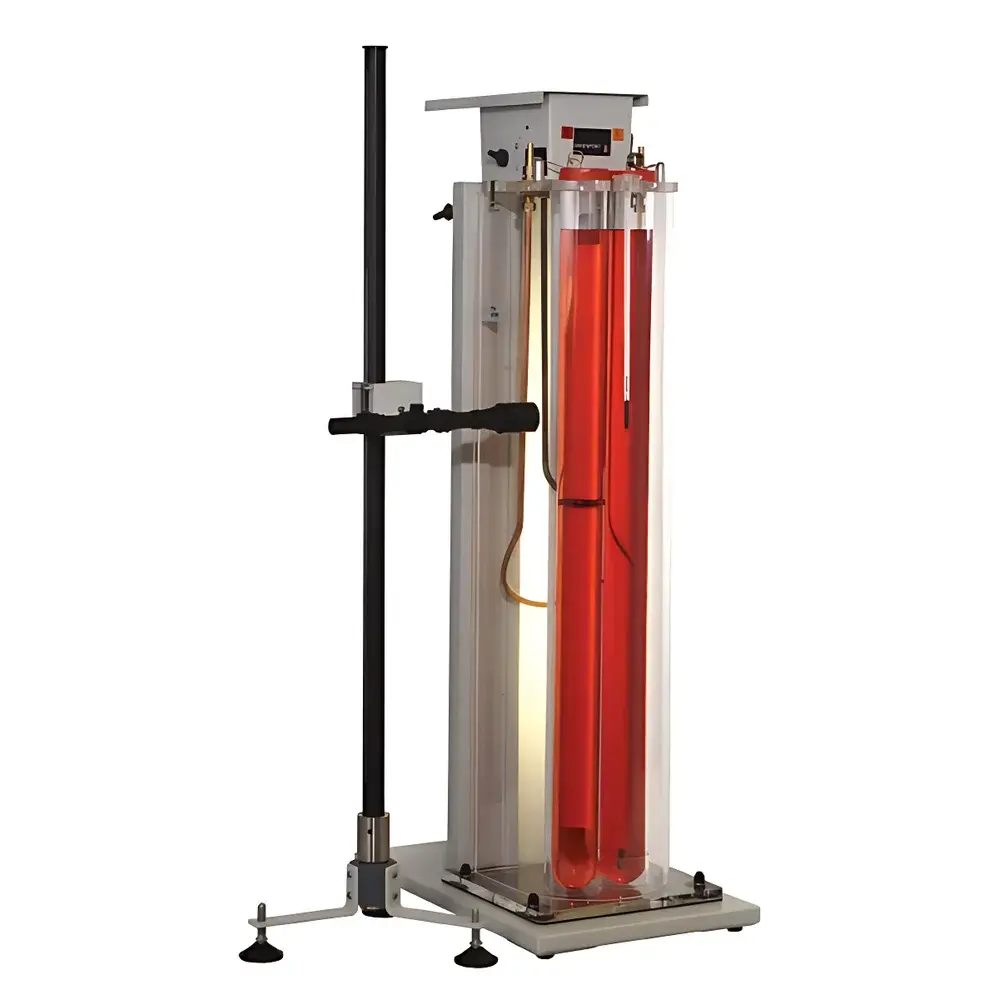
Davenport DC02 Density Gradient Column System
| Brand | Davenport |
|---|---|
| Origin | USA |
| Manufacturer Type | Authorized Distributor |
| Product Category | Imported Instrument |
| Model | DC02 |
| Pricing | Upon Request |
| Industry Application | General-Purpose Solid Density Analysis |
| Instrument Type | Density Gradient Column |
| Form Factor | Benchtop Laboratory System |
| Sample Type | Solid Particles (e.g., Plastic Pellets, Powders, Granules) |
| Density Range | 0.8000–1.5999 g/mL |
| Density Resolution | 0.0001 g/mL |
| Temperature Control | 23.0 ± 0.1 °C (Stabilized via Integrated Heating/Cooling Loop) |
| Minimum Sample Mass | 1 g |
Overview
The Davenport DC02 Density Gradient Column System is a precision-engineered benchtop instrument designed for the accurate and repeatable determination of solid material density—particularly suited for polymer pellets, thermoplastic granules, composite fillers, and other small, free-flowing solid samples. It operates on the principle of buoyancy-based equilibrium positioning within a stable, linear density gradient column. When introduced into the column, a sample settles at the axial position where the local liquid density matches its intrinsic bulk density—a method grounded in Archimedean physics and standardized under ASTM D1505, ISO 1183-1 (Method A), and BS 2782-6:1994 Method 620D. Unlike digital densitometers or pycnometers, the DC02 eliminates operator-dependent volume measurement errors by relying solely on positional stability and calibrated reference float behavior. Its design prioritizes thermal inertia and hydrodynamic stability: the column is housed in a double-walled, thermostatically controlled glass reservoir maintained at 23.0 ± 0.1 °C using a closed-loop system integrating resistive heating elements and passive copper cooling coils—minimizing convective disruption to the gradient profile.
Key Features
- Benchtop architecture with integrated temperature stabilization system ensuring <0.1 °C deviation over 24-hour operation
- Linear density gradient column fabricated from borosilicate glass, chemically resistant to common gradient fluids (e.g., aqueous cesium chloride, sodium iodide, or methanol/water mixtures)
- Calibrated reference float set (typically nine floats) traceable to NIST-certified density standards; each float certified to ±0.0001 g/mL and spaced at uniform 0.09–0.10 g/mL intervals across the 0.8000–1.5999 g/mL range
- Optical alignment scale with 0.1 mm resolution etched directly onto the column housing for precise buoyancy position reading
- No moving parts in measurement zone—ensures long-term calibration integrity and minimal maintenance
- Designed for GLP-compliant laboratories: supports audit-ready documentation of gradient validation, temperature logs, and float recalibration records
Sample Compatibility & Compliance
The DC02 accommodates solid specimens with dimensions ≤ 5 mm diameter and mass ≥ 1 g—including virgin and recycled plastic pellets (PE, PP, PET, ABS), rubber crumbs, ceramic powders, pharmaceutical excipients, and mineral granules. Samples must be non-porous or pre-saturated to eliminate air entrapment artifacts. The system conforms to regulatory frameworks governing materials characterization in quality control environments: it satisfies the physical testing requirements of ASTM D1505 (Standard Test Method for Density of Plastics by the Density-Gradient Technique), ISO 1183-1 (Plastics — Methods of Determination of Density — Part 1: Immersion Method, Liquid Pyknometer Method and Titration Method), and USP for density-based identity verification. Gradient fluid selection and preparation follow ISO/IEC 17025-aligned protocols, and all reference floats are supplied with individual calibration certificates compliant with ISO/IEC 17025:2017 Annex A.
Software & Data Management
While the DC02 is an analog-optical instrument requiring no embedded firmware or onboard software, it integrates seamlessly into digital laboratory workflows. Optional companion tools include Davenport GradientLog™ (Windows-based desktop application) for digitizing float positions, calculating interpolated densities, generating gradient linearity reports (R² ≥ 0.9998), and exporting CSV/PDF outputs compatible with LIMS and ELN platforms. All measurement data—including date/time stamps, ambient lab conditions, operator ID, and temperature log snapshots—can be archived with full traceability. The system supports 21 CFR Part 11-compliant electronic signatures when deployed with validated third-party ELN solutions.
Applications
- Batch-to-batch consistency verification of polymer resins in compounding and extrusion facilities
- Identification and segregation of mixed plastic waste streams prior to mechanical recycling
- Verification of filler loading density in filled composites (e.g., CaCO₃-, talc-, or glass-fiber-reinforced polymers)
- Quality release testing of medical-grade polymer components per ISO 10993-1 biocompatibility screening prerequisites
- Research-scale density mapping of copolymer composition gradients in gradient polymer synthesis
- Forensic analysis of unknown particulate evidence in materials science labs
FAQ
What gradient fluids are compatible with the DC02 system?
Aqueous cesium chloride (CsCl), sodium iodide (NaI), and methanol–water mixtures are most commonly used. Fluid selection depends on required density range, chemical compatibility with samples, and environmental handling requirements.
How often must the reference floats be recalibrated?
Annual recalibration is recommended; however, verification against master floats or certified density standards should be performed before each analytical campaign.
Can the DC02 measure porous or hygroscopic materials?
Yes—with preconditioning: samples must be vacuum-dried and impregnated with a non-reactive, low-surface-tension fluid (e.g., fluorinated oil) to displace internal voids prior to testing.
Is the 23 °C temperature setpoint adjustable?
No—the system is engineered exclusively for 23.0 °C operation to ensure compliance with ASTM D1505 and ISO 1183 thermal conditioning requirements; deviation compromises gradient linearity and inter-laboratory reproducibility.
Does the DC02 require external certification for ISO/IEC 17025 accreditation?
Yes—while the instrument itself is not accredited, its use within an accredited lab requires documented validation of gradient linearity, temperature uniformity, float calibration traceability, and analyst competency per ISO/IEC 17025 Clause 6.4.
Related Products



