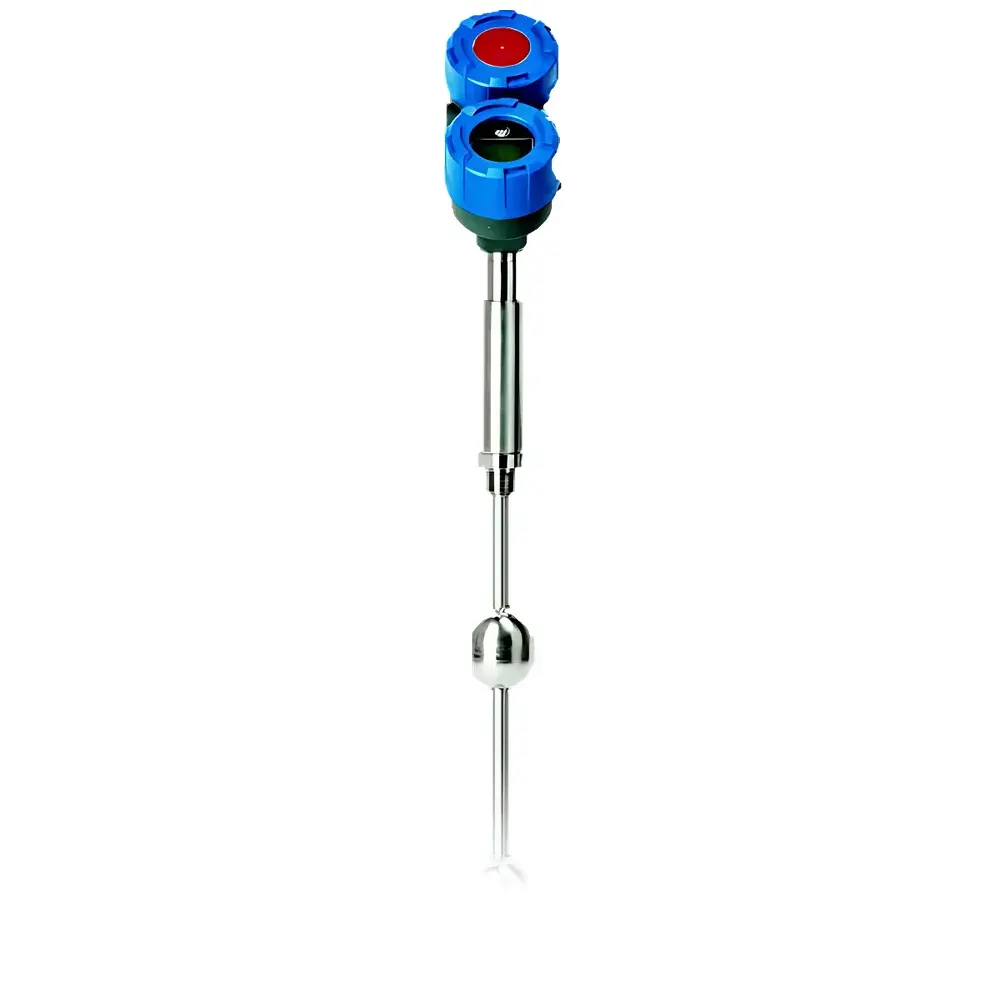
MAGNETROL Jupiter® JM4 Series Magnetostrictive Level Transmitter
| Brand | MAGNETROL |
|---|---|
| Model | Jupiter® JM4 Series |
| Type | Magnetostrictive Level Transmitter |
| Measurement Principle | Time-of-Flight (TOF) via magnetostrictive waveguide and magnetic float interaction |
| Output Signal | 4–20 mA analog (HART® or FOUNDATION Fieldbus™ optional) |
| Housing | Dual-compartment, rotatable and removable head |
| Mounting Options | Direct insertion or external mounting on MAGNETROL Orion® magnetic level indicators |
| Process Connection | Threaded (NPT, BSP) or flanged (ANSI, DIN, JIS) |
| Wetted Materials | Hastelloy® C-276 or Monel® 400 available |
| Environmental Rating | IP66/IP67, NEMA 4X |
| Certifications | ATEX, IECEx, FM, CSA for hazardous areas (Class I Div 1, Zone 1) |
| Compliance | Designed to meet requirements of FDA 21 CFR Part 11 for electronic records in regulated life science environments when integrated with validated control systems |
Overview
The MAGNETROL Jupiter® JM4 Series Magnetostrictive Level Transmitter is an industrial-grade continuous level measurement instrument engineered for high-accuracy, stable, and repeatable liquid level detection in demanding process applications. It operates on the magnetostrictive time-of-flight (TOF) principle: a torsional strain pulse is generated along a precision waveguide when the magnetic field of a position-sensing float interacts with a current pulse applied to the wire. The transit time between pulse initiation and return signal detection is linearly proportional to float position—and thus liquid level—with sub-millimeter resolution and long-term stability unaffected by changes in density, conductivity, dielectric constant, or foam formation. Unlike radar or ultrasonic technologies, the JM4 is immune to vapor space disturbances, condensation, or tank geometry constraints, making it especially suited for pressurized, vacuum, or thermally variable vessels common in pharmaceutical, biotech, and chemical processing.
Key Features
- True magnetostrictive sensing architecture delivering ±0.5 mm typical repeatability and ≤1 mm linearity error over full span—validated per IEC 60770-1
- Rotatable, field-replaceable transmitter head with integrated graphical display and real-time waveform capture for diagnostics and commissioning verification
- Dual-compartment housing design isolates electronics from process-side environmental stressors, enhancing reliability in high-vibration or corrosive atmospheres
- Modular integration capability: functions as a standalone probe or as an intelligent add-on module mounted directly atop or beneath MAGNETROL Orion® magnetic level gauges
- Configurable output options—including 4–20 mA with HART® v7.5 or FOUNDATION Fieldbus™ (FF) H1—supporting both legacy DCS integration and modern IIoT-ready architectures
- Process-wetted components available in corrosion-resistant alloys including Hastelloy® C-276 and Monel® 400, certified for use with aggressive media such as concentrated acids, caustics, and sterilants
Sample Compatibility & Compliance
The JM4 Series is suitable for clean, viscous, and mildly abrasive liquids—including water, solvents, hydrocarbons, glycols, buffer solutions, and sterile process fluids—across temperatures from −40 °C to +120 °C and pressures up to 10 MPa (1450 psi), depending on configuration. It meets international safety and quality directives: ATEX II 1G Ex ia IIC T6 Ga, IECEx ia IIC T6 Ga, FM Class I Div 1 Groups A–D, and CSA Class I Div 1 Groups A–D. For regulated industries, the device supports audit-trail-enabled configuration management when deployed with MAGNETROL’s certified firmware and compatible host systems compliant with FDA 21 CFR Part 11 and EU Annex 11. All units are manufactured under ISO 9001:2015 quality management systems and conform to Pressure Equipment Directive (PED) 2014/68/EU for Category IV pressure-bearing assemblies.
Software & Data Management
Configuration and diagnostics are performed via MAGNETROL’s proprietary PC-based software suite—compatible with Windows 10/11 and supporting USB, RS-232, and HART modem interfaces. The software enables full parameterization (span, zero, damping, fail-safe mode), waveform analysis, sensor health trending, and firmware updates. When equipped with FOUNDATION Fieldbus™, the JM4 supports standardized function blocks (AI, DI, DEV), device description (DD) files, and FDT/DTM integration within Emerson DeltaV, Honeywell Experion, or Siemens Desigo platforms. Data logging and alarm history are retained locally in non-volatile memory, with timestamped event records exportable for GLP/GMP documentation.
Applications
The JM4 Series is widely deployed across hygienic and hazardous process environments: continuous level monitoring in bioreactors and harvest tanks (USP compliant validation support available); interface level detection in three-phase separators; inventory control in bulk storage silos and cryogenic LNG tanks; and precise dosing-level feedback in API synthesis reactors. Its robust construction and intrinsic safety certification make it ideal for upstream oil & gas separation trains, pharmaceutical clean-in-place (CIP) and steam-in-place (SIP) vessels, and food-grade intermediate holding tanks subject to frequent sanitation cycles.
FAQ
Can the JM4 be installed on existing Orion® magnetic level gauges without process shutdown?
Yes—the external-mount configuration allows hot-tap installation on the top or bottom flange of any MAGNETROL Orion® series gauge, eliminating the need for vessel depressurization or draining.
Is waveform capture data exportable for root-cause analysis?
Yes—raw waveform traces and diagnostic metadata can be saved in CSV format and imported into third-party analytics tools for predictive maintenance modeling.
Does the JM4 support SIL2-certified safety loops?
Yes—certified per IEC 61508:2010 (SIL2) for use in safety instrumented functions (SIFs) when integrated with appropriate logic solvers and certified configuration practices.
What is the maximum recommended probe length for high-temperature applications?
Standard probes support up to 8 meters; extended-length variants (up to 12 m) are available with specialized thermal shielding and PTFE-insulated waveguides rated for sustained operation at 120 °C.
How does the dual-compartment housing improve long-term reliability?
By physically separating the display/interface electronics from the signal-conditioning circuitry, the design minimizes thermal drift, reduces electromagnetic interference coupling, and extends mean time between failures (MTBF) beyond 100,000 hours under continuous operation.