
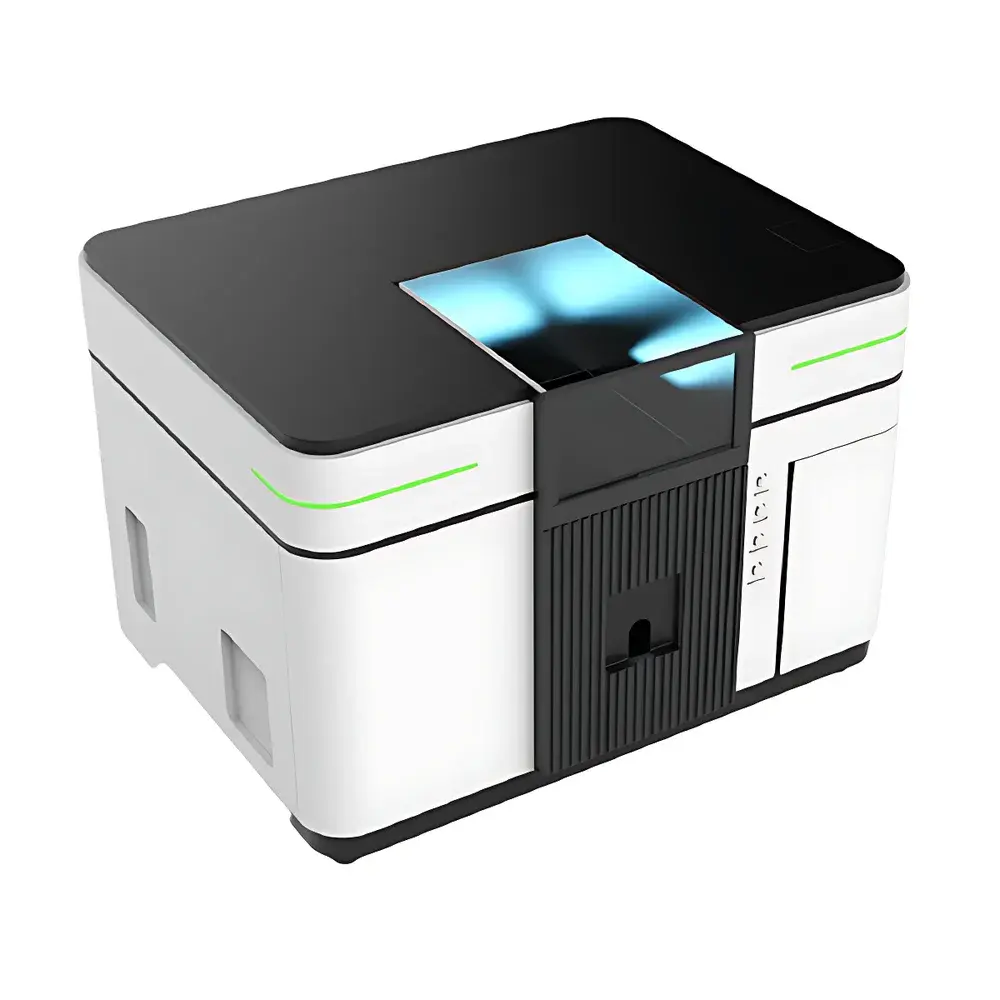
Yoke LAS-600A Luban Series Flame and Graphite Furnace Atomic Absorption Spectrometer
| Brand | Yoke |
|---|---|
| Origin | Shanghai, China |
| Manufacturer Type | Direct Manufacturer |
| Instrument Type | Flame and Graphite Furnace AAS |
| Monochromator | Plane Grating (1800 lines/mm, blazed at 250 nm) |
| Optical System | Double-Beam |
| Detector | Photomultiplier Tube (PMT) |
| Background Correction | D₂ Lamp + Self-Reversal (Self-Absorption) Method |
| Spectral Bandwidths | 0.1, 0.2, 0.4, 0.7, 1.4, 2.0 nm (6-step automatic switching) |
| Wavelength Range | 185–900 nm |
| Lamp Positions | 8 |
| Gas Control | Integrated Intelligent Gas Management Module |
| Automation Level | Fully Automated Wavelength Scanning, Peak Search & Alignment, HV Optimization, Energy Balancing, Lamp Parameter Recall, and Atomizer Vertical Positioning |
Overview
The Yoke LAS-600A Luban Series Atomic Absorption Spectrometer is a dual-mode analytical instrument engineered for trace metal quantification in environmental, pharmaceutical, clinical, food safety, and industrial quality control laboratories. It operates on the fundamental principle of atomic absorption spectroscopy—measuring the attenuation of resonant radiation as ground-state free atoms in a high-temperature atomization source absorb characteristic wavelengths emitted by hollow cathode lamps (HCLs). The LAS-600A supports both flame atomization (for elements with moderate volatility and sensitivity requirements) and electrothermal graphite furnace atomization (for sub-pg detection limits and limited sample volumes), enabling method flexibility across diverse regulatory and research workflows. Its double-beam optical architecture compensates for source intensity drift and lamp aging, ensuring long-term baseline stability and measurement reproducibility. The Czerny-Turner monochromator, equipped with an 1800-line/mm plane grating blazed at 250 nm, delivers high spectral resolution and throughput across the full operational range (185–900 nm), critical for resolving adjacent emission lines and minimizing spectral interferences.
Key Features
- Intelligent gas control system with real-time pressure monitoring, flow regulation, and fail-safe interlocks for acetylene, nitrous oxide, and argon—compliant with OSHA and EN 61000-6-4 electromagnetic compatibility standards.
- Dual-background correction capability: simultaneous D₂-lamp continuum correction for structured background (e.g., molecular bands) and self-reversal (self-absorption) correction for non-structured, high-intensity background—enabling accurate quantitation in complex matrices such as soil digests or biological fluids.
- Full automation suite: motorized 8-lamp turret with auto-recall of optimized lamp current, slit width, and burner head position; automated wavelength scanning and peak search within ±0.5 nm tolerance; dynamic high-voltage adjustment for PMT gain stabilization.
- Motor-driven atomizer vertical positioning with programmable height optimization per element—critical for maximizing atomization efficiency and minimizing matrix-induced signal suppression in graphite furnace mode.
- Multi-signal acquisition modes: absorbance, concentration, emission intensity, and background absorbance—each configurable with time-averaged, peak-height, or integrated peak-area readout for alignment with ASTM E1900, ISO 11171, and USP validation protocols.
Sample Compatibility & Compliance
The LAS-600A accommodates aqueous solutions, acid-digested environmental samples (EPA Method 200.7/200.9), biological tissue homogenates (per CLIA and CAP guidelines), and pharmaceutical excipient extracts. Flame mode accepts sample introduction via standard nebulizer-burner systems (air-acetylene or N₂O-acetylene); graphite furnace mode supports direct solid sampling (via platform-assisted electrothermal vaporization) and micro-volume liquid injection (5–50 µL). All firmware and data handling routines are designed to support audit trails, electronic signatures, and user access levels—facilitating compliance with FDA 21 CFR Part 11, EU Annex 11, and GLP/GMP documentation requirements when deployed with validated software configurations.
Software & Data Management
The instrument is controlled via Yoke’s proprietary AAS Analyst Suite v4.x—a Windows-based application supporting method development, sequence programming, calibration curve generation (linear, quadratic, and weighted least-squares), QC check standards (spike recovery, duplicate analysis), and report export in PDF, CSV, and XML formats. Raw signal data are timestamped and stored with full metadata (lamp ID, slit width, bandwidth, gas flow rates, atomizer temperature ramp profile). Audit trail logs record all user actions—including parameter modifications, calibration events, and data deletions—with immutable timestamps and operator IDs. Data integrity safeguards include automatic backup to network drives and optional integration with LIMS via ASTM E1461-compliant APIs.
Applications
- Environmental monitoring: Pb, Cd, As, Cr, and Hg determination in drinking water (EPA 200.9), wastewater, and soil leachates.
- Pharmaceutical quality control: catalyst residue testing (e.g., Pd, Pt, Ni) in active pharmaceutical ingredients per ICH Q2(R2) guidance.
- Clinical toxicology: quantification of essential (Zn, Cu, Fe) and toxic (Al, Li, Tl) metals in serum and whole blood.
- Food and feed safety: screening for heavy metals in infant formula, seafood, and animal feedstuffs aligned with EU Commission Regulation (EC) No 1881/2006.
- Geological and metallurgical R&D: multi-element analysis of ore concentrates and alloy dissolution samples using matrix-matched calibration and standard addition techniques.
FAQ
Does the LAS-600A support hydride generation or cold vapor AAS techniques?
No—the LAS-600A is configured exclusively for flame and graphite furnace atomization. Hydride generation and cold vapor modules are available as separate accessories under Yoke’s optional HG-CVAAS upgrade kit (model HG-600), requiring hardware retrofit and software license activation.
What level of spectral resolution is achievable at 279.5 nm for Mg determination?
With the 0.1 nm spectral bandwidth setting and 1800-line/mm grating, the instrument achieves a practical resolution of ≤0.15 nm FWHM at 279.5 nm, sufficient to resolve Mg I 279.553 nm from nearby Fe I 279.482 nm in complex digests.
Is the software compliant with 21 CFR Part 11 for regulated laboratories?
Yes—when deployed with password-protected user roles, electronic signature enforcement, and enabled audit trail logging, the AAS Analyst Suite meets core technical requirements of 21 CFR Part 11. Full validation documentation (IQ/OQ/PQ templates) is provided upon request.
Can the graphite furnace program be customized for rapid thermal ramping?
Yes—the GF temperature program supports up to 30-step heating profiles, including drying, pyrolysis, atomization, and cleaning stages, with ramp rates adjustable from 1°C/s to 2000°C/s and hold times from 0.1 s to 300 s.
What maintenance intervals are recommended for the PMT detector and D₂ lamp?
PMT gain calibration is recommended every 3 months or after 2000 lamp-hours; D₂ lamp replacement is advised at 500 hours of cumulative operation or when background correction efficiency drops below 92% during routine verification checks.
Related Products





