
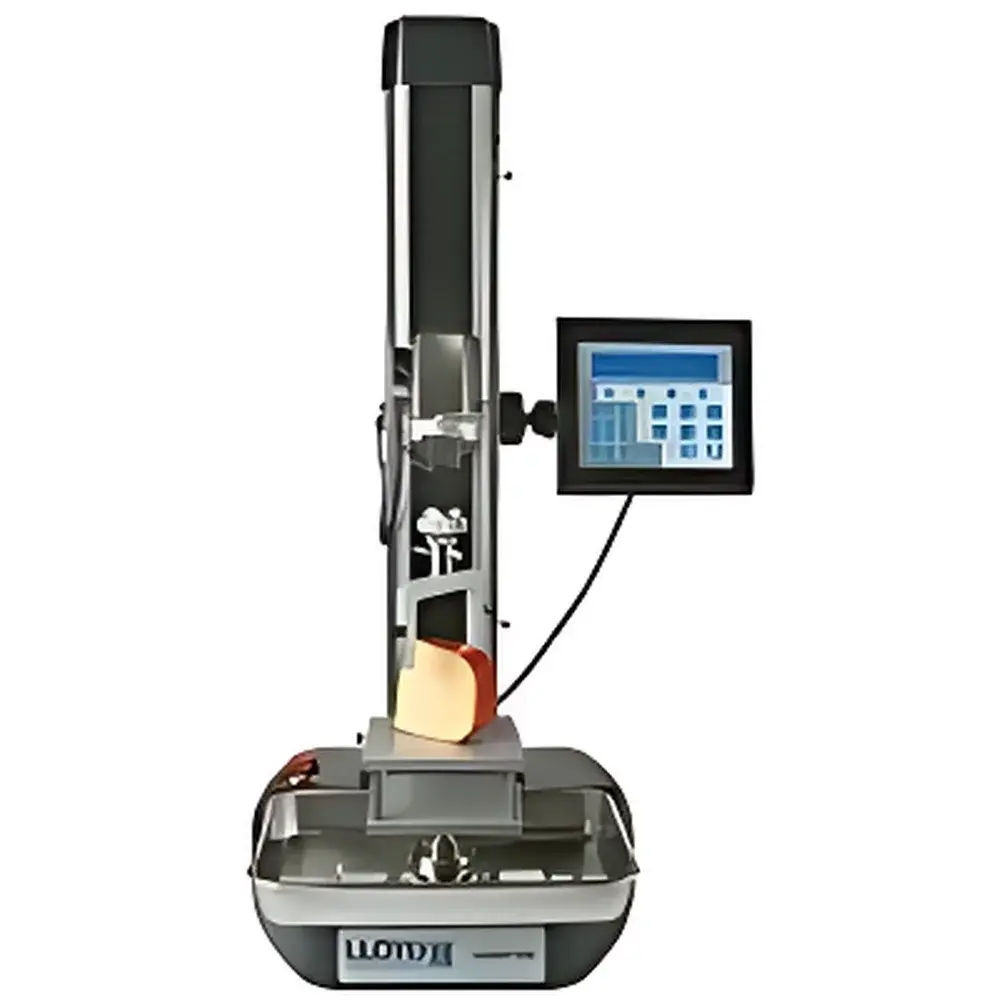
Lloyd TA1 Texture Analyzer
| Brand | Lloyd |
|---|---|
| Origin | USA |
| Model | TA1 |
| Maximum Load Capacity | 1 kN |
| Maximum Test Speed | 2032 mm/min |
| Maximum Crosshead Travel | 500 mm |
| Software | NexygenPlus Texture Analysis Suite |
| Compliance | ASTM F3179, ISO 11357-4 (thermoplastic texture correlation), USP <721> (hardness of solid dosage forms), GLP-compliant audit trail enabled |
Overview
The Lloyd TA1 Texture Analyzer is a high-precision, single-column mechanical testing system engineered for objective, reproducible texture evaluation of food products, pharmaceutical solid dosage forms, cosmetics, and soft biomaterials. Based on the fundamental principles of uniaxial compression, tension, penetration, extrusion, and shear force measurement, the TA1 quantifies mechanical responses—including force, displacement, and time—under controlled test conditions. Its modular design accommodates standardized probes (e.g., Kramer shear cells, spherical probes, puncture needles, and Warner–Bratzler blades) and complies with widely adopted international test protocols for texture profiling. The instrument operates within a load range up to 1 kN and supports rapid actuation speeds up to 2032 mm/min, enabling both high-throughput screening and fine-resolution analysis of transient deformation behavior. With a maximum crosshead travel of 500 mm, the TA1 accommodates large-format samples such as loaves, cakes, or packaged retail units without repositioning.
Key Features
- Robust single-column frame with precision-ground lead screws and integrated optical encoder for sub-micron position resolution
- High-speed servo-controlled motor drive delivering consistent velocity profiles across the full speed range (0.01–2032 mm/min)
- Integrated load cell with overload protection and factory-calibrated traceability to NIST standards
- Quick-change probe mount system compatible with ISO/ASTM-standardized fixtures and custom tooling
- Real-time force–displacement–time data acquisition at up to 10 kHz sampling rate
- Front-panel tactile interface with intuitive menu navigation and on-device test parameter validation
- Compliance-ready firmware supporting 21 CFR Part 11–aligned user access control, electronic signatures, and immutable audit trails
Sample Compatibility & Compliance
The TA1 supports diverse sample geometries and physical states—from viscous gels and aerated foams to fibrous meats, baked goods, confectionery, and chewable tablets. Its open-test chamber design allows ambient, chilled, or heated environmental integration via optional temperature-controlled stages (−40 °C to +150 °C). Method development aligns with established regulatory frameworks: ASTM F3179 for food texture classification, ISO 11357-4 for thermomechanical correlation in polymer-based foods, and USP for tablet hardness and friability assessment. All hardware and software components are validated per IQ/OQ protocols, and documentation packages support GMP/GLP audits in FDA- and EMA-regulated facilities.
Software & Data Management
NexygenPlus software serves as the analytical engine for the TA1, offering preconfigured test methods (e.g., “TPA – Two-Pulse Compression”, “Penetration – Single Cycle”, “Extrusion – Syringe Flow”) and customizable script-based protocols. It computes industry-standard texture parameters—including hardness, fracturability, adhesiveness, cohesiveness, springiness, chewiness, gumminess, and resilience—directly from raw force–displacement curves. Data export options include CSV, Excel, and XML formats; spectral overlays, statistical batch comparisons, and trend charts are generated natively. The software maintains full traceability: every test record logs operator ID, timestamp, calibration status, environmental metadata, and version-controlled method files—meeting ALCOA+ data integrity requirements.
Applications
- Food R&D: Quantifying textural changes during ingredient substitution (e.g., fat replacement, gluten-free formulation), shelf-life stability studies, and sensory correlation modeling
- Quality Control: In-line verification of dough elasticity, cheese firmness, yogurt viscosity, meat tenderness, and snack crispness against release specifications
- Pharmaceutical Manufacturing: Tablet hardness mapping, capsule shell rupture force, chewable tablet disintegration kinetics, and transdermal patch tack evaluation
- Academic Research: Biomechanical characterization of hydrogels, plant tissue rigidity, and oral processing dynamics using instrumental sensory models
- Process Optimization: Correlating texture metrics with thermal history (e.g., baking profile), moisture content, or enzymatic treatment duration
FAQ
What is the recommended calibration frequency for the TA1 load cell?
Annual recalibration by an ISO/IEC 17025-accredited laboratory is advised; internal verification using certified reference weights should be performed before each shift or test series.
Can NexygenPlus generate reports compliant with FDA 21 CFR Part 11?
Yes—when deployed in validated configuration with role-based user accounts, electronic signatures, and audit-trail logging enabled, NexygenPlus satisfies Part 11 requirements for electronic records and signatures.
Is the TA1 suitable for testing hot or frozen samples?
Yes—when paired with optional environmental chambers or Peltier-cooled stages, the TA1 maintains measurement fidelity across −40 °C to +150 °C operating ranges.
Does the system support third-party probe integration?
Yes—the universal probe mount accepts ISO-standard threaded interfaces (M6, ¼”-20 UNC), enabling compatibility with OEM and custom-designed fixtures.
How does the TA1 ensure test-to-test reproducibility?
Through closed-loop position/force control, real-time PID tuning, mechanical damping optimization, and automated zero-force compensation prior to each test cycle.




