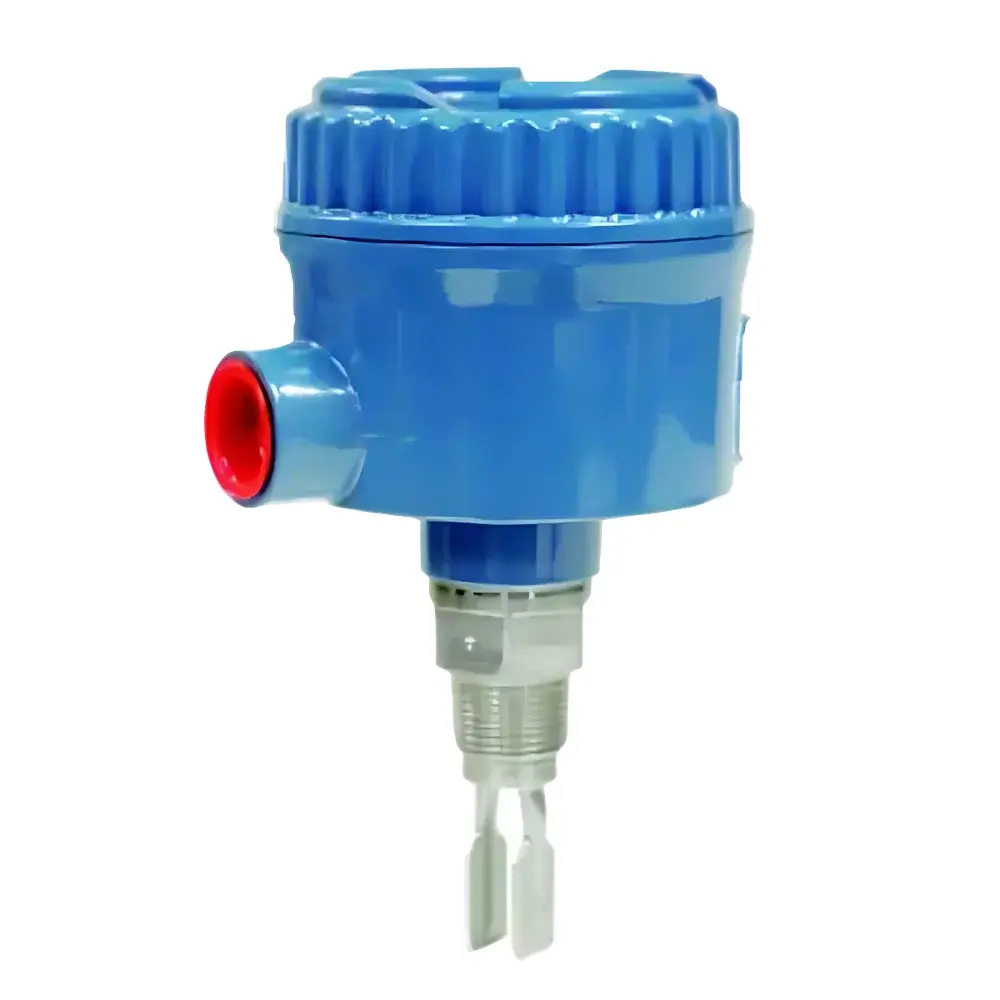
Drexelbrook TF Series Tuning Fork Level Switch
| Brand | Drexelbrook |
|---|---|
| Origin | Shanghai, China |
| Manufacturer Type | Authorized Distributor |
| Product Category | Domestic |
| Model | TF Series Tuning Fork Level Switch |
| Pricing | Upon Request |
| Product Type | Level Switch |
| Measurement Principle | Piezoelectrically Driven Tuning Fork Resonance |
| Operating Temperature Range | 0–150 °C |
| Maximum Process Pressure | 6.9 MPa |
| Configuration Options | Integral or Remote Mount |
| Fork Length | Customizable |
| Installation | Standard NPT or ISO 228 Threaded Mounting |
Overview
The Drexelbrook TF Series Tuning Fork Level Switch is an intrinsically robust, vibration-based point-level detection device engineered for reliable on/off liquid level monitoring in demanding industrial process environments. It operates on the principle of piezoelectric-driven resonance: a stainless-steel tuning fork is electromechanically excited at its natural resonant frequency (typically 1,000–1,200 Hz). When submerged in liquid, the fork’s resonant frequency shifts and damping increases due to mass loading and viscous drag—this change is detected by the integrated electronics and triggers a solid-state output signal. Unlike capacitive or RF admittance switches, the TF Series requires no calibration, exhibits minimal sensitivity to coating, foam, or turbulence, and delivers high repeatability across wide viscosity ranges—from water-like fluids to heavy oils and slurries with suspended solids up to 30% w/w.
Key Features
- True two-point detection: No false trips from splashing, vapor, or condensation due to dual-frequency discrimination logic
- Hermetically sealed piezoelectric drive/sense elements housed within 316L stainless steel fork assembly
- Custom fork lengths available from 40 mm to 200 mm to accommodate tank geometry, nozzle constraints, and minimum immersion requirements
- Integral electronics housing rated IP67; optional explosion-proof enclosures (ATEX II 1G Ex ia IIC T6 Ga / IECEx ia IIC T6 Ga) and flameproof variants (NEC/CEC Class I Div 1, Groups A–D)
- Wide operating temperature range: –40 °C to +150 °C ambient; process temperature compatibility extends to 150 °C with standard wetted materials
- Maximum process pressure rating: 6.9 MPa (1,000 psi) at 20 °C, derated per ASME B16.5 flange standards for elevated temperatures
- Flexible mounting: Compatible with NPT 1″, NPT 1½”, or ISO 228 G1″ threaded connections; flanged and sanitary tri-clamp options available upon request
Sample Compatibility & Compliance
The TF Series is validated for continuous duty in liquids including hydrocarbons, solvents, acids (pH 2–12), alkalis, food-grade syrups, and aqueous suspensions. It is not recommended for dry bulk solids or highly aerated foams exceeding 50% void fraction. All wetted parts comply with FDA 21 CFR §177.2600 for indirect food contact. Electrical design conforms to IEC 61000-6-2 (immunity) and IEC 61000-6-4 (emissions). Device configuration and documentation support compliance with ISA-88 and ISA-95 batch control frameworks. Traceability documentation—including material certifications (EN 10204 3.1), pressure test reports, and RoHS/REACH declarations—is provided with each shipment.
Software & Data Management
While the TF Series is a hardwired, analog/digital point-level switch with no embedded firmware or network interface, it integrates seamlessly into distributed control systems (DCS), programmable logic controllers (PLC), and safety instrumented systems (SIS) via 2-wire 4–20 mA HART® or discrete SPDT relay outputs. HART-enabled models support remote diagnostics—including fork contamination status, drive amplitude monitoring, and sensor health flagging—accessible via standard handheld communicators or asset management platforms compliant with FDT/DTM and EDDL specifications. Configuration parameters (e.g., fail-safe mode, delay timers, sensitivity thresholds) are set using magnetic programming tools—eliminating the need for electrical access during commissioning or maintenance.
Applications
Typical deployment scenarios include overfill protection in chemical day tanks, low-level detection in solvent recovery sumps, pump protection in wastewater lift stations, interface detection in decanters, and inventory control in bulk storage silos for edible oils and biofuels. The TF Series is widely specified in pharmaceutical clean utilities (PW, WFI), brewery CIP tanks, and offshore oil & gas production modules where SIL-2 capability (per IEC 61508) is required. Its immunity to dielectric constant variation makes it especially suitable for applications involving mixed-phase liquids or composition drift—such as polymer emulsions or latex reactors—where capacitance-based alternatives frequently exhibit instability.
FAQ
Can the TF Series detect interface between two immiscible liquids?
Yes—provided the density difference exceeds 0.1 g/cm³ and interfacial tension is sufficient to maintain a stable boundary; optimal performance is achieved with vertical mounting and fork orientation perpendicular to flow.
Is calibration required after installation?
No—factory-set resonance detection thresholds eliminate field calibration; however, functional verification using dry/wet test procedures per IEC 61511 is recommended during loop checkout.
What is the minimum immersion depth for reliable detection?
Standard forks require ≥15 mm submersion; custom short forks (40 mm total length) permit detection with as little as 8 mm immersion under laminar conditions.
Does fork coating affect performance?
Light, uniform coatings (≤0.5 mm thickness) have negligible impact; heavy, asymmetric buildup may require periodic cleaning or selection of self-cleaning fork geometries.
Is the device suitable for use in vacuum service?
Yes—rated for full vacuum (–100 kPa gauge) when installed with appropriate sealing gaskets and verified per ASME PCC-1 guidelines.
Related Products