
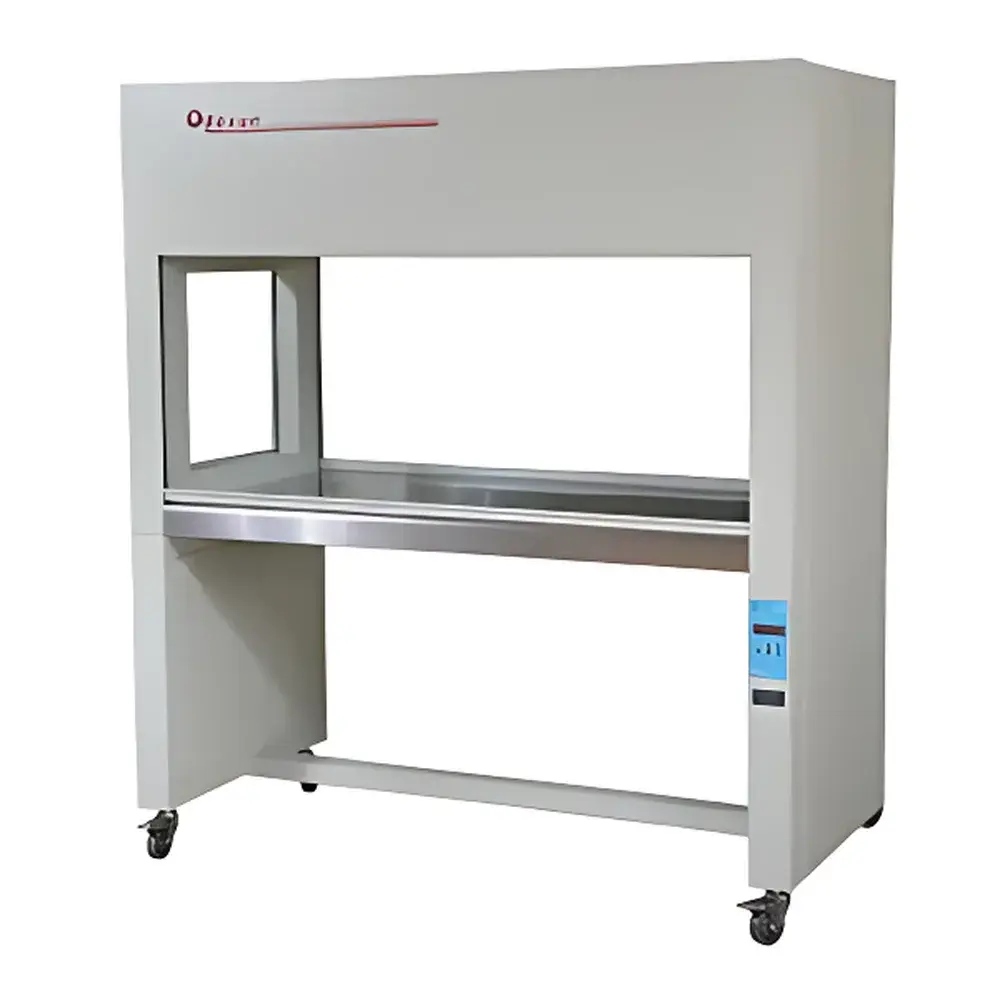
BOXUN SW-CJ-2FD Vertical Flow Clean Bench
| Brand | BOXUN |
|---|---|
| Origin | Shanghai, China |
| Manufacturer Type | Direct Manufacturer |
| Product Category | Domestic |
| Model | SW-CJ-2FD |
| Instrument Type | Vertical Flow Clean Bench |
| Cleanliness Class | ISO Class 5 (100-grade, ≥99.99% filtration efficiency for particles ≥0.5 µm) |
| Noise Level | ≤67 dB(A) |
| User Capacity | Dual-operator, single-front configuration |
| Airflow Pattern | Vertical downward laminar flow |
| Working Surface Dimensions | 1300 × 650 × 520 mm (W×D×H) |
| Overall Dimensions | 1460 × 700 × 1650 mm (W×D×H) |
| HEPA Filter Specification | 1250 × 560 × 50 mm (single unit) |
| Pre-filter | Medium-efficiency panel filter |
| Air Velocity Range | 0.3–0.6 m/s (adjustable in six steps) |
| Illumination | ≥300 lux |
| UV Lamp | 20 W (timer-controlled, 0–999 min) |
| Fluorescent Lamp | 40 W |
| Vibration Amplitude (peak-to-peak) | ≤5 µm (X/Y/Z axes) |
| Power Supply | AC 220 ±10 V, 50/60 Hz |
| Rated Power | 0.3 kW |
| Net Weight | 200 kg |
Overview
The BOXUN SW-CJ-2FD Vertical Flow Clean Bench is an ISO Class 5-certified laminar flow workstation engineered for reliable personnel- and product-protection in non-sterile but particle-sensitive laboratory operations. It operates on the principle of vertical unidirectional airflow: ambient air is drawn through a pre-filter to capture coarse particulates, then forced by a high-efficiency centrifugal blower through a certified HEPA filter (≥99.99% retention of ≥0.5 µm particles), delivering laminar, low-turbulence air vertically downward across the work surface at a precisely controllable velocity (0.3–0.6 m/s). Unlike biological safety cabinets, this clean bench does not recirculate air nor provide protection against hazardous aerosols or volatile chemicals; instead, it establishes a localized contamination-free zone ideal for aseptic handling of non-pathogenic samples, media preparation, electronics assembly, and precision instrumentation calibration where environmental particulate control is critical.
Key Features
- Robust structural design featuring cold-rolled steel housing with electrostatic powder coating and a seamless SUS304 stainless steel work surface—resistant to corrosion, chemical splashes, and routine disinfectants.
- Centrifugal blower system with stable rotational speed and low acoustic signature (≤67 dB[A]), ensuring consistent airflow performance and operator comfort during extended use.
- Intuitive LCD control panel with tactile membrane switches enabling six-step fan speed adjustment, independent ON/OFF control for UV germicidal lamp (20 W, timer-enabled: 0–999 minutes) and fluorescent illumination (40 W, ≥300 lux).
- Vertically oriented, quasi-enclosed work chamber with adjustable counterbalanced sash—permits precise positioning of the front access window within its operational range while maintaining laminar integrity.
- Dual-stage filtration architecture: a replaceable medium-efficiency pre-filter extends the service life of the primary HEPA filter (1250 × 560 × 50 mm), reducing long-term maintenance frequency and total cost of ownership.
- Compliance-ready mechanical layout—including vibration-damped mounting and rigid frame construction—ensures stable operation (vibration amplitude ≤5 µm peak-to-peak across X/Y/Z axes), supporting sensitive weighing and optical alignment tasks.
Sample Compatibility & Compliance
The SW-CJ-2FD is intended for applications involving non-hazardous, non-volatile, and non-pathogenic materials. It supports routine microbiological procedures such as sterile media pouring, plant tissue culture transfer, and reagent dispensing where particulate exclusion—not biocontainment—is the primary objective. While not certified to NSF/ANSI 49 or EN 12469 (standards governing biosafety cabinets), its filtration and airflow performance aligns with ISO 14644-1 Class 5 requirements for cleanroom environments. The unit facilitates adherence to Good Laboratory Practice (GLP) and current Good Manufacturing Practice (cGMP) documentation protocols when integrated into validated workflows—particularly in pharmaceutical QC labs, academic research cores, and microelectronics fabrication support areas requiring controlled particulate exposure.
Software & Data Management
This clean bench operates via embedded hardware controls without external software dependency. All operational parameters—including fan speed setting, UV exposure duration, and lamp status—are retained locally and displayed in real time on the integrated LCD interface. No network connectivity, data logging, or electronic audit trail functionality is provided, consistent with its role as a standalone physical containment device rather than a regulated analytical instrument. For laboratories subject to FDA 21 CFR Part 11 or EU Annex 11 compliance requirements, manual logbook entries documenting daily UV cycle verification, airflow checks (e.g., using calibrated anemometers), and filter replacement dates are recommended and fully supported by the unit’s deterministic control architecture.
Applications
- Aseptic preparation of microbial growth media and cell culture reagents in academic and industrial life science labs.
- Handling of sensitive optical components, semiconductor wafers, and precision sensors in microfabrication and metrology settings.
- Environmental sample processing—including air filter analysis and water microbiology filtration—where background particulate interference must be minimized.
- Calibration and assembly of high-resolution analytical instrumentation (e.g., FTIR accessories, laser alignment stages) requiring stable, low-vibration, particle-free workspaces.
- Teaching laboratories conducting foundational microbiology techniques under controlled, repeatable environmental conditions.
FAQ
What is the difference between a vertical flow clean bench and a biological safety cabinet?
A vertical flow clean bench protects only the sample from environmental particulates via downward laminar airflow; it does not protect the operator from aerosols or vapors. A biological safety cabinet provides both product and personnel protection through inward airflow and HEPA-filtered exhaust, complying with NSF/ANSI 49 standards.
Can the SW-CJ-2FD be used for handling pathogenic organisms?
No. This unit lacks inward airflow, negative pressure containment, and certified exhaust filtration required for biosafety level 2 (BSL-2) or higher agents. It is strictly intended for non-hazardous applications.
How often should the HEPA filter be replaced?
Filter replacement intervals depend on usage intensity and ambient air quality. Under typical laboratory conditions with pre-filter maintenance every 3–6 months, HEPA service life ranges from 18 to 36 months. Pressure drop monitoring and annual airflow verification are recommended.
Is the UV lamp suitable for sterilizing surfaces inside the chamber?
Yes—the 20 W UV-C lamp (253.7 nm) is effective for surface decontamination of stainless steel and glass surfaces when operated for ≥15 minutes post-use, provided no shadowed zones exist and the lamp is cleaned regularly to maintain output.
Does the unit comply with ISO 14644-1 Class 5 certification out of the box?
The SW-CJ-2FD is designed and tested to meet ISO 14644-1 Class 5 airborne particle concentration limits (≤3,520 particles/m³ ≥0.5 µm) under standardized test conditions; final site-specific validation per ISO 14644-3 is required after installation.



