
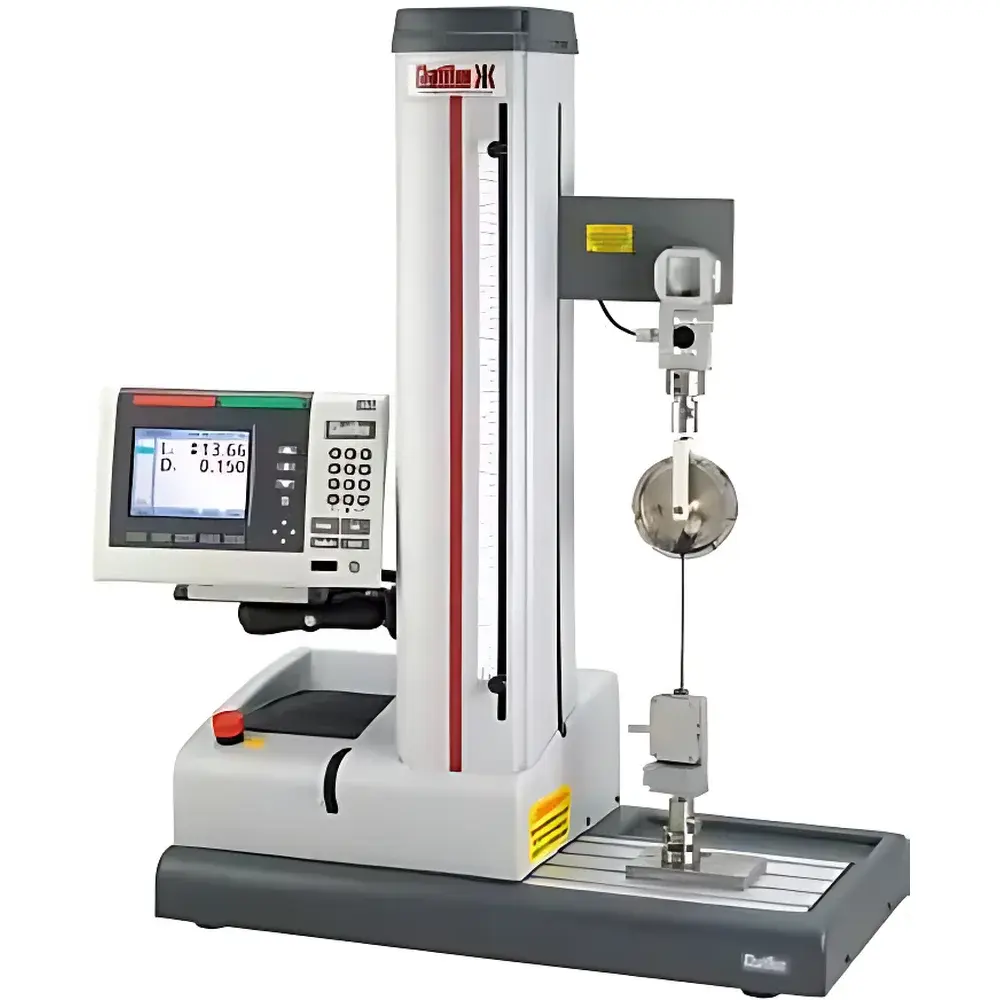
Chatillon TCD Series Digital Force Gauge and Testing System
| Brand | Chatillon |
|---|---|
| Origin | USA |
| Model | TCD |
| Load Cell Accuracy | ±0.1% of full scale |
| Travel Control Accuracy | ±0.25% of set displacement |
| Display | High-resolution color graphical LCD with menu-driven interface |
| Control Architecture | Closed-loop PID motion control |
| Test Modes | Limit Force, Limit Displacement, Limit Time, Break Test, Crush Test, Cyclic Test |
| Compliance | Designed for ASTM E4, ISO 7500-1, and USP <1043> force measurement validation protocols |
Overview
The Chatillon TCD Series Digital Force Gauge and Testing System is a precision-engineered electromechanical testing platform designed for quantitative mechanical property evaluation in regulated industrial, quality assurance, and R&D environments. Operating on the principle of strain-gauge-based load transduction combined with closed-loop servo-controlled linear actuation, the TCD system delivers traceable, repeatable force and displacement measurements across static and dynamic test regimes. Its architecture integrates a high-stability load cell (certified to ±0.1% full-scale accuracy per ISO 7500-1 Class 1), a low-backlash ball-screw-driven actuator, and a real-time PID feedback loop that maintains positional fidelity within ±0.25% of commanded travel—critical for applications requiring strict stroke repeatability, such as spring rate characterization or seal compression profiling. Unlike standalone gauges, the TCD functions as a complete force-displacement data acquisition system, enabling synchronized capture of load, position, time, and derived metrics (e.g., peak force, yield point, energy absorption) without external DAQ hardware.
Key Features
- High-fidelity color graphical LCD interface with intuitive menu navigation, soft-key function mapping, and real-time waveform visualization
- Closed-loop PID motion control engine ensuring consistent velocity profiles and sub-millimeter displacement repeatability
- Integrated load cell calibrated to ISO 7500-1 Class 1 standards, with NIST-traceable certification documentation available upon request
- Pre-programmed test methods compliant with common industry protocols: limit-force hold, limit-displacement ramp, time-controlled dwell, tensile break, compressive crush, and multi-cycle fatigue simulation
- Robust aluminum frame with adjustable height and interchangeable mounting plates for universal fixture integration (e.g., grips, probes, custom tooling)
- USB 2.0 and RS-232 communication ports supporting both real-time streaming and batch data export in CSV/Excel-compatible formats
Sample Compatibility & Compliance
The TCD system accommodates specimens ranging from miniature electronic components (e.g., tactile switch actuation, MEMS membrane deflection) to industrial assemblies (e.g., automotive latch engagement, medical device plunger resistance). Standard fixtures include parallel jaw grips, compression platens, and hook adapters; custom tooling adheres to ISO 26203-2 mechanical interface specifications. From a regulatory standpoint, the system supports GLP and GMP workflows through audit-trail-enabled software logging (optional), user-access controls, and electronic signature capability aligned with FDA 21 CFR Part 11 requirements. Force calibration intervals follow ASTM E4 recommendations, and displacement verification aligns with ISO 9277 Annex B procedures.
Software & Data Management
The included ForceAnalyser™ software provides comprehensive test definition, execution, and post-processing functionality. Users configure test parameters—including target force thresholds, displacement limits, dwell durations, and pass/fail criteria—via a drag-and-drop workflow editor. During acquisition, dual-channel real-time plots display force vs. time and force vs. displacement simultaneously, with automatic annotation of critical events (e.g., peak load, inflection points). Post-test, the software calculates derived values including modulus, stiffness, hysteresis area, and cycle-to-failure statistics. All raw data files embed metadata (operator ID, timestamp, calibration status, environmental conditions) and support cryptographic hashing for data integrity verification. Export options include PDF reports with embedded charts, CSV for statistical analysis in JMP or Minitab, and XML for LIMS integration.
Applications
- Quality control of spring-loaded mechanisms in consumer electronics and automotive interiors
- Validation of insertion/extraction forces for medical connectors and catheter guidewires per ISO 80369-3
- Compression testing of pharmaceutical tablets per USP and Ph. Eur. 2.9.40
- Peel strength assessment of adhesive tapes and laminated packaging materials (ASTM D903, FINAT FTM 1)
- Dynamic fatigue evaluation of elastomeric seals under cyclic compression loading
- Calibration verification of secondary force standards in metrology laboratories
FAQ
What calibration standards does the TCD system conform to?
The load cell meets ISO 7500-1 Class 1 accuracy requirements, and displacement verification follows ISO 9277 Annex B. Calibration certificates are NIST-traceable and include uncertainty budgets.
Can the TCD perform tests requiring variable speed profiles?
Yes—the closed-loop PID controller supports programmable ramp rates, dwell segments, and multi-step velocity sequences via the ForceAnalyser™ software.
Is the system compatible with existing laboratory information management systems (LIMS)?
Data export in CSV, XML, and PDF formats enables seamless integration with major LIMS platforms; optional API modules support direct database writes.
Does the TCD meet FDA 21 CFR Part 11 requirements for electronic records?
When configured with ForceAnalyser™ Enterprise Edition, the system provides role-based access control, electronic signatures, and immutable audit trails compliant with 21 CFR Part 11 Subpart B.
What is the maximum recommended sampling rate for high-speed transient capture?
The system acquires synchronized force and position data at up to 1 kHz, sufficient for capturing shock events in drop-testing or snap-fit engagement dynamics.



