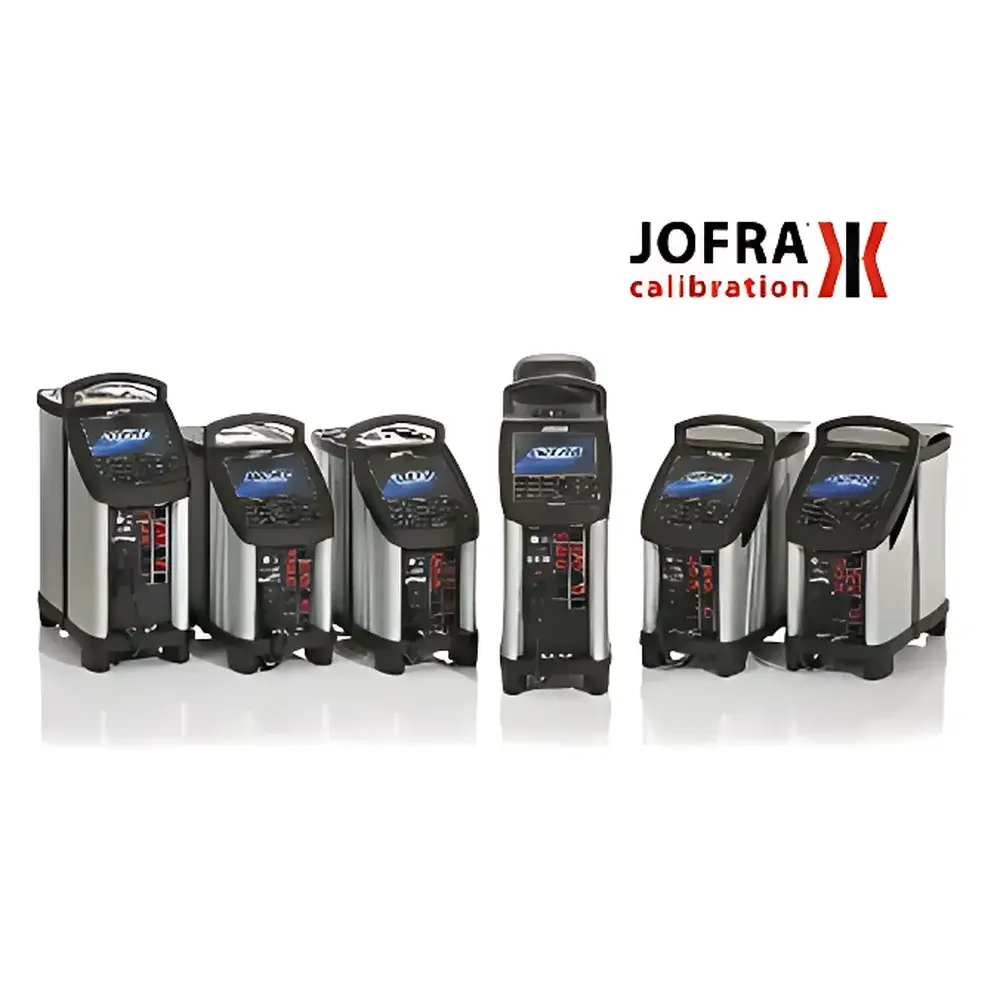
AMETEK JOFRA RTC/PTC/CTC/MTC/ETC Series Dry-Block Temperature Calibrators
| Brand | AMETEK JOFRA |
|---|---|
| Origin | Denmark |
| Instrument Type | Dry-Block Calibrator |
| Temperature Range | −100 °C to 1205 °C |
| Models | RTC, PTC, CTC, MTC, ETC Series |
| Accuracy (typ.) | ±0.04 °C to ±0.5 °C |
| Stability (typ.) | ±0.005 °C to ±0.1 °C |
| Display | Full-color touchscreen interface |
| Control Architecture | Active dual-zone or triple-zone thermal control (RTC), MVI active power fluctuation immunity (CTC/MTC), DLC dynamic load compensation (RTC) |
| Compliance | Designed for ISO/IEC 17025-accredited calibration labs |
Overview
AMETEK JOFRA dry-block temperature calibrators are precision-engineered thermal calibration systems designed for traceable, on-site and laboratory-based verification of contact temperature sensors—including RTDs, thermistors, thermocouples, and digital probes. Operating on the principle of resistive heating and high-efficiency thermal conduction within a solid metal block, these instruments eliminate fluid handling risks while delivering rapid thermal response, exceptional axial/radial uniformity, and long-term stability across an industry-leading range of −100 °C to 1205 °C. Each series—RTC (Reference), PTC (Professional), CTC (Compact), MTC (Marine), and ETC (Entry)—is purpose-built for distinct operational priorities: metrological rigor, industrial robustness, field portability, marine-grade reliability, or cost-sensitive rapid deployment. All units comply with fundamental thermodynamic calibration principles defined in ASTM E2877, IEC 60584, and ISO 17025 Clause 6.5.2 for calibration equipment performance validation.
Key Features
- Multi-series architecture: Five dedicated platforms (RTC, PTC, CTC, MTC, ETC) optimized for reference-grade metrology, industrial QA/QC, field service, marine environments, and entry-level verification tasks
- Dynamic Load Compensation (DLC) technology (RTC series): Patented algorithm that continuously adjusts heater output to maintain uniformity across multiple sensor insertions—even with varying thermal mass or geometry
- Active dual-zone and triple-zone thermal control (RTC/PTC): Independent regulation of upper and lower block zones ensures axial temperature consistency up to 190 mm insertion depth (CTC-652)
- MVI (Micro-Voltage Immunity) circuitry (CTC/MTC): Actively suppresses thermal drift induced by line voltage fluctuations (±10 %), critical for shipboard or generator-powered operation
- Rapid thermal cycling: Achieves 350 °C in ≤7 minutes (PTC), full stabilization in ≤3 minutes (ETC), and sub-10-second step recovery under load
- Full-color graphical touchscreen with icon-driven navigation, real-time stability indicators, and customizable countdown timers
- Modular well inserts: Interchangeable multi-hole blocks (up to 6 wells) support simultaneous calibration of heterogeneous probe types and diameters (1.5–13 mm)
- Integrated reference sensor interface: Plug-and-play compatibility with AMETEK-certified Pt100 reference probes (e.g., JOFRA RS-900), eliminating manual cold-junction compensation errors
Sample Compatibility & Compliance
JOFRA dry-block calibrators accommodate all standard contact temperature sensors compliant with IEC 60751 (RTDs), ASTM E1137 (thermocouples), and IEC 60584-1 (thermoelectric reference tables). The CTC-652 model supports insertion depths up to 190 mm, enabling calibration of long stem thermowells and immersion probes used in HVAC, pharmaceutical bioreactors, and turbine monitoring. Units are constructed from aerospace-grade aluminum and stainless steel housings with rubberized impact protection (ETC/MTC), meeting IP54 ingress protection for dust/moisture resistance. Calibration certificates issued with each instrument include as-found/as-left data traceable to NIST or DKD standards. Software-generated reports satisfy GLP/GMP documentation requirements and include electronic signatures, version-controlled audit trails, and metadata logging per FDA 21 CFR Part 11 Annex 11 guidelines.
Software & Data Management
JofraCal software (Windows-compatible, USB/Ethernet interface) provides full instrument control, automated calibration sequence execution (e.g., ramp-hold-step protocols), and uncertainty budgeting per GUM (JCGM 100:2008). It enables direct export of CSV, PDF, and XML files compatible with LIMS and SAP QM modules. Audit trail functionality records user actions, parameter changes, and calibration events with timestamps and operator IDs. Data encryption, role-based access control, and electronic signature workflows ensure compliance with ISO/IEC 17025:2017 Clause 7.11 and EU Annex 11. Firmware updates are delivered via secure HTTPS channel with cryptographic integrity verification.
Applications
- Primary and secondary calibration laboratories performing accredited temperature sensor verification per ISO/IEC 17025
- Pharmaceutical manufacturing: Validation of sterilization autoclaves, lyophilizers, and environmental chambers (ICH Q5A, EU GMP Annex 15)
- Power generation: Field calibration of turbine bearing RTDs, boiler thermocouples, and nuclear plant safety-critical sensors
- Maritime engineering: On-vessel calibration of engine coolant, lube oil, and exhaust gas temperature sensors under variable AC supply conditions
- Aerospace MRO: Rapid verification of avionics temperature transducers during line maintenance without fluid contamination risk
- Food processing: Sanitary sensor calibration in wet environments where liquid baths pose cross-contamination hazards
FAQ
What is the difference between dry-block and liquid-bath calibrators?
Dry-block calibrators use solid-metal heating blocks for faster thermal response, zero fluid maintenance, and safer operation in cleanrooms or hazardous locations. Liquid baths offer superior axial uniformity at low temperatures (<0 °C) but require strict fluid management and pose spill/fire risks.
Can JOFRA calibrators validate thermocouples directly?
Yes—via integrated reference junction compensation using certified Pt100 sensors. No external ice bath or manual cold-junction correction is required.
Is JofraCal software validated for regulated industries?
JofraCal complies with ALCOA+ data integrity principles and includes features required for 21 CFR Part 11 compliance: electronic signatures, audit trails, and data immutability controls.
How often does a JOFRA calibrator require recalibration?
Annual recalibration is recommended for RTC/PTC units in accredited labs; MTC models specify extended 3-year accuracy specifications to reduce lifecycle costs while maintaining documented metrological confidence.
Do these instruments support external reference probes?
All series except ETC offer optional external reference probe interfaces (e.g., CTC-C model), enabling hybrid calibration setups with independently traceable references.