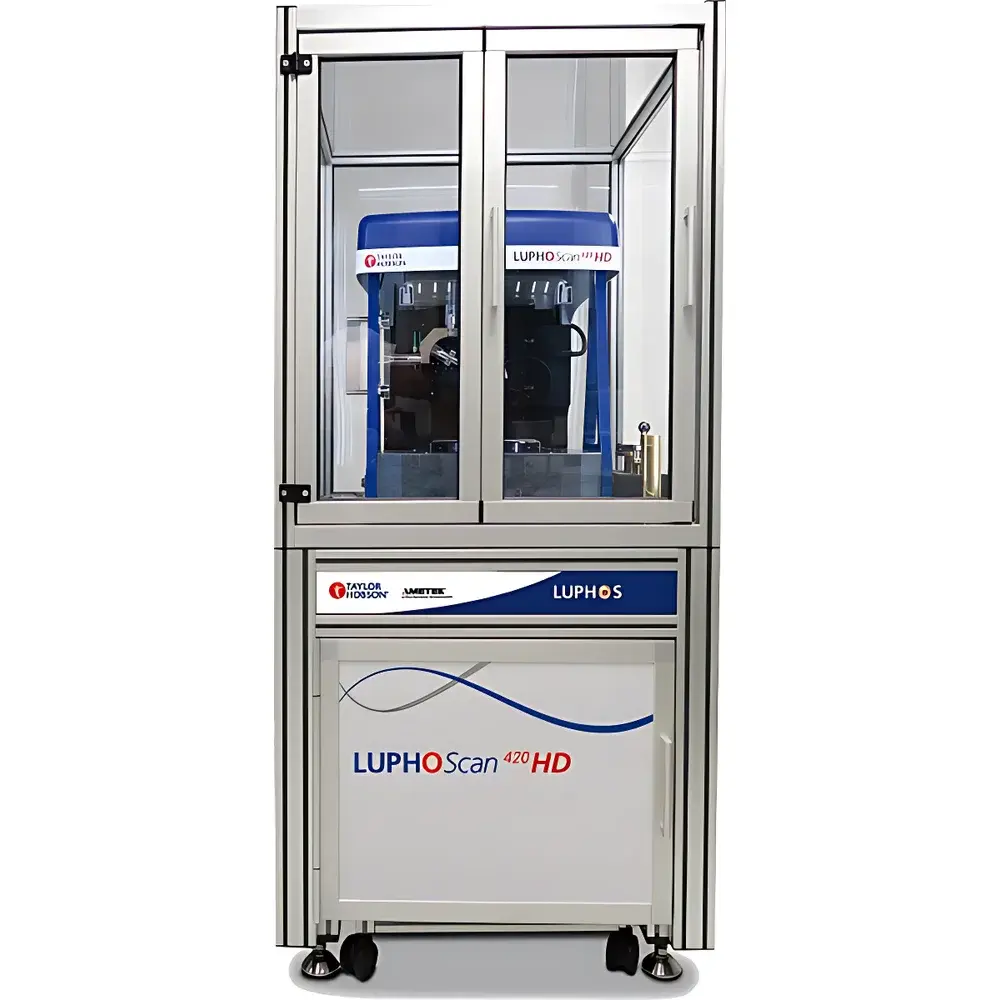
Taylor Hobson LuphoScan 260HD / 420HD Non-Contact 3D Aspheric Optical Surface Metrology System
| Brand | Taylor Hobson |
|---|---|
| Origin | United Kingdom |
| Model | LuphoScan 260HD / 420HD |
| Measurement Principle | Multi-Wavelength Interferometry (MWLI®) |
| Maximum Measurable Diameter | 260 mm / 420 mm |
| Vertical Resolution | < 50 nm |
| Typical Measurement Time (30 mm spherical lens) | < 120 s |
| Typical Measurement Time (130 mm spherical lens) | < 330 s |
| Sample Type | Rotationally Symmetric Optics (aspheres, spheres, flats, freeforms) |
| Sensor Compatibility | Transparent optics, polished metals, ground surfaces |
| Software Platform | Form Talysurf® with LuphoScan Module |
| Compliance | ISO 10110-5, ISO 14999-2, ISO 25178, ASTM E2925, supports GLP/GMP audit trails |
Overview
The Taylor Hobson LuphoScan 260HD and 420HD are high-precision, non-contact 3D optical surface metrology systems engineered for the quantitative characterization of rotationally symmetric optical components. Built upon proprietary Multi-Wavelength Interferometry (MWLI®) technology, the LuphoScan platform delivers traceable, sub-50 nm vertical resolution topographic measurements without physical contact—eliminating risk of surface damage or probe-induced artifacts. Unlike conventional stylus profilometers or single-wavelength interferometers, MWLI® enables unambiguous phase unwrapping across discontinuous, steep, or low-reflectivity surfaces—including aspheric lenses with inflection points, flat-topped apices, or highly curved convex/concave geometries. The system operates by synthesizing multiple coherent wavelengths to extend the unambiguous measurement range while maintaining nanometric sensitivity, making it uniquely suited for full-aperture, form-critical metrology in advanced optical manufacturing and R&D environments.
Key Features
- Multi-Wavelength Interferometry (MWLI®) sensor architecture enabling robust, absolute height measurement on transparent, metallic, and ground optical surfaces
- Dual-platform configuration options: LuphoScan 260HD (max. 260 mm diameter) and LuphoScan 420HD (max. 420 mm diameter), both supporting interchangeable reference optics and kinematic mounting fixtures
- High-speed scanning capability: full 3D topography acquisition for a 30 mm diameter spherical lens completed in under 2 minutes; 130 mm lens measured in under 5.5 minutes
- Integrated thermal and mechanical stability design, including low-drift granite base, active vibration isolation, and temperature-compensated reference frame architecture
- Support for complex surface classes: aspheres (conic, polynomial, Q-type), spheres, flats, freeforms, diffractive optical elements (DOEs), and segmented or annular optics
- LuphoSwap modular accessory system for extended metrology functions—including lens thickness, wedge, and decenter error measurement—without reconfiguration of core hardware
Sample Compatibility & Compliance
The LuphoScan system accommodates a broad spectrum of optically relevant samples: monolithic fused silica, BK7, CaF₂, and sapphire lenses; coated or uncoated metal mirrors; diamond-turned infrared optics; and precision-ground optical flats. Its MWLI® sensor achieves reliable fringe contrast on surfaces with reflectivity as low as 4% (e.g., AR-coated substrates) and handles transmission through up to 25 mm of optical path length—enabling direct measurement of lens front/back surfaces without disassembly. All measurement data comply with international standards governing optical surface specification and verification: ISO 10110-5 (surface irregularity), ISO 14999-2 (interferometric testing of aspheres), ISO 25178 (areal surface texture), and ASTM E2925 (non-contact optical profiling). The system’s software architecture supports 21 CFR Part 11-compliant user authentication, electronic signatures, and full audit trail logging for regulated quality assurance workflows.
Software & Data Management
LuphoScan operates under the Form Talysurf® metrology software suite, extended with the dedicated LuphoScan module. This environment provides real-time 3D visualization, Zernike and Q-polynomial fitting, deviation mapping against CAD-defined nominal surfaces, and automated pass/fail reporting per user-defined tolerances. Raw interferograms and processed topographies are stored in vendor-neutral formats (e.g., .xyz, .stl, .tif) alongside metadata including environmental conditions, calibration status, and operator ID. Batch processing, script-driven automation via Python API, and integration with enterprise MES/QMS platforms (e.g., Siemens Opcenter, ETQ Reliance) are supported. All data handling adheres to GLP and GMP principles, with configurable retention policies, version-controlled analysis methods, and tamper-evident digital signatures.
Applications
The LuphoScan platform is deployed across optical fabrication facilities, national metrology institutes, and aerospace-grade lens suppliers for end-to-end process validation—from prototype asphere qualification to high-volume production line verification. Primary use cases include: certification of molded plastic aspheres for automotive ADAS cameras; form error assessment of off-axis parabolic mirrors in EUV lithography tools; thickness and wedge characterization of doublet assemblies in astronomical instrumentation; and metrology of hybrid refractive-diffractive surfaces used in AR/VR waveguides. Its ability to resolve sub-micron figure errors on surfaces with slopes exceeding 30° makes it indispensable for next-generation freeform optics used in compact imaging systems and laser beam shaping optics.
FAQ
What surface types can the LuphoScan measure without coating or preparation?
It measures bare, uncoated transparent optics (e.g., fused silica, BK7), polished metals (Al, Cu, stainless steel), and ground or lapped surfaces—no anti-reflective coating or surface enhancement required.
Does the system support measurement of lenses with central obscuration or apertures?
Yes—via custom aperture masks and programmable scan path definition, enabling accurate topography capture of annular, segmented, or ring-shaped optical elements.
How is traceability maintained across instrument calibrations?
Traceability is ensured through NPL-traceable reference flats, on-system drift monitoring using dual-path interferometric references, and annual factory recalibration with full uncertainty budget documentation per ISO/IEC 17025.
Can LuphoScan integrate into an automated optical assembly line?
Yes—the system supports Ethernet/IP and OPC UA communication protocols, enabling bidirectional data exchange with PLCs and SCADA systems for inline SPC and adaptive process control.
Is software validation support available for regulated industries?
Taylor Hobson provides IQ/OQ documentation packages, installation qualification templates, and 21 CFR Part 11 validation guides for pharmaceutical, defense, and medical device manufacturers.