
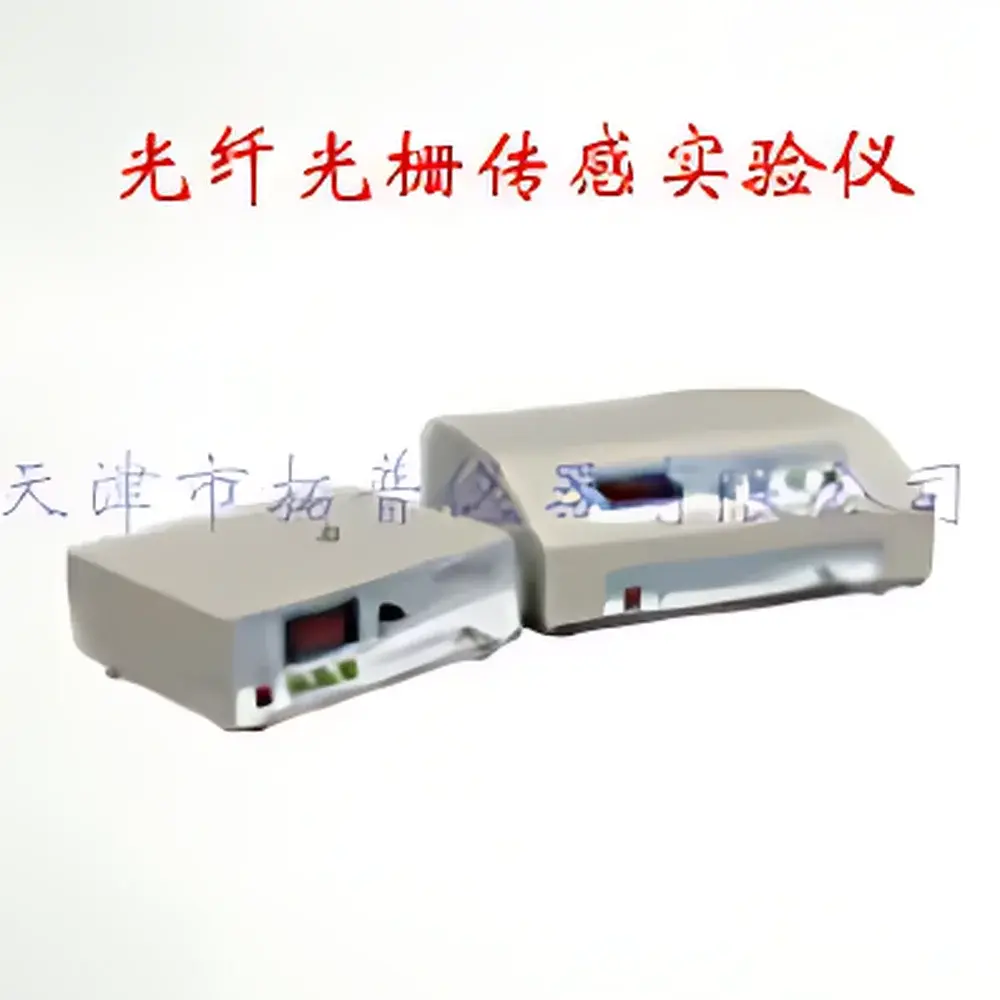
Fiber Bragg Grating (FBG) Sensing Experiment System – FST-1
| Origin | Tianjin, China |
|---|---|
| Manufacturer Type | Authorized Distributor |
| Origin Category | Domestic (PRC) |
| Model | FST-1 |
| Pricing | Available Upon Request |
| Wavelength Scanning Method | Manual |
| Data Recording | Manual & Computer-Automated |
| Strain Sensing Resolution | <10 με |
| Temperature Sensing Resolution | <1 °C |
| Wavelength Range (ASE Source) | 1525–1565 nm (C-band) |
| ASE Source & EDFA | Independently Operable |
| System Composition | FBG Test Unit + FBG Sensing Unit |
| Interface | RS-232 Serial Communication |
Overview
The Fiber Bragg Grating (FBG) Sensing Experiment System – FST-1 is a modular, education- and research-oriented optical instrumentation platform engineered for hands-on investigation of wavelength-encoded photonic sensing principles. It operates on the fundamental physical mechanism of Bragg wavelength shift (ΔλB) in uniform fiber Bragg gratings, where changes in local temperature (ΔT) or axial strain (Δε) induce linear, reversible shifts in the reflected central wavelength according to the well-established coupled-mode theory: ΔλB/λB = (1 − pe)·Δε + (α + ζ)·ΔT. This system enables quantitative, real-time observation and measurement of these shifts via manual wavelength scanning across the C-band (1525–1565 nm), providing foundational experimental validation of FBG transduction physics essential for structural health monitoring, composite material testing, and distributed temperature/strain metrology.
Key Features
- Integrated dual-unit architecture: Separately configurable FBG Test Unit (for spectral interrogation and baseline characterization) and FBG Sensing Unit (for controlled thermal/mechanical perturbation)
- High-stability Erbium-doped fiber ASE broadband light source (C-band, 1525–1565 nm), sourced from a U.S.-based manufacturer, ensuring spectral continuity and low ripple (<0.5 dB) over the full operating range
- Co-located Erbium-doped fiber amplifier (EDFA) with independent power supply and gain control—enabling standalone use as a signal-boosting stage in multi-node sensor networks
- Manual precision wavelength tuning mechanism with calibrated vernier scale, supporting sub-nanometer step resolution for pedagogical clarity and repeatability
- Dual-mode data acquisition: Real-time manual plotting of reflection spectra on external display, or automated waveform capture and peak tracking via included Windows-based software
- RS-232 serial interface compliant with standard TIA/EIA-232-F electrical specifications, enabling deterministic timing synchronization and legacy lab integration
Sample Compatibility & Compliance
The FST-1 accommodates standard single-mode telecom-grade optical fibers (ITU-T G.652.D) with UV-written uniform FBGs having reflectivity >85% and full-width-at-half-maximum (FWHM) bandwidths between 0.2 nm and 0.6 nm. It supports both bare-fiber and packaged grating configurations mounted on calibration stages, cantilevers, or thermal chambers. While designed primarily for academic laboratories and teaching labs, the system’s mechanical rigidity, thermal drift compensation design (passive aluminum chassis), and traceable wavelength referencing align with ISO/IEC 17025 general requirements for calibration laboratories. All optical components meet IEC 61300-2-4 (vibration) and IEC 61300-2-1 (impact) environmental robustness standards for classroom deployment.
Software & Data Management
The bundled PC software provides a deterministic, low-latency interface for spectral acquisition, peak detection (using centroid and parabolic interpolation algorithms), and differential wavelength tracking. Raw spectral data is saved in CSV format with timestamped metadata (scan start time, ambient temperature, user ID). The software implements audit-trail logging per GLP guidelines—including operator login, parameter change history, and export timestamps—to support undergraduate thesis documentation and internal lab quality assurance protocols. No cloud connectivity or remote access functionality is included; all processing occurs locally to ensure data sovereignty and reproducibility under controlled network-offline conditions.
Applications
- Undergraduate and graduate laboratory instruction in photonics, optical sensing, and smart materials
- Validation of thermo-optic and elasto-optic coefficients in silica fiber
- Calibration of FBG-based strain gauges against reference extensometers (e.g., ASTM E83 Class B)
- Temperature-compensated strain isolation experiments using dual-grating configurations
- Signal-to-noise ratio (SNR) analysis of FBG reflection spectra under varying source power and detector integration times
- Introduction to wavelength-division multiplexing (WDM) concepts in sensor arrays
FAQ
Is the ASE broadband source certified to ITU-T G.694.1 channel grid specifications?
No—the source is intentionally broadband and unchannelized; it serves as a continuum illumination source for spectral interrogation, not as a WDM transmitter.
Can the system be upgraded to support automatic wavelength scanning?
Not natively—the FST-1 is mechanically designed for manual scanning to emphasize first-principles understanding; however, third-party motorized translation stages with compatible mounting interfaces may be integrated externally.
Does the software comply with FDA 21 CFR Part 11 for electronic records?
It does not implement electronic signatures or role-based access control required for Part 11 compliance; it is intended for educational and non-GxP research environments.
What is the maximum allowable input power to the FBG test unit’s photodetector?
The detector is rated for continuous-wave optical input up to +3 dBm; exceeding this may cause saturation or nonlinear response—users are advised to attenuate amplified ASE output when necessary.
Are calibration certificates provided with the system?
A factory-assembled performance verification report (including source spectrum flatness, peak wavelength accuracy, and thermal drift over 2 hours) is supplied; NIST-traceable calibration is available as an optional service.



