
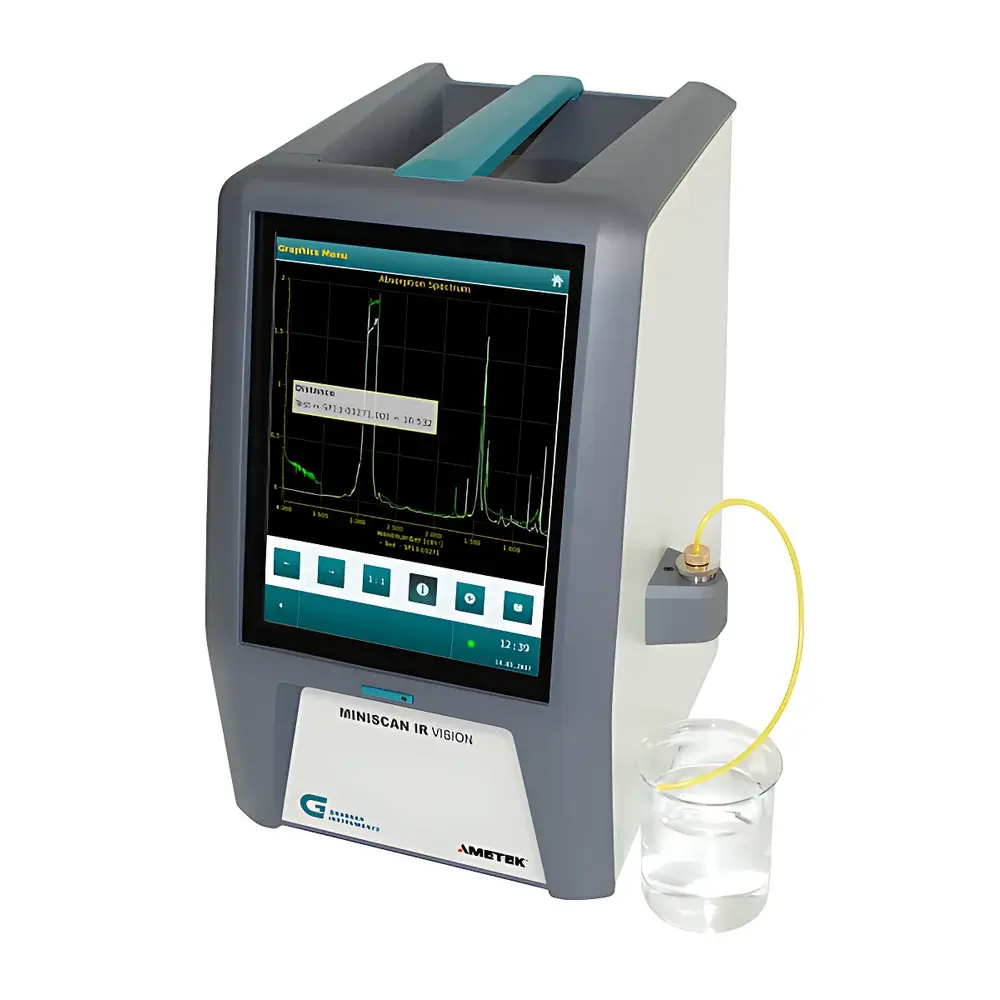
Grabner MINISCAN IR Vision Diesel Portable Mid-Infrared Cetane Number Analyzer
| Brand | Grabner |
|---|---|
| Origin | Austria |
| Model | MINISCAN IR Vision Diesel |
| Portability | Portable |
| Measurement Parameter | Cetane Number |
| Measurement Range | 20–80 CN |
| Measurement Accuracy | ±0.5 CN |
| Analysis Time | < 80 s |
| Sample Volume | 6 mL |
| Compliance Standards | ASTM D5845, ASTM D6277, EN 238, SH/T 0797, EN 14078, ASTM D7806, GB/T 23801, ASTM E1655, GB/T 29858 |
| Calibration Method | PLS-based Multivariate Spectral Quantification |
| Integrated Density Measurement | Thermoelectrically Controlled |
| Optical System | Dual Interferometer with Auto-Mirror Calibration |
| Display | 10-inch Industrial Touchscreen |
| Power Supply | 12 V DC (Vehicle Adapter Compatible) |
| Sample Database | SGS-Verified Real-Fuel Reference Library |
Overview
The Grabner MINISCAN IR Vision Diesel is a portable, mid-infrared (MIR) spectrometer engineered for rapid, field-deployable quantification of diesel fuel cetane number (CN) and over 20 additional physicochemical parameters. It operates on the principle of Fourier-transform infrared (FTIR) spectroscopy coupled with chemometric modeling—specifically partial least squares (PLS) regression—to correlate full-spectrum absorbance features (4000–600 cm⁻¹) with reference values established via primary methods (e.g., ASTM D613 engine testing). Unlike conventional laboratory-based CN analyzers, this instrument eliminates the need for combustion engines or hazardous reagents by deriving predictive models from high-fidelity spectral signatures of hydrocarbon composition, aromaticity, and oxygenate content. Its compact, ruggedized architecture supports deployment in refinery blending units, terminal quality control labs, mobile inspection teams, and third-party verification facilities—delivering laboratory-grade accuracy without infrastructure dependency.
Key Features
- Portable FTIR platform with integrated thermoelectric temperature control across sample cell, density module, and optical path—ensuring volumetric and mass-based parameter stability across ambient fluctuations (10–40 °C).
- Dual interferometer design with real-time auto-mirror calibration: compensates for mechanical drift induced by transport vibration or thermal shock, maintaining optical alignment integrity after off-road transit.
- 6 mL sample requirement with bubble-free metal syringe injection system—validated per Grabner’s internal durability protocol (100,000+ actuations) and certified to IEC 60068-2 shock/vibration standards.
- 10-inch sunlight-readable industrial touchscreen with glove-compatible interface; supports operation under ISO 14644 Class 8 cleanroom conditions and IP54-rated environmental ingress protection.
- Onboard density measurement module compliant with ASTM D1298 and ISO 3675—thermoelectrically stabilized to ±0.001 g/cm³ repeatability at 15 °C.
- Pre-loaded SGS-curated reference database comprising >12,000 real-world diesel samples—including biodiesel blends (B5–B30), synthetic hydrotreated fuels, and low-sulfur ultra-low sulfur diesel (ULSD)—each traceably certified against NIST-traceable reference materials.
Sample Compatibility & Compliance
The MINISCAN IR Vision Diesel accepts untreated, unfiltered diesel samples meeting ASTM D975, EN 590, and GB 19147 specifications. It is validated for use with fatty acid methyl ester (FAME) blends up to B30, hydrogenated vegetable oil (HVO), and Fischer–Tropsch synthetic diesel. Regulatory compliance includes full alignment with ASTM E1655 (standard practice for multivariate calibration), ASTM D5845 (oxygen content), ASTM D6277/EN 238/SH/T 0797 (benzene), EN 14078/ASTM D7806/GB/T 23801 (FAME), and GB/T 29858 (infrared spectral quantitative analysis). All calibration models undergo GLP-compliant validation per ISO/IEC 17025:2017 Annex A, including linearity assessment (r² ≥ 0.998), bias evaluation against primary reference methods, and intermediate precision testing across operator shifts and instruments.
Software & Data Management
The embedded Grabner IRVision software provides audit-trail-enabled data handling compliant with FDA 21 CFR Part 11 requirements. Each analysis generates a timestamped, digitally signed report containing raw interferogram, processed spectrum, PLS prediction residuals, density reading, and uncertainty estimation (k=2). Users may export results in CSV, PDF/A-2, or ASTM E2500-18-compliant XML formats. The system supports secure network integration via TLS 1.2 encrypted Ethernet or Wi-Fi (WPA3), enabling centralized data aggregation into LIMS environments. Calibration transfer between instruments is performed using standardized transfer standards traceable to PTB (Physikalisch-Technische Bundesanstalt) reference spectra.
Applications
- Real-time blend optimization in refinery hydrotreating and blending racks, reducing reliance on offline GC/FID or engine test data.
- Terminal and depot QC screening for CN compliance prior to dispatch—meeting EN 590 Clause 5.2 and ASTM D975 Table 1 requirements.
- Field verification of biodiesel admixture levels during custody transfer or regulatory inspections (e.g., EPA Renewable Fuel Standard audits).
- Accelerated R&D of alternative diesel formulations, including co-processing of bio-oils and catalytic cracking fractions.
- Supporting ISO 8217 marine distillate fuel certification (RMG/RMD grades) through simultaneous determination of CN, density, and aromatic content.
FAQ
Does the instrument require periodic recalibration with certified reference fuels?
Yes—Grabner recommends annual performance verification using NIST-traceable cetane reference standards (e.g., cetane number 30, 50, and 70), with optional factory recalibration available under Grabner Service Plan GSP-IRV-D.
Can the analyzer be used for gasoline octane determination?
No—the MINISCAN IR Vision Diesel is chemometrically optimized exclusively for diesel-range hydrocarbons (C10–C25); gasoline analysis requires the separate MINISCAN IR Vision Gasoline platform.
Is method validation documentation provided for regulatory submissions?
Yes—each instrument ships with a Certificate of Conformance, full validation report per ASTM D6299, and IQ/OQ/PQ protocols aligned with ISO/IEC 17025 accreditation requirements.
What maintenance is required beyond routine cleaning?
No consumables or optical alignment tools are needed; only quarterly verification of density module calibration and annual interferometer energy check using built-in reference laser diagnostics.
How is data integrity ensured during power interruption?
All analyses are written to non-volatile flash memory in real time; unsaved data is retained through brownout events lasting ≤500 ms, and the system resumes analysis upon power restoration without loss of spectral fidelity.





