
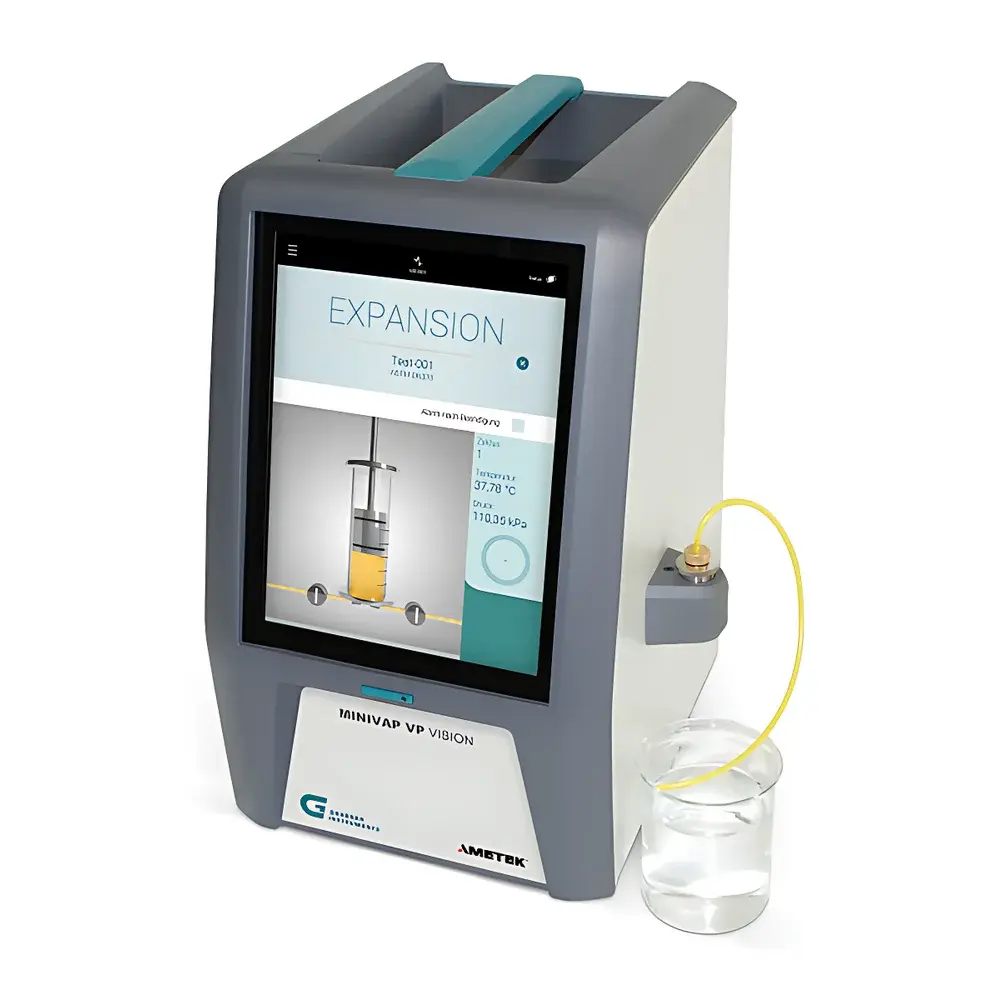
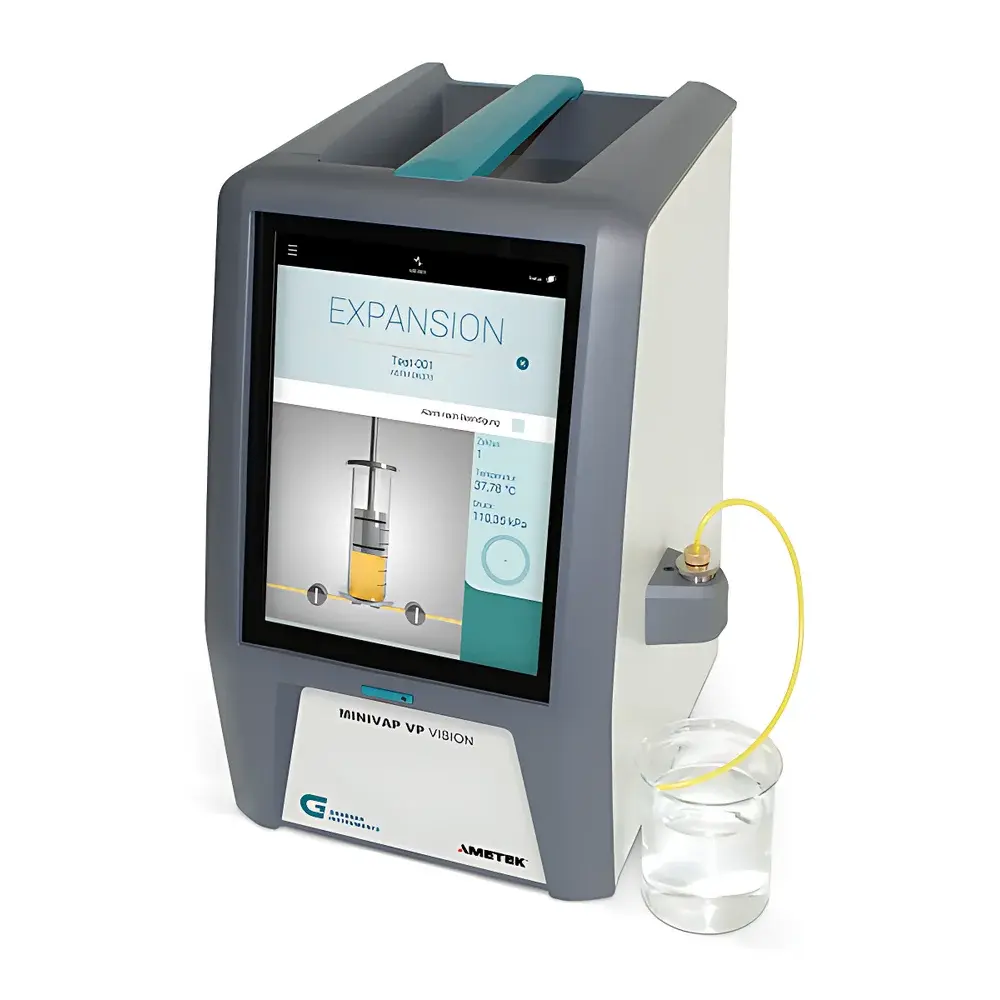
GRABNER MINIVAP VP Vision Automated Micro Vapor Pressure Analyzer
| Brand | GRABNER |
|---|---|
| Origin | Austria |
| Model | MINIVAP VP Vision |
| Analysis Method | Three-Stage Expansion Method |
| Pressure Range | 0–2000 kPa |
| Temperature Range | 0–120 °C |
| Repeatability | ≤ 0.2 kPa (pure substance @ 37.8 °C) |
| Reproducibility | ≤ 0.5 kPa (pure substance @ 37.8 °C) |
| Sample Volume | 1 mL |
| Test Time | ~5 min (method-dependent) |
| Display | 10-inch industrial-grade color touchscreen |
| Compliance | ASTM D5191, D6377, D6378, D6897, D5188 |
Overview
The GRABNER MINIVAP VP Vision is an automated micro vapor pressure analyzer engineered for high-precision, trace-volume determination of vapor pressure in petroleum products and volatile organic compounds. It operates on the internationally validated three-stage expansion method—a thermodynamic equilibrium technique that measures the partial pressure of vapor above a liquid sample at controlled temperature, without requiring vacuum systems or solvent degassing. This principle ensures compliance with regulatory frameworks including U.S. EPA Method 40 CFR Part 60 Appendix A-1, ASTM D6378 (for Reid Vapor Pressure correction), and ASTM D6377 (for true vapor pressure of crude oil and condensates). The instrument is explicitly referenced in U.S. Federal Register Vol. 58, No. 52 (March 17, 1993) as an approved alternative to traditional RVP testers. Its design reflects decades of refinement in vapor-phase thermodynamics instrumentation, delivering metrological traceability to NIST-traceable pressure and temperature standards.
Key Features
- Three-stage expansion methodology with piston-driven volume modulation—eliminates need for external vacuum pumps and minimizes operator intervention.
- Patented 2D-Correction™ calibration across 273 reference points, ensuring accuracy across the full 0–2000 kPa range without interpolation error.
- Integrated oscillation module enabling rapid phase equilibration for crude oil, LPG, and high-viscosity samples—critical for accurate TVP (True Vapor Pressure) and bubble point assessment.
- Sampling Pro™ valve architecture with ceramic-coated piston seals, validated for >100,000 cycles and proven to reduce carryover between dissimilar matrices (e.g., gasoline → jet fuel → naphtha).
- Centralized lubrication system—no field maintenance required; eliminates downtime associated with manual greasing or seal replacement.
- Fast Mode™ method combining ASTM D5191 and D5188 protocols for accelerated screening of reformulated gasoline blends while preserving statistical validity.
- Robust mechanical construction certified per EN 60068-2-6 (vibration), EN 60068-2-27 (shock), and EN 60068-2-14 (thermal cycling)—validated for mobile labs, offshore platforms, and military deployment.
- 10-inch capacitive touchscreen interface supporting gloved operation, multi-language UI (English, German, French, Chinese, Russian, Japanese), and intuitive tap-to-run workflow.
Sample Compatibility & Compliance
The MINIVAP VP Vision accommodates diverse sample types—including unleaded gasoline, aviation turbine fuel (Jet A-1, JP-8), crude oil, liquefied petroleum gas (LPG), hydrocarbon solvents (e.g., toluene, xylene), and oxygenated blends (ETBE, MTBE). Its 1 mL sample requirement reduces hazardous material handling and waste generation, aligning with ISO/IEC 17025 laboratory sustainability guidelines. Regulatory compliance extends beyond method-specific validation: the analyzer supports audit-ready data integrity per FDA 21 CFR Part 11 (electronic records/signatures), includes configurable user access levels, and logs all calibration events, method edits, and result exports with timestamped, immutable audit trails. It meets EU REACH Annex VII requirements for vapor pressure classification under CLP Regulation (EC) No 1272/2008 and satisfies GHS hazard communication criteria for flammability category assignment.
Software & Data Management
Cockpit™ PC software serves as the centralized command hub for fleet-wide instrument management. Deployed on Windows-based workstations or virtualized environments, it enables remote configuration, firmware updates, diagnostic monitoring, and real-time status reporting across geographically dispersed units via secure TLS-encrypted LAN or VPN connections. All measurement data—including raw pressure/temperature curves, equilibrium detection flags, and correction coefficients—are stored locally in non-volatile memory (>100,000 test records) and exportable in CSV (for LIMS integration) or PDF (with embedded graphs and metadata). Calibration history—including date, technician ID, standard used, and deviation reports—is fully exportable and supports GLP/GMP documentation workflows. Optional LIMS connectivity via ASTM E1384-compliant drivers ensures seamless bidirectional data exchange.
Applications
This analyzer is routinely deployed in refinery QC laboratories for real-time monitoring of gasoline blending streams, in pipeline custody transfer terminals for crude assay verification, and in regulatory testing facilities validating compliance with EPA Tier 3, Euro 5/6, and China VI fuel specifications. Its low-volume capability makes it ideal for research applications involving limited-sample catalyst studies or synthetic fuel formulations. In environmental forensics, it quantifies VOC volatility for soil vapor intrusion modeling. For upstream operations, the included crude oil test kit—with piston-type pressure float chamber and programmable gas/oil ratio (GOR) ramping—enables direct TVP and bubble point determination per API RP 25 and ASTM D6897. Its portability and 12 V DC option support field-deployed testing in remote well sites or marine bunkering operations.
FAQ
Does the MINIVAP VP Vision require external cooling or refrigeration units?
No—its integrated Peltier-controlled thermal chamber maintains ±0.01 °C stability from 0–120 °C without auxiliary chillers or dry ice.
Can it measure vapor pressure of water-miscible fuels like ethanol blends?
Yes—the Sampling Pro™ valve and wetted-path materials (Hastelloy C-276, sapphire, FKM elastomers) resist corrosion and phase separation during repeated ethanol/gasoline analysis.
Is method validation support available for ISO/IEC 17025 accreditation?
GRABNER provides documented IQ/OQ/PQ protocols, uncertainty budgets per EURACHEM/CITAC Guide, and traceable calibration certificates compliant with ISO/IEC 17025:2017 Clause 6.4.
How is cross-contamination mitigated between high- and low-volatility samples?
The dual-piston actuation sequence in Sampling Pro™ valve isolates sample contact surfaces; automated solvent flush (2.2 mL) and vacuum purge cycles are executed between runs per ASTM D6377 Annex A3.
What cybersecurity measures protect Cockpit™ network communications?
All remote sessions enforce TLS 1.2+ encryption, certificate-based authentication, and role-based access control; no default credentials are shipped, and firmware updates require signed digital signatures.





