
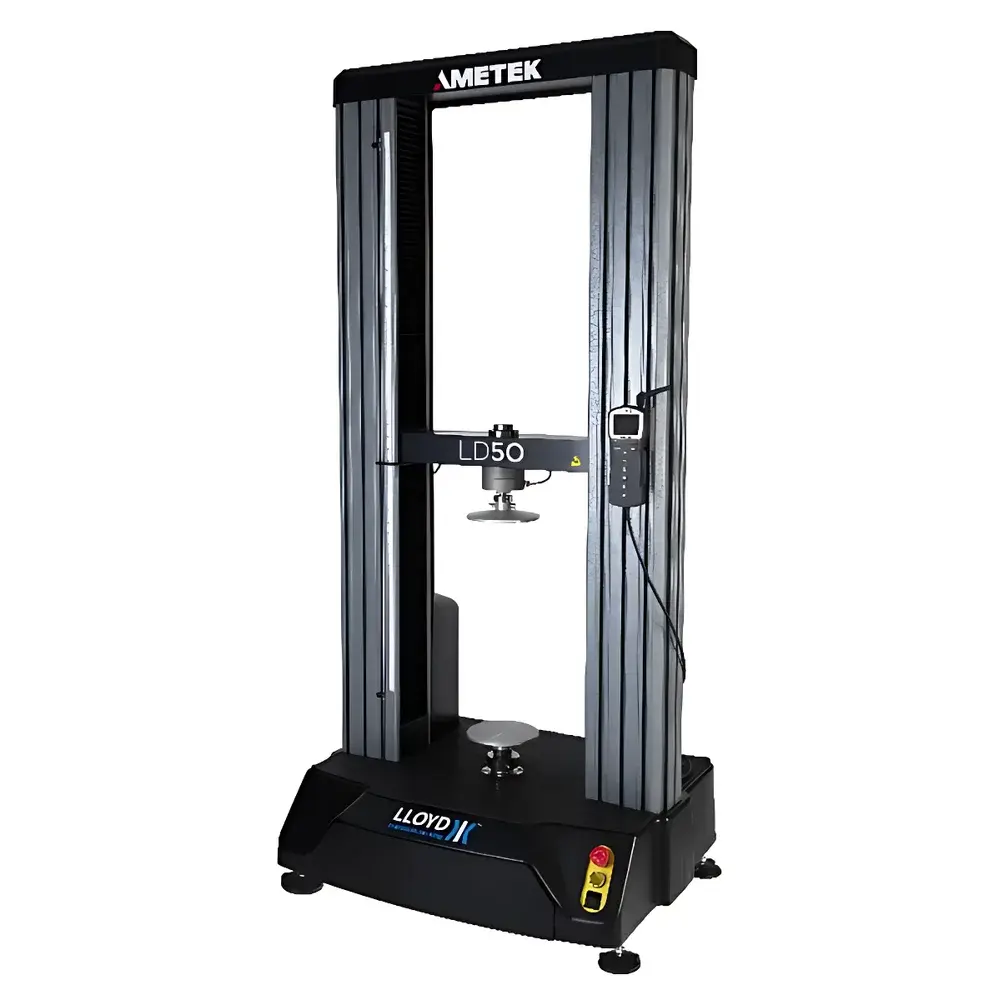
Lloyd Instruments LD Series Universal Testing Machines
| Brand | Lloyd Instruments |
|---|---|
| Origin | USA |
| Model Range | LD5, LD10, LD30, LD50, LD100 |
| Type | Electromechanical Universal Testing Machine |
| Compliance | ASTM, ISO, DIN, GB |
| Accessories | Full suite of grips, fixtures, safety enclosures, environmental chambers (e.g., temperature-controlled) |
| Drive System | Precision ball-screw actuator with AC servo motor |
| Control Architecture | Closed-loop digital force and position control |
| Software Platform | NEXYGENPlus (ISO 17025-compliant data handling, audit trail, user permission levels, FDA 21 CFR Part 11 ready) |
Overview
The Lloyd Instruments LD Series Universal Testing Machines represent a rigorously engineered electromechanical platform for static mechanical property evaluation of materials and components across research, quality control, and production environments. Built on a robust dual-column frame architecture with high-rigidity crossheads and precision-ground ball-screw actuators, the LD Series employs closed-loop digital servo control to deliver repeatable force application (±0.5% of reading) and displacement accuracy (±0.01 mm) under both tension and compression loading. The system operates on fundamental principles of Hooke’s Law and stress–strain continuum mechanics, enabling standardized determination of tensile strength, yield point, elongation at break, modulus of elasticity, flexural properties, peel adhesion, puncture resistance, and compressive yield—fully traceable to SI units and calibrated per ISO/IEC 17025 requirements.
Key Features
- Modular dual-column frames available in five capacity classes: LD5 (5 kN), LD10 (10 kN), LD30 (30 kN), LD50 (50 kN), and LD100 (100 kN), each optimized for stiffness-to-load ratio and thermal stability.
- High-resolution load cells (up to 1/1000 of full scale resolution) with automatic recognition and auto-zeroing; compliant with ISO 7500-1 Class 0.5 accuracy.
- Integrated safety architecture including light curtains, emergency stop circuits, mechanical overload protection, and programmable travel limits—certified to CE Machinery Directive 2006/42/EC and ANSI B11.1.
- Thermally stable crosshead guidance with low-friction linear bearings ensures minimal lateral deflection (<0.02 mm/m) during high-speed testing up to 2,000 mm/min.
- Direct drive AC servo motor eliminates belt or gear backlash, delivering consistent torque response and enabling true constant-rate-of-traverse (CRT) and constant-rate-of-loading (CRL) test modes.
Sample Compatibility & Compliance
The LD Series accommodates specimens ranging from sub-millimeter polymer films and medical device sutures to structural composites and metallic fasteners—enabled by interchangeable grip systems (pneumatic, wedge, hydraulic, and custom tooling) and modular fixture interfaces. All standard configurations meet essential requirements of ASTM E4, ASTM E8/E8M, ISO 6892-1, ISO 178, ISO 1133, DIN 53455, and GB/T 228.1. Optional environmental integration supports testing at temperatures from –70 °C to +300 °C using certified climate chambers, with real-time thermal compensation algorithms embedded in NEXYGENPlus software. Systems are routinely validated for GLP and GMP environments, supporting 21 CFR Part 11 compliance through electronic signatures, audit trails, and role-based access control.
Software & Data Management
NEXYGENPlus is the native Windows-based control and analysis platform, designed for regulatory-grade data integrity. It provides synchronized acquisition of force, displacement, strain (via extensometer input), and environmental parameters at up to 10 kHz sampling rate. Test methods are stored as reusable templates conforming to standard method definitions (e.g., “ASTM D638 Type I Tensile”). Raw data is saved in encrypted .nxd format with embedded metadata (operator ID, calibration date, machine ID, environmental logs). Export options include CSV, PDF reports (with customizable headers, logos, and pass/fail criteria), and direct SQL database logging for enterprise LIMS integration. Audit trail functionality records all user actions—including method edits, result overrides, and calibration events—with immutable timestamps.
Applications
- Materials science labs evaluating polymer viscoelasticity, metal ductility, and composite interlaminar shear strength.
- Medical device manufacturers performing ISO 11137-compliant packaging seal strength, catheter tensile integrity, and orthopedic implant fixation testing.
- Automotive suppliers validating gasket compression set, rubber bushing hysteresis, and seatbelt webbing elongation per SAE J211.
- Food packaging QA teams conducting peel strength (ASTM F904), puncture resistance (ASTM D5748), and burst testing (ASTM F1140).
- Academic institutions supporting undergraduate mechanics labs and graduate-level fracture mechanics research with reproducible boundary-condition control.
FAQ
What standards does the LD Series support out of the box?
Preconfigured test methods cover ASTM D638, D790, D1876, E8, ISO 6892-1, 178, 1133, and GB/T 228.1. Custom method development is supported via NEXYGENPlus scripting engine.
Can the LD Series be integrated into an existing MES or LIMS environment?
Yes—via OPC UA server interface, ODBC-compliant database export, or REST API for bidirectional data exchange with LabVantage, Thermo Fisher SampleManager, or Siemens Opcenter.
Is third-party calibration certification included?
Each system ships with UKAS-accredited calibration certificate (traceable to NIST) for load cell and displacement transducer, valid for 12 months under normal use conditions.
What extensometer options are compatible?
Contact-type (mechanical and pneumatic clip-on), non-contact (digital image correlation and laser extensometers), and video-based strain measurement systems are fully supported with hardware-triggered synchronization.
Does Lloyd provide validation documentation for regulated industries?
Yes—IQ/OQ protocols, risk assessments (per ISO 14971), and 21 CFR Part 11 implementation guides are provided as part of the Validation Support Package.



