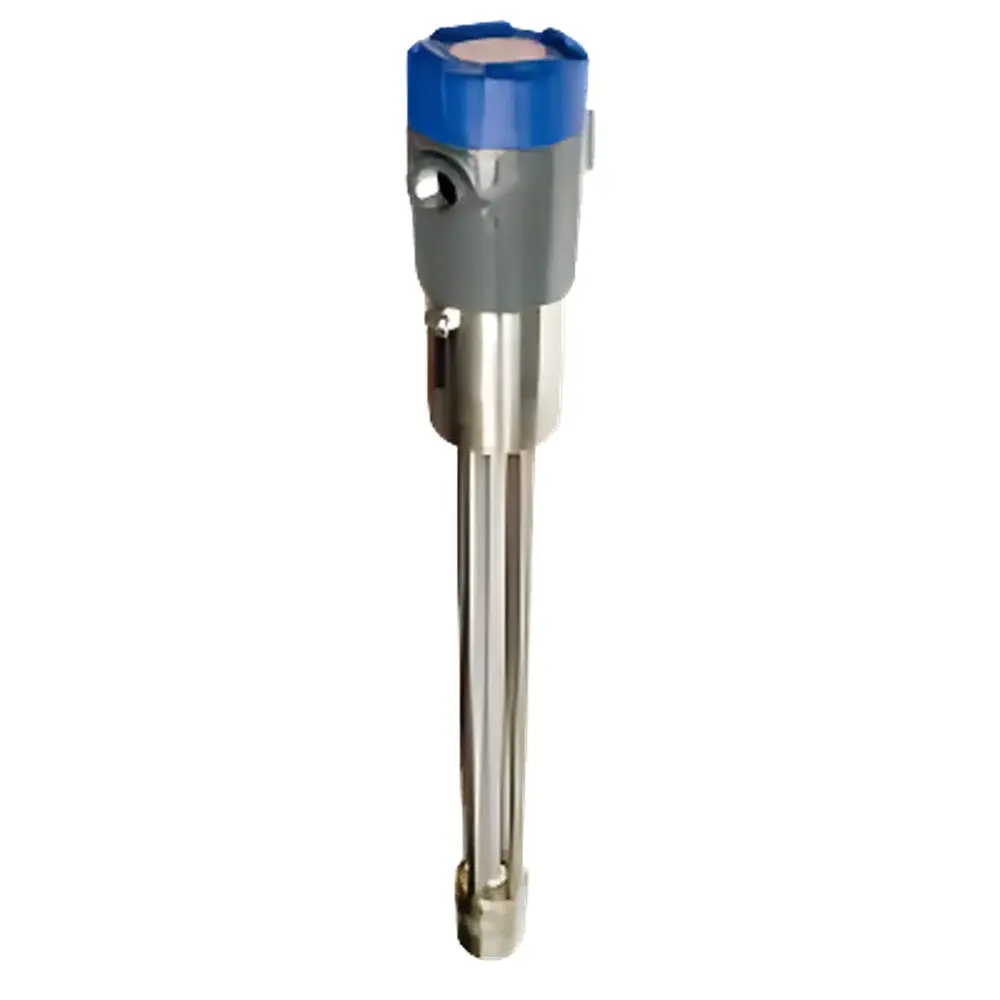
MAGNETROL Genesis™ ED1 & ED2 Series Multiphase Level Analyzer
| Brand | MAGNETROL |
|---|---|
| Model | Genesis™ ED1 & ED2 Series |
| Measurement Principle | Guided Wave Radar (GWR) Time-Domain Reflectometry (TDR) |
| Output Signals | Up to four 4–20 mA HART®-enabled analog outputs |
| Power Supply | 24 VDC loop-powered |
| Enclosure Certification | Flameproof (Ex d) and Non-incendive (Ex nA) |
| Display | Graphical LCD with 4-key keypad |
| Remote Electronics Option | Up to 30 m cable distance from probe |
| Probe Configurations | Reinforced coaxial probe or 5-rod probe |
| Compliance | IEC 61508 SIL 2 capable, ATEX, IECEx, FM, CSA certified |
Overview
The MAGNETROL Genesis™ ED1 & ED2 Series Multiphase Level Analyzer is an intrinsically robust guided wave radar (GWR) instrument engineered for continuous, high-fidelity interface level measurement in complex multiphase separation vessels. Utilizing time-domain reflectometry (TDR), the analyzer transmits low-energy electromagnetic pulses along a guided probe immersed in the process medium; reflections occur at each dielectric discontinuity—such as oil/water, water/sediment, or emulsion/upper phase interfaces—enabling precise determination of up to four distinct layer boundaries within a single vessel. Unlike conventional single-point level switches or capacitance-based systems, the Genesis™ ED1 & ED2 delivers simultaneous, independent measurements of top liquid level, emulsion layer upper boundary, aqueous phase level, and sediment accumulation—critical for real-time optimization of desalters, three-phase separators, and wash tanks in upstream, midstream, and refining operations.
Key Features
- True multiphase capability: Simultaneous detection and output of up to four discrete level interfaces using a single probe and electronics unit.
- Dual-directional signal processing: Unique algorithm architecture generates both top-down and bottom-up echo profiles, enhancing reliability in low-dielectric or highly attenuating media such as heavy crudes and viscous emulsions.
- Process-agnostic measurement: Independent of conductivity, density, viscosity, or temperature gradients—performance validated across API gravity ranges from 7° to 45° and salinities up to 300,000 ppm.
- Explosion-protected design: Certified for hazardous areas under multiple international schemes including ATEX II 1/2 G Ex d IIC T6 Gb / Ex nA IIC T6 Gc, IECEx Ex d IIC T6 Gb / Ex nA IIC T6 Gc, FM Class I Div 1 Groups B, C, D, and CSA Class I Div 1 Groups B, C, D.
- Human-centered interface: Backlit graphical LCD display with intuitive 4-key navigation enables on-site configuration, real-time echo curve visualization, damping adjustment, and layer threshold calibration without external software.
- Flexible installation architecture: Optional remote electronics housing supports separation of probe and transmitter up to 30 meters via standard RG-59 coaxial cable—reducing thermal stress exposure and simplifying maintenance in high-temperature or confined-access applications.
Sample Compatibility & Compliance
The Genesis™ ED1 & ED2 is qualified for use in hydrocarbon processing environments containing crude oil, produced water, caustic wash solutions, and stable or transient emulsions. Probe variants—including reinforced coaxial and five-rod configurations—are selected based on vessel geometry, foam tendency, and mechanical loading requirements. All units comply with IEC 61000-6-2 (immunity) and IEC 61000-6-4 (emissions), meet EMC directive 2014/30/EU, and support functional safety requirements per IEC 61508 up to SIL 2 when integrated into certified safety instrumented systems (SIS). Documentation packages include full traceable calibration records, material certifications (ASTM A182 F22, ASTM A105), and hazardous area certification summaries aligned with ISO/IEC 17065.
Software & Data Management
Configuration and diagnostics are supported via native HART® 7 protocol communication using standard handheld communicators (e.g., Rosemount 375/475) or PC-based tools compliant with HART Communication Foundation specifications. The device supports universal HART variables—including primary and secondary measured values, diagnostic status flags, and raw echo data export—and integrates seamlessly into DCS, PLC, and asset management platforms (e.g., Emerson DeltaV, Honeywell Experion, Siemens Desigo CC) via analog + digital hybrid signals. Audit trails, parameter change logs, and firmware revision history are retained onboard and accessible through HART read commands—supporting GLP/GMP-aligned operational discipline and FDA 21 CFR Part 11 compliance when deployed with validated host systems.
Applications
Primary deployment domains include electrostatic desalters requiring precise control of wash water injection and emulsion bed height; horizontal and spherical three-phase separators managing oil/water/emulsion stratification; heater treaters where sediment buildup must be monitored to prevent corrosion and fouling; and refinery wastewater equalization basins where interfacial stability impacts downstream biological treatment efficiency. Additional use cases span LNG pretreatment units (glycol/water interface), bitumen froth treatment vessels, and offshore floating production storage and offloading (FPSO) separation modules operating under dynamic motion conditions.
FAQ
Can the Genesis™ ED1 & ED2 measure emulsion layers with variable thickness and dielectric properties?
Yes—the dual-directional TDR algorithm adapts dynamically to changing reflection amplitudes and time-of-flight dispersion, enabling stable tracking of emulsion boundaries even when dielectric constant fluctuates between 2.0 and 5.5.
Is probe length customization available for tall separation vessels?
Standard probe lengths range from 1 to 12 meters; custom lengths up to 25 meters are available with engineering review for mechanical resonance and signal integrity validation.
Does the device support partial stroke testing (PST) for SIL-certified loops?
Yes—integrated diagnostics include simulated echo response verification and loop integrity checks compatible with PST routines defined in IEC 61511 Annex F.
What is the maximum process temperature rating for the coaxial probe variant?
The standard coaxial probe is rated to 200°C (392°F); high-temp versions with Inconel 600 sheathing extend operation to 315°C (600°F) with optional ceramic insulation.
How is sediment interface discrimination achieved in high-solids slurry environments?
By combining low-frequency pulse modulation (150 MHz center frequency) with adaptive noise filtering and multi-echo peak clustering algorithms, the analyzer distinguishes true sediment reflection from acoustic clutter caused by suspended solids or vessel wall echoes.