
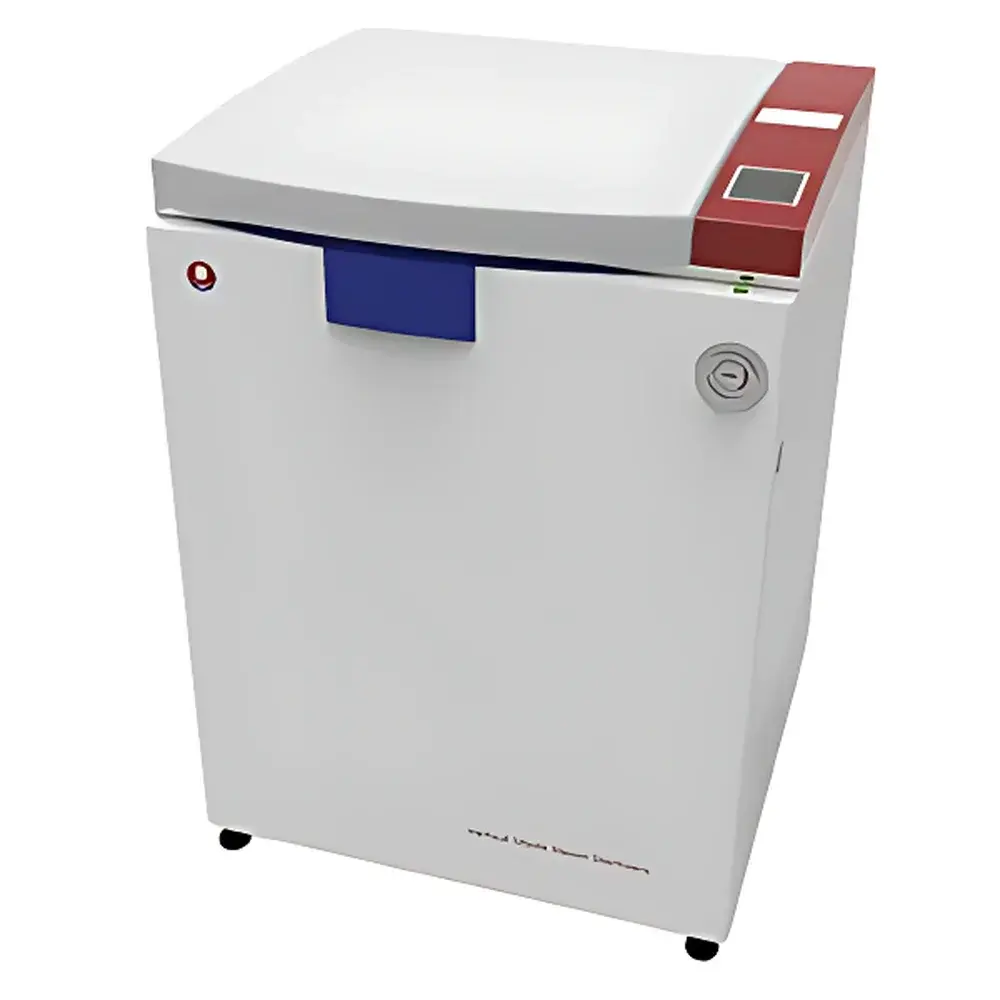
BOXUN BXM-150M Vertical Steam Sterilizer
| Brand | BOXUN |
|---|---|
| Origin | Shanghai, China |
| Manufacturer Type | Direct Manufacturer |
| Product Category | Domestic |
| Model | BXM-150M |
| Instrument Type | Vertical |
| Max Temperature | 135 °C |
| Max Working Pressure | 0.22 MPa |
| Chamber Dimensions | Ø500 × 870 mm |
| External Dimensions | 850 × 910 × 1180 mm |
| Chamber Volume | 150 L |
| Temperature Range (Sterilization) | 105–135 °C |
| Temperature Range (Drying) | 102 °C |
| Temperature Range (Melting) | 40–100 °C |
| Temperature Range (Warming/Insulation) | 25–85 °C |
| Time Range (Sterilization) | 4–120 min |
| Time Range (Drying/Melting/Insulation) | 0–999 min |
| Pre-set Delay | Up to 99 h 60 min |
| Design Pressure | 0.25 MPa |
| Drying Residual Moisture | <1% |
| Heating Power | 10.5 kW |
| Power Supply | 380 V ±38 V, 50 Hz ±1 Hz |
| Ambient Operating Conditions | 5–40 °C, 20–80% RH |
Overview
The BOXUN BXM-150M Vertical Steam Sterilizer is a fully automated, microprocessor-controlled Class B vacuum-assisted steam sterilization system engineered for reliable, repeatable terminal sterilization of heat- and moisture-stable laboratory and healthcare materials. It operates on the fundamental principle of saturated steam under controlled pressure and temperature—leveraging the lethal effect of moist heat on microbial structures including spores, viruses, and vegetative cells. Designed in accordance with ISO 17665-1:2017 (Sterilization of health care products — Moist heat — Part 1: Requirements for the development, validation and routine control of a sterilization process for medical devices), the BXM-150M supports gravity displacement and optional pulse vacuum cycles, ensuring complete air removal from porous loads and hollow instruments prior to sterilization. Its 150 L stainless steel chamber enables high-throughput processing of wrapped instruments, glassware, culture media, textiles, and biohazardous waste in research laboratories, clinical diagnostics centers, pharmaceutical QC labs, and university core facilities.
Key Features
- Double-locking automatic door mechanism combining mechanical interlock and electronic safety verification—prevents accidental opening during pressurized operation and ensures compliance with EN 61010-1 and ASME BPVC Section VIII Div. 1 safety standards.
- High-resolution capacitive touchscreen interface with intuitive icon-based navigation; supports 16 user-definable sterilization, drying, melting, and warming programs with password-protected editing and recall.
- SUS304 stainless steel sterilization chamber and four-tier perforated baskets—resistant to corrosion from repeated exposure to steam, alkalis, and acidic residues.
- Integrated cooling fan and forced-air drying system achieving residual moisture ≤1%, critical for rapid turnaround of surgical instruments and glassware.
- Dual independent water supply channels (deionized and municipal) with auto-refill detection and level monitoring; optional softener module ensures feedwater conductivity <5 µS/cm, minimizing scale formation and extending heating element life.
- C.W.S. Condensate Water Reuse System recaptures and reuses condensate for subsequent sterilization cycles—reducing water consumption by up to 30% and supporting sustainability objectives.
- W.P.S. Waste Purification System filters exhaust steam through a multi-stage activated carbon and HEPA-combined filter, removing volatile organics and particulates before atmospheric release—meeting local environmental discharge requirements.
- Standard single-point PT100 temperature probe for real-time load monitoring; optional wireless temperature sensors (validated to ±0.25 °C at 121 °C) support IQ/OQ/PQ documentation per ISO 13485 and FDA 21 CFR Part 820.
Sample Compatibility & Compliance
The BXM-150M accommodates a broad spectrum of load types: solid instruments, wrapped packs, porous materials (e.g., gauze, linen), liquid media (with anti-boil-over programming), and regulated biohazard waste (Category A/B). Chamber geometry (Ø500 × 870 mm) allows vertical stacking of standard autoclave trays and compatibility with common ISO 11140-compliant chemical indicators. All sterilization cycles are traceable via internal audit log (≥10,000 event records) with time-stamped entries for temperature, pressure, phase duration, and fault codes. Data export is supported via USB 2.0 port in CSV format, enabling integration into LIMS or electronic quality management systems (eQMS). The system meets essential requirements of the EU Medical Device Regulation (MDR 2017/745) Annex I, and its validation protocol aligns with ISO 11135 (for ethylene oxide) and ISO 11137 (for radiation)—though it is primarily deployed for steam-based modalities.
Software & Data Management
Firmware v3.2 includes embedded data logging with non-volatile memory retention for ≥10 years without power. Each cycle generates a unique identifier, recording start/end timestamps, setpoints, actual profiles, alarm triggers, and operator ID (if networked). Exported datasets include full thermobaric curves synchronized to millisecond resolution—enabling statistical process control (SPC) analysis and root-cause investigation. Optional thermal printer (Epson or domestic thermal ribbon) provides immediate hardcopy output compliant with ALCOA+ principles (Attributable, Legible, Contemporaneous, Original, Accurate, Complete, Consistent, Enduring, Available). For regulated environments, optional 21 CFR Part 11-compliant software add-ons provide electronic signatures, role-based access control, and immutable audit trails—fully compatible with GxP-aligned quality systems.
Applications
- Routine sterilization of reusable surgical tools, pipette tips, and centrifuge tubes in hospital central sterile supply departments (CSSD).
- Preparation and sterilization of agar, broth, and selective media in microbiology and molecular biology laboratories.
- Decontamination of animal bedding, cage components, and necropsy instruments in AAALAC-accredited vivaria.
- Validation of sterilization parameters for ISO 13485-certified medical device manufacturers performing in-house bioburden reduction.
- Processing of BSL-2/BSL-3 waste streams prior to off-site incineration or landfill disposal—documented per CDC/NIH Biosafety in Microbiological and Biomedical Laboratories (BMBL) guidelines.
FAQ
What is the maximum allowable load weight per cycle?
The chamber supports up to 120 kg of uniformly distributed load, assuming proper basket loading and steam penetration pathways.
Does the BXM-150M support vacuum-assisted air removal?
Yes—it offers programmable pulse vacuum cycles (2–99 pulses) with adjustable vacuum depth and hold time, meeting EN 285 requirements for porous load sterilization.
Can the unit be integrated into a building management system (BMS)?
Optional RS485 Modbus RTU interface enables remote status monitoring, cycle initiation, and alarm relay outputs—compatible with most industrial SCADA platforms.
Is third-party validation support available?
BOXUN provides IQ/OQ documentation templates and collaborates with certified validation partners to execute installation, operational, and performance qualification protocols per ISO/IEC 17025.
What maintenance intervals are recommended?
Daily: Chamber wipe-down and door gasket inspection. Quarterly: Safety valve calibration, vacuum pump oil change, and filter replacement. Annually: Full thermocouple and pressure transducer calibration by accredited metrology lab.



