
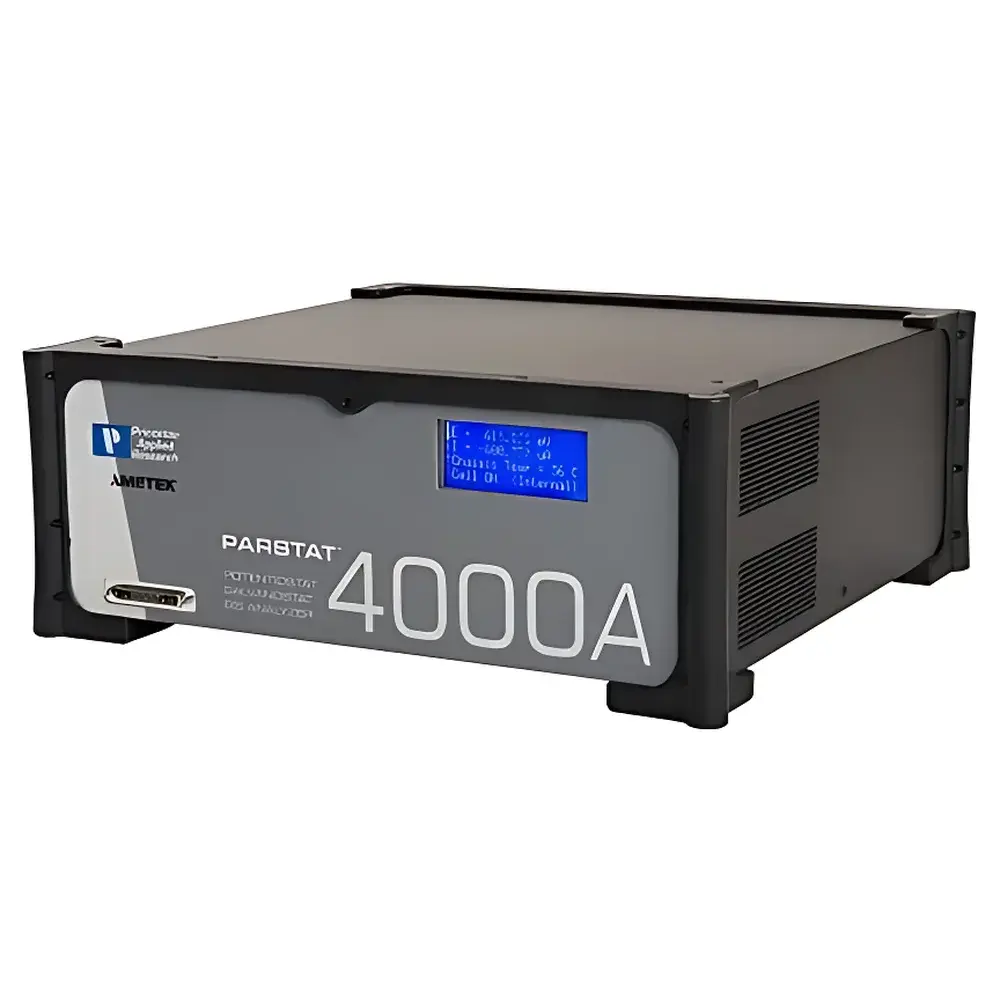
Princeton Applied Research PARSTAT 4000A Electrochemical Workstation
| Brand | Princeton Applied Research |
|---|---|
| Origin | USA |
| Model | PARSTAT 4000A |
| Channel Count | Single-Channel |
| Current Range | ±4 A (expandable to ±20 A) |
| Current Accuracy | ±0.2% |
| Potential Accuracy | ±0.2% |
| Potentiostatic Range | ±10 V |
| Galvanostatic Range | ±4 A |
| Maximum Cell Voltage | ±48 V |
| Minimum Current Range | 40 pA (optional low-current module: 80 fA) |
| Current Resolution | 1.2 fA (optional: 2.5 aA) |
| EIS Frequency Range | 10 µHz – 10 MHz |
| Sampling Rate | 1 µs |
| Onboard Memory | 4 MB |
| Input Impedance | >10¹³ Ω |
| Grounding Mode | Floating (isolated ground) |
Overview
The Princeton Applied Research PARSTAT 4000A Electrochemical Workstation is a research-grade, single-channel potentiostat/galvanostat/FRA system engineered for precision, stability, and broad-spectrum electrochemical characterization. Built upon five decades of expertise in electrochemical instrumentation design, the PARSTAT 4000A implements a true analog front-end architecture with ultra-low-noise current measurement circuitry, high-voltage compliance, and real-time digital signal processing. Its core measurement principle relies on controlled-potential (potentiostatic) and controlled-current (galvanostatic) techniques, coupled with frequency-domain analysis via integrated Fast Fourier Transform (FFT)-based impedance spectroscopy. The system is optimized for demanding applications where high dynamic range, sub-femtoampere resolution, microsecond temporal fidelity, and galvanic isolation are essential—particularly in corrosion science, battery electrode kinetics, fuel cell membrane characterization, biosensor development, and nanoscale electrochemical deposition.
Key Features
- ±48 V maximum cell voltage enables stable polarization of high-impedance systems—including coated metals, concrete-embedded rebar, soil-electrolyte interfaces, and polymer electrolytes—without signal distortion or compliance limitation.
- Standard ±4 A current output (expandable to ±20 A with external amplifier) supports both macro-scale energy device testing and microelectrode-based kinetic studies across ten auto-ranging current spans (40 pA to 20 A).
- Baseline current resolution of 1.2 fA; optional low-current module achieves 2.5 aA resolution with adaptive filtering, critical for evaluating passive film growth, microporous coating integrity, and single-nanowire charge transfer.
- Integrated Frequency Response Analyzer (FRA) delivers electrochemical impedance spectroscopy (EIS) from 10 µHz to 10 MHz, covering diffusion-limited, charge-transfer, and dielectric relaxation processes across diverse time constants.
- 1 µs per-point sampling rate with 4 MB onboard buffer ensures lossless acquisition during transient events—even under intermittent host PC communication—enabling reliable pulse voltammetry, GSM/CDMA battery discharge profiling, and fast-scan cyclic voltammetry.
- Floating (isolated) ground architecture eliminates ground-loop artifacts when measuring grounded samples such as pressurized autoclaves, reinforced concrete structures, or industrial pipelines, ensuring measurement integrity in field-representative configurations.
Sample Compatibility & Compliance
The PARSTAT 4000A accommodates a wide variety of electrochemical cells—from standard three-electrode beaker setups and rotating disk electrodes (RDE) to custom-built high-pressure/high-temperature reactors and microfluidic sensor platforms. Its >10¹³ Ω input impedance and low-bias current design preserve signal fidelity for insulating substrates, thin-film coatings, and biological interfaces. The system complies with key international standards relevant to electrochemical testing, including ASTM G5/G59/G102 (corrosion), ASTM F2942 (battery impedance), ISO 16773 (coating evaluation), and USP (electrochemical sensor validation). Data acquisition and instrument control meet GLP/GMP-aligned traceability requirements, with optional audit trail logging compatible with FDA 21 CFR Part 11–compliant software environments.
Software & Data Management
Studio software—supplied standard with the PARSTAT 4000A—provides a modular, scriptable interface for experiment design, real-time visualization, and post-acquisition modeling. It includes preconfigured methods for linear polarization resistance (LPR), Tafel extrapolation, electrochemical noise analysis (ENA), cyclic voltammetry (CV), chronoamperometry (CA), and multi-sine EIS. Equivalent circuit fitting tools support nonlinear least-squares regression using Randles, Voigt, and distributed element models. All raw data are stored in vendor-neutral binary format with embedded metadata (timestamp, parameter set, hardware configuration), enabling reproducible reprocessing and third-party interoperability. Batch sequence execution, external trigger synchronization (TTL/Analog), and delayed-start protocols facilitate unattended long-term monitoring—critical for corrosion aging studies or battery cycle-life validation.
Applications
- Corrosion Science: Quantification of corrosion rate, polarization resistance (Rp), and coating defect density via LPR, EIS, and zero-resistance ammeter (ZRA) coupling; evaluation of inhibitor efficiency under variable pH, temperature, and chloride concentration.
- Battery & Energy Storage: In situ EIS of Li-ion, Na-ion, and solid-state batteries across state-of-charge; galvanostatic intermittent titration technique (GITT); differential capacity analysis (dQ/dV); pulse discharge profiling under telecom load profiles.
- Fuel Cells & Photovoltaics: I-V curve acquisition for PEMFC/SOFC performance mapping; humidity-dependent membrane resistance tracking; photovoltaic quantum efficiency and fill-factor determination.
- Sensors & Biosensors: Amperometric detection at pA–fA levels; redox cycling at microelectrodes; impedance-based label-free biomolecular binding assays; stability assessment of enzyme-modified electrodes.
- Nanomaterials & Deposition: Controlled potential nucleation and growth of graphene, carbon nanotubes, and atomic-layer metal films; scanning electrochemical microscopy (SECM) probe calibration; single-entity collision electrochemistry.
FAQ
What is the maximum achievable current resolution with the optional low-current module?
The optional low-current module provides a minimum current range of 80 fA and a resolution of 2.5 aA under optimized filtering and shielding conditions.
Does the PARSTAT 4000A support simultaneous multi-frequency EIS?
Yes—the integrated FRA supports multi-sine EIS acquisition, enabling rapid spectral capture without sequential frequency stepping.
Can the system perform galvanostatic EIS on battery electrodes?
Yes—galvanostatic EIS mode is fully supported, including current-controlled perturbation superimposed on constant DC bias for anode/cathode half-cell characterization.
Is Studio software compatible with automated laboratory workflows?
Yes—Studio supports COM automation, Python API integration, and LabVIEW drivers for incorporation into centralized test management systems.
How does the floating ground capability improve measurement reliability in corrosion testing?
It eliminates ground-loop-induced noise and common-mode interference when the working electrode or cell body is physically bonded to earth-referenced infrastructure—such as reinforced concrete or pipeline steel—ensuring accurate potential control and current measurement.






