
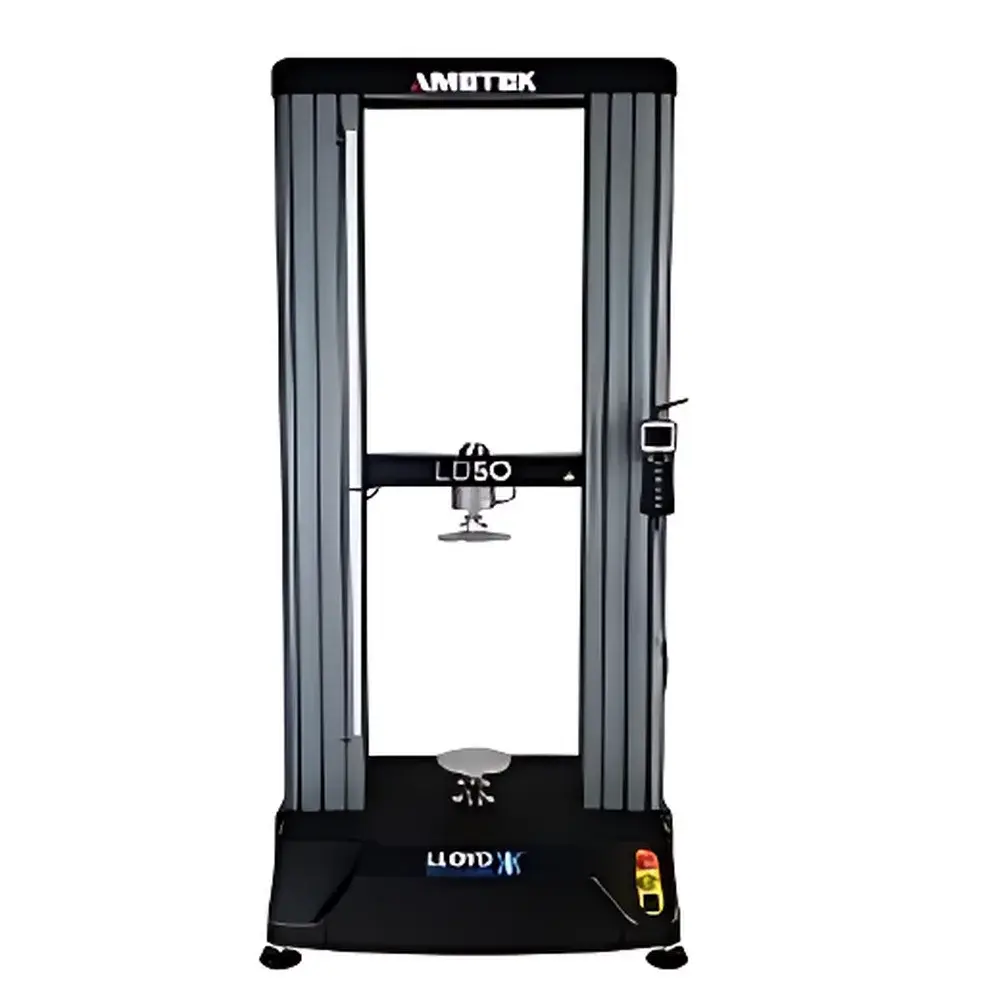
Lloyd Instruments LD50 Dual-Column Universal Testing Machine
| Brand | Lloyd Instruments |
|---|---|
| Origin | USA |
| Model | LD50 |
| Maximum Load Capacity | 50 kN (11,240 lbf) |
| Column Spacing | 452 mm (17.8 in) |
| Crosshead Travel (Standard) | 1070 mm (42 in) |
| Crosshead Travel (Extended) | 1669 mm (65.7 in) |
| Drive System | AC Servo Motor with Preloaded Ball Screw |
| Load Cell Type | Interchangeable Spoke-Type Load Cells |
| Compliance | CE Marked |
| Software | NEXYGENPlus with Built-in Standards Library |
| Instrument Type | Electromechanical Universal Testing Machine |
Overview
The Lloyd Instruments LD50 Dual-Column Universal Testing Machine is an electromechanical materials testing system engineered for precision, repeatability, and long-term stability in demanding mechanical property evaluation environments. Operating on the fundamental principle of controlled force application and displacement measurement under closed-loop servo control, the LD50 delivers high-fidelity tensile, compression, flexure, peel, shear, and cyclic loading data across a broad range of engineering materials—including metals, polymers, composites, elastomers, adhesives, textiles, and biomedical specimens. Its dual-column architecture provides superior rigidity and lateral stability, minimizing parasitic bending moments during off-axis loading or large-sample deformation. Designed and manufactured in the United States, the LD50 conforms to CE safety directives and meets structural integrity requirements defined in ISO 7500-1 (Class 0.5 accuracy) and ASTM E4 for verification of force-measuring systems.
Key Features
- Dual-column steel frame with 452 mm (17.8 in) column spacing—optimized for large-format or multi-gauge specimens and modular fixture integration.
- High-stiffness crosshead guided by precision linear bearings and preloaded ball screws, ensuring axial alignment and sub-micron positional reproducibility over full travel (1070 mm standard; 1669 mm extended option).
- AC servo-driven actuation system delivering smooth, low-noise motion with programmable speed ranges from 0.001 to 2000 mm/min—enabling quasi-static through high-rate mechanical characterization.
- Interchangeable spoke-type load cells calibrated to ±0.5% of reading across their full range, supporting traceable force measurement from 0.5% to 100% of capacity (50 kN maximum).
- Integrated overload protection, emergency stop circuitry, and hardware-based safety interlocks compliant with EN ISO 13857 and EN 60204-1.
- Modular electronics architecture allowing seamless upgrades to advanced sensors (e.g., extensometers, video strain systems) and auxiliary modules (e.g., environmental chambers, hydraulic grips).
Sample Compatibility & Compliance
The LD50 accommodates specimens up to 450 mm wide and 1070 mm tall (standard configuration), making it suitable for standardized test specimens per ASTM D638, ISO 527, ASTM D790, ISO 178, ASTM D1876, ISO 11339, and EN 14410. Its open-access design facilitates rapid tooling changes using T-slot bases and quick-release grip systems. All mechanical components are constructed from stress-relieved, anodized aluminum and hardened steel to ensure dimensional stability under thermal drift and mechanical fatigue. The system is CE-marked and designed to support GLP/GMP-regulated workflows—full audit trail logging, user access controls, and electronic signature capability are available via optional NEXYGENPlus validation packages aligned with FDA 21 CFR Part 11 requirements.
Software & Data Management
NEXYGENPlus software serves as the central interface for test definition, execution, real-time monitoring, and post-processing. It includes over 120 preconfigured test methods mapped directly to international standards (ASTM, ISO, DIN, JIS, BS), eliminating manual parameter entry errors. Users may define custom multi-step protocols—including ramp-hold-relax cycles, staircase loading, and conditional branching based on force/displacement thresholds. Raw data streams (force, displacement, time, extensometer strain) are recorded at up to 10 kHz and exported natively to CSV, XML, or proprietary .nxd format. Direct export to Microsoft Excel and Word templates enables automated report generation within enterprise documentation frameworks. All data files include embedded metadata (operator ID, calibration date, environmental conditions) and support digital signature workflows for regulatory submissions.
Applications
The LD50 supports routine QC verification in manufacturing (e.g., weld strength, packaging seal integrity, fastener torque-tension correlation), R&D material development (e.g., stress–strain curve derivation, modulus calculation, yield point determination), and regulatory compliance testing (e.g., medical device pull strength per ISO 11607, automotive gasket compression set per SAE J2238). Its extended travel option enables full-thickness testing of structural composites and civil engineering specimens such as reinforced concrete beams or asphalt cores. With optional accessories—including pneumatic wedge grips, compression platens with self-aligning features, and environmental chambers operating from −70 °C to +250 °C—the LD50 functions as a platform for accelerated aging studies, temperature-dependent mechanical behavior analysis, and long-term creep/relaxation profiling.
FAQ
What is the maximum load capacity of the LD50 model?
The LD50 is rated for a maximum static load of 50 kN (11,240 lbf), verified per ISO 7500-1 Class 0.5 accuracy requirements.
Does the LD50 support automated test sequencing?
Yes—NEXYGENPlus enables fully automated multi-specimen test sequences with automatic grip positioning, load cell zeroing, and pass/fail logic based on user-defined acceptance criteria.
Can the LD50 be integrated into a networked laboratory information management system (LIMS)?
Yes—via TCP/IP communication and configurable API endpoints, the LD50 supports bidirectional data exchange with validated LIMS platforms for sample tracking, result ingestion, and audit trail synchronization.
Is third-party calibration certification included with purchase?
Each LD50 ships with a UKAS-accredited certificate of conformance for force and displacement channels, traceable to NIST and PTB primary standards.
What maintenance intervals are recommended for routine operation?
Lloyd Instruments recommends biannual inspection of drive train lubrication, ball screw preload, and load cell mounting integrity—detailed in the maintenance logbook supplied with each system.



