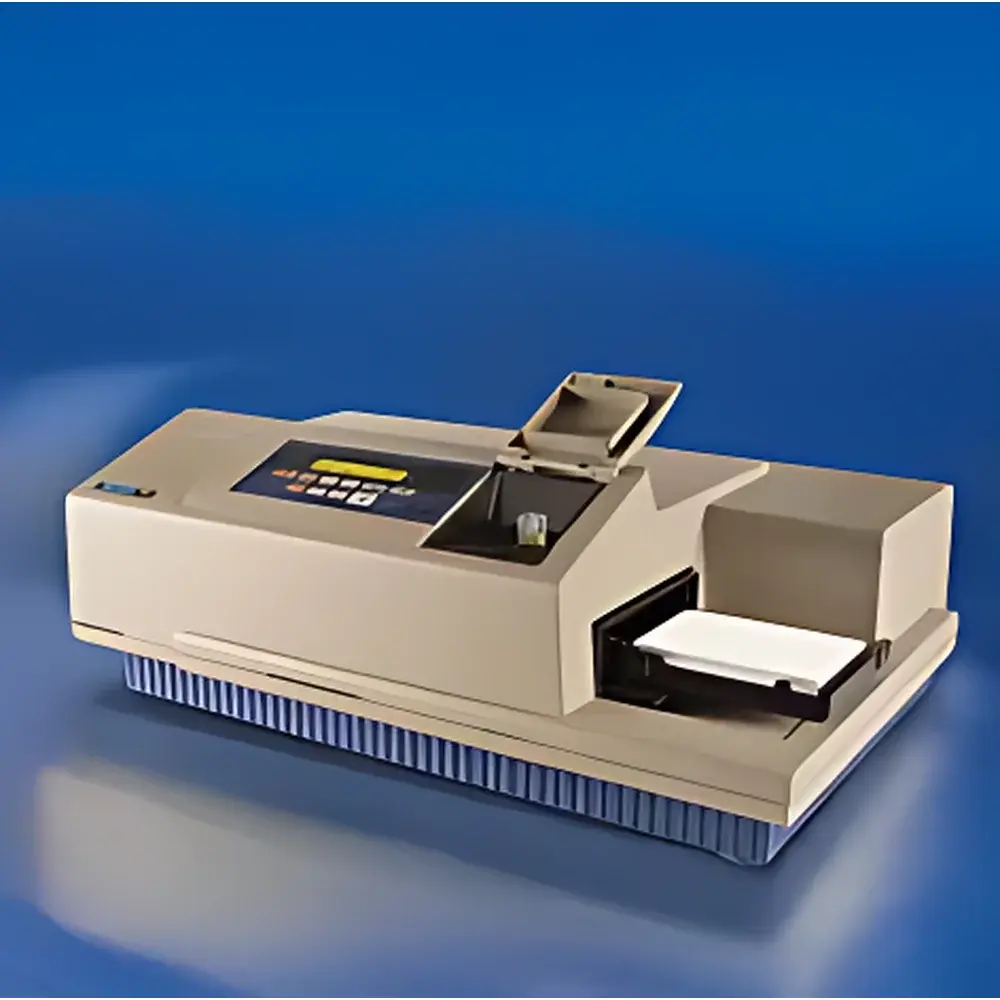
Molecular Devices SpectraMax® M3 Multi-Mode Microplate Reader
| Brand | Molecular Devices |
|---|---|
| Origin | USA |
| Manufacturer Type | Original Equipment Manufacturer (OEM) |
| Import Status | Imported |
| Model | SpectraMax® M3 |
| Functionality | Multi-Mode |
| Automation Level | Fully Automated |
| Assay Modes | Endpoint, Kinetic, Full-Wavelength Scanning, Well-Scan (Single-Well Point Scan) |
| Curve Fitting | SoftMax Pro Software (Supports 4PL, 5PL, Linear, Log-Log, Exponential, and Custom Equations) |
| Detectors | Dual Photomultiplier Tubes (PMTs) + Four Silicon Photodiodes |
| Wavelength Range | 200–1000 nm (Abs) |
| Absorbance Range | 0–4 OD |
| Absorbance Linearity | 0–3 OD (R² ≥ 0.999) |
| Read Time per 96-Well Plate | ≤18 sec |
| Absorbance Precision | < ±0.006 OD |
Overview
The Molecular Devices SpectraMax® M3 Multi-Mode Microplate Reader is an engineered platform for quantitative biochemical and cellular assay measurement across absorbance (UV-Vis), fluorescence intensity (FI), and luminescence (Lum) detection modalities. Built upon a dual-grating monochromator architecture, it delivers continuous spectral selection from 200 to 1000 nm without reliance on discrete filter sets—enabling method flexibility, rapid protocol development, and long-term cost efficiency. Its optical design incorporates reference photodiodes for real-time excitation source normalization, angled emission optics to suppress stray light in narrow-Stokes-shift assays (e.g., TR-FRET), elliptical mirror-based light collection for minimal chromatic aberration, and UV-transmitting fused silica fiber optics to preserve throughput at short wavelengths. The instrument supports standard microplate formats (6–384-well), cuvette-based measurements via integrated sample chamber, and optional accessories including the SpectraDrop™ ultra-low-volume plate (2 µL/well, 24- or 64-sample capacity) and StakMax™ automated stacker (up to 50 plates with barcode support). Designed for research laboratories, core facilities, and regulated environments, the SpectraMax M3 balances high-fidelity data acquisition with operational robustness and compliance-ready software infrastructure.
Key Features
- Dual-grating monochromator system enabling continuous wavelength selection at 1 nm increments (200–1000 nm for absorbance; 250–850 nm for FI/Lum)
- Hybrid detection architecture: two high-sensitivity photomultiplier tubes (PMTs) for low-light luminescence and fluorescence, plus four calibrated silicon photodiodes optimized for absorbance linearity and dynamic range
- Integrated cuvette port supporting absorbance, FI, and Lum measurements in standard 1 cm pathlength cuvettes
- Advanced thermal control using Virtual Cover™ technology: maintains precise, uniform temperature (ambient to 45°C) across the microplate chamber without physical lid contact
- Sub-18-second read time for full 96-well plates in endpoint mode, scalable to kinetic and spectral scanning protocols
- Optical validation suite: ABS1 (absorbance), FL1 (fluorescence), and LM1 (luminescence) verification plates included for routine performance qualification
- IQ/OQ documentation packages and SpectraTest™ calibration standards compliant with ISO/IEC 17025 and ASTM E2923 guidelines
Sample Compatibility & Compliance
The SpectraMax M3 accommodates all standard microplate geometries—including flat-bottom, round-bottom, and V-bottom plates—as well as opaque, clear, and black-walled configurations for optimal signal discrimination in heterogeneous assays. Its cuvette port accepts standard 12.5 × 12.5 mm square cuvettes, facilitating direct comparison between plate- and tube-based assays. Regulatory compliance is embedded at both hardware and software levels: SoftMax Pro GxP Edition provides full audit trail, role-based user permissions, electronic signatures, and 21 CFR Part 11–compliant data integrity controls—including immutable experiment logs, versioned protocol storage, and exportable PDF/e-signature reports. Instrument qualification follows vendor-supplied IQ/OQ protocols aligned with GMP/GLP expectations, while optical verification adheres to ASTM E2923-18 (Standard Practice for Verification of Microplate Readers). The system is validated for use in applications requiring traceable metrology, including ELISA, enzyme kinetics, cytotoxicity screening, and ADME/PK profiling.
Software & Data Management
SoftMax Pro software serves as the unified interface for instrument control, data acquisition, analysis, and reporting. It includes over 140 pre-validated assay templates—covering ELISA, BCA, Bradford, GFP expression, luciferase reporter assays, HTRF®, LanthaScreen™ TR-FRET, and IC₅₀/LD₅₀ dose-response modeling—with customizable curve-fitting algorithms (4-parameter logistic, 5PL, linear regression, log-log, exponential decay). Data visualization tools support multi-plate overlays, heatmaps, kinetic traces, and publication-ready graph generation. For enterprise integration, SoftMax Pro offers native drivers for major LIMS platforms (e.g., LabVantage, Thermo Fisher SampleManager) and robotic workcells (Tecan, Hamilton, Agilent). All raw data are stored in vendor-neutral .smv format, with metadata-enriched exports to CSV, Excel, and XML. The GxP-compliant module enforces ALCOA+ principles (Attributable, Legible, Contemporaneous, Original, Accurate, Complete, Consistent, Enduring, Available) throughout the data lifecycle.
Applications
The SpectraMax M3 supports a broad spectrum of life science workflows: quantitative immunoassays (endpoint and kinetic ELISA/EIA), enzymatic activity profiling (e.g., kinase, protease, phosphatase assays), cell viability and cytotoxicity assessment (MTT, XTT, ATP-luciferase), microbial growth and minimum inhibitory concentration (MIC) determination, nucleic acid and protein quantification (A₂₆₀/A₂₈₀), green fluorescent protein (GFP) and other fluorescent reporter monitoring, transcriptional activation studies (luciferase, β-galactosidase), membrane permeability assays (e.g., PAMPA), and early-stage ADME/toxicology screening (CYP inhibition, transporter assays). Its spectral flexibility and low-volume capability also enable label-free protein conformation studies and high-content secondary screening in academic and pharmaceutical discovery settings.
FAQ
Does the SpectraMax M3 support TR-FRET and HTRF assays?
Yes—the instrument’s dual-PMT detection, adjustable excitation/emission bandwidths, and optimized optical path (including angled emission geometry) provide high signal-to-noise ratios essential for time-resolved FRET applications such as Cisbio HTRF and Life Technologies LanthaScreen.
Can I perform kinetic measurements across multiple plates?
Yes—SoftMax Pro supports inter-plate kinetic scheduling, enabling staggered initiation and synchronized data collection across up to 50 plates when integrated with StakMax.
Is the SpectraDrop ultra-low-volume plate compatible with all detection modes?
SpectraDrop is validated for absorbance and fluorescence intensity measurements; luminescence compatibility requires configuration-specific optimization due to reduced pathlength and surface effects.
What validation documentation is provided for FDA-regulated environments?
Molecular Devices supplies IQ/OQ protocols, SpectraTest optical verification kits (ABS1/FL1/LM1), SoftMax Pro GxP validation package, and 21 CFR Part 11 implementation guidance—all aligned with industry best practices for analytical instrument qualification.
How does the Virtual Cover temperature control differ from conventional heated lids?
Virtual Cover uses infrared sensors and predictive thermal modeling to maintain setpoint temperature without physical contact—eliminating condensation, evaporation artifacts, and plate deformation risks associated with mechanical lids.
Related Products