
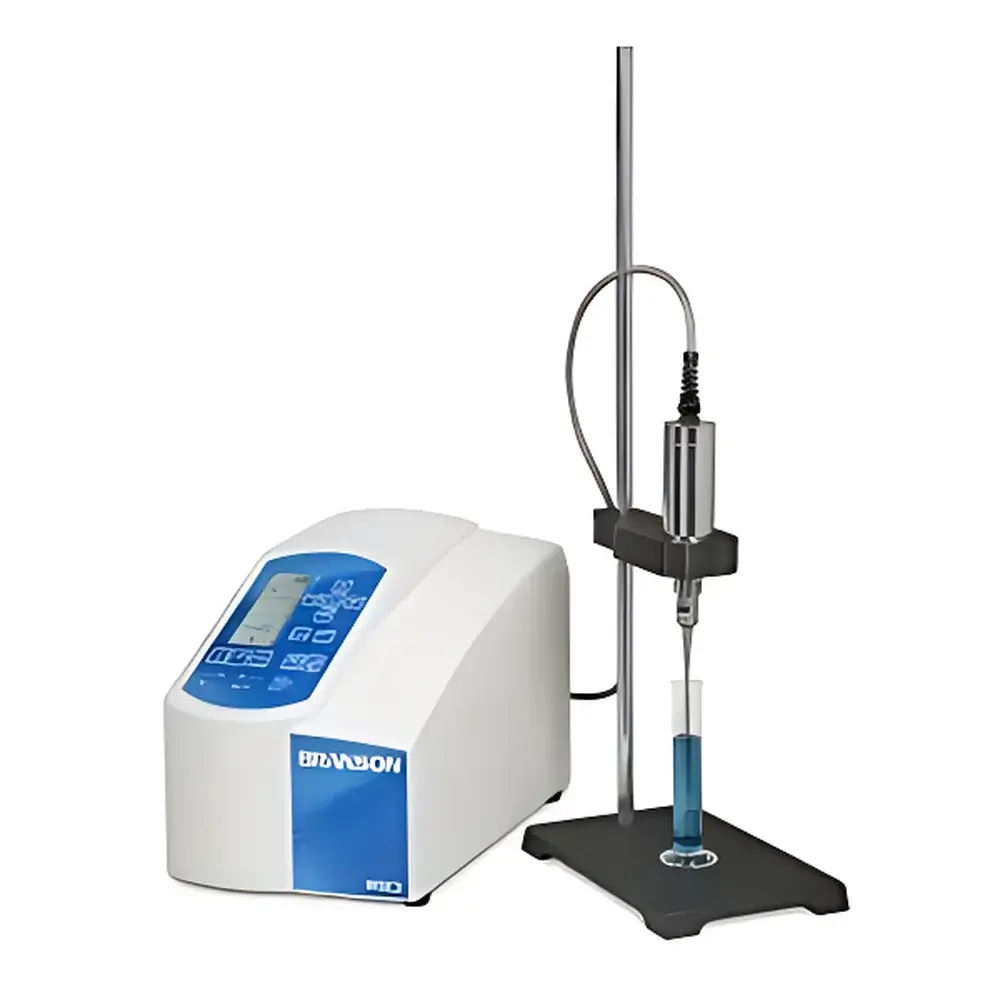
Branson Sonifier SFX150 Ultrasonic Cell Disruptor
| Brand | Branson |
|---|---|
| Origin | Mexico |
| Manufacturer Type | Authorized Distributor |
| Import Status | Imported |
| Model | SFX150 |
| Instrument Type | Ultrasonic Cell Disruptor |
| Maximum Output Power | 150 W |
| Operating Frequency | 40 kHz |
| Sample Volume Range | 0.1–150 mL |
| Pulse Duration Resolution | 0.01 s |
| Amplitude Adjustment Range | 10–100% |
| Programmable Methods | 20 user-defined protocols |
| Energy Control Range | 1–999,999 J |
| Time Control Range | 0.01 s to 99 h 59 min 59 s |
| Input Voltage | AC 200–240 V, 50/60 Hz |
| Standard Probe | 3 mm (1/8″) titanium alloy (Ti-7Al-4V) |
| Dimensions (W×D×H) | 348 × 203 × 242 mm |
| Weight | 6.35 kg |
Overview
The Branson Sonifier® SFX150 is a digitally controlled, benchtop ultrasonic cell disruptor engineered for reproducible lysis, homogenization, and particle size reduction in life science laboratories. It operates on the principle of high-intensity ultrasonic cavitation: an electrical signal drives a piezoelectric transducer to generate mechanical vibrations at 40 kHz, which are transmitted through a titanium alloy probe into liquid samples. This induces rapid formation and collapse of microscopic vapor cavities—releasing localized shockwaves, microstreaming, and shear forces sufficient to disrupt cellular membranes, solubilize inclusion bodies, fragment chromatin, or disperse nanoparticles. Designed for volumes between 0.1 mL and 150 mL, the SFX150 delivers precise energy delivery without requiring external cooling or acoustic enclosures under standard ambient conditions—enabled by its high-efficiency vertical transducer architecture and low-heat-generation design.
Key Features
- Digital amplitude control (10–100%) with real-time feedback ensures consistent mechanical energy transfer across replicates.
- Three independent operational modes: time-controlled, energy-controlled (Joules), and temperature-controlled (requires optional temperature probe)—each supporting programmable pulse-on/pulse-off sequences.
- High-resolution timing capability down to 0.01-second pulses enables fine-tuned optimization for heat-sensitive biomolecules such as antibodies, enzymes, or RNA.
- Integrated process monitoring displays real-time output power (W), cumulative energy (J), elapsed time, and (when equipped) sample temperature—supporting traceable experimental documentation.
- 20 programmable method slots allow storage of validated protocols—including amplitude, duty cycle, total duration, and mode selection—for rapid recall and inter-laboratory method transfer.
- Standard 3 mm (1/8″) titanium alloy probe (Grade Ti-7Al-4V) provides corrosion resistance and mechanical durability; optional probe diameters (2 mm, 6 mm, 13 mm) and accessories (cup horns, microtips, rack adapters) extend application flexibility.
Sample Compatibility & Compliance
The SFX150 accommodates a broad range of biological matrices—including bacterial cultures (E. coli, Bacillus), yeast, mammalian cells (HEK293, CHO), plant tissues, and subcellular fractions—without compromising integrity of downstream analytes. Its energy-based control architecture supports compliance with GLP and GMP-aligned workflows where parameter traceability is required. While the instrument itself does not carry FDA 21 CFR Part 11 certification, its programmable protocol storage, timestamped energy logging, and user-accessible audit trail (via USB export of run logs) facilitate alignment with ISO/IEC 17025, USP <1058>, and ASTM E2500-22 guidance for analytical instrument qualification. Optional temperature probes enable adherence to thermal stability criteria defined in ICH Q5C for protein therapeutics.
Software & Data Management
The SFX150 features an embedded microcontroller with a graphical LCD interface and tactile membrane keypad—designed for glove-compatible, error-resistant operation in biosafety cabinets or laminar flow hoods. All parameters are displayed in SI units with immediate visual confirmation of settings prior to activation. Run data—including start/stop timestamps, total energy delivered, average power, and (if enabled) peak temperature—is stored internally and exportable via USB flash drive in CSV format for integration into LIMS or electronic lab notebooks (ELN). No proprietary software installation is required; exported files are compatible with common statistical analysis platforms (e.g., GraphPad Prism, JMP, Python pandas).
Applications
- Cell lysis for recombinant protein extraction from E. coli inclusion bodies, with reduced aggregation versus mechanical bead-beating.
- Chromatin shearing for ChIP-seq library preparation, achieving narrow fragment size distributions (200–500 bp) under temperature-controlled pulsing.
- Nanoparticle dispersion in drug delivery formulations, including liposomes and polymeric micelles.
- RNA isolation from fibrous or lipid-rich tissues (e.g., brain, adipose), minimizing RNase activation via sub-ambient temperature maintenance.
- Preparation of antigenic lysates for monoclonal antibody development, preserving epitope conformation through low-thermal-stress sonication.
- Microbial inactivation studies requiring calibrated ultrasonic dose delivery (J/mL) for kinetic modeling.
FAQ
Is the SFX150 compliant with electromagnetic compatibility (EMC) standards for laboratory use?
Yes—the instrument meets IEC 61326-1:2013 Class A requirements for electromagnetic emissions and immunity, suitable for shared research facility environments.
Can the SFX150 be integrated into automated liquid handling workflows?
It does not feature RS-232, Ethernet, or digital I/O ports; however, its repeatable manual triggering and protocol recall support semi-automated batch processing when paired with programmable stage controllers or timed incubation systems.
What is the expected service life of the standard 3 mm probe under typical usage?
With proper load matching, amplitude limitation (<80%), and avoidance of dry-sonication, the Ti-7Al-4V probe typically exceeds 1,000 hours of operational lifetime before measurable tip erosion affects performance.
Does Branson provide IQ/OQ documentation templates for the SFX150?
Yes—Branson offers downloadable qualification templates aligned with ASTM E2500-22, including test protocols for amplitude linearity verification, energy delivery accuracy (±3% full scale), and temperature probe calibration traceability.
Is the SFX150 suitable for processing hazardous or BSL-2+ agents?
When used with sealed microtubes or cup-horn adapters inside a certified biosafety cabinet, it complies with CDC/NIH Biosafety in Microbiological and Biomedical Laboratories (BMBL) 6th edition recommendations for aerosol containment during sonication of pathogenic material.
Related Products





