
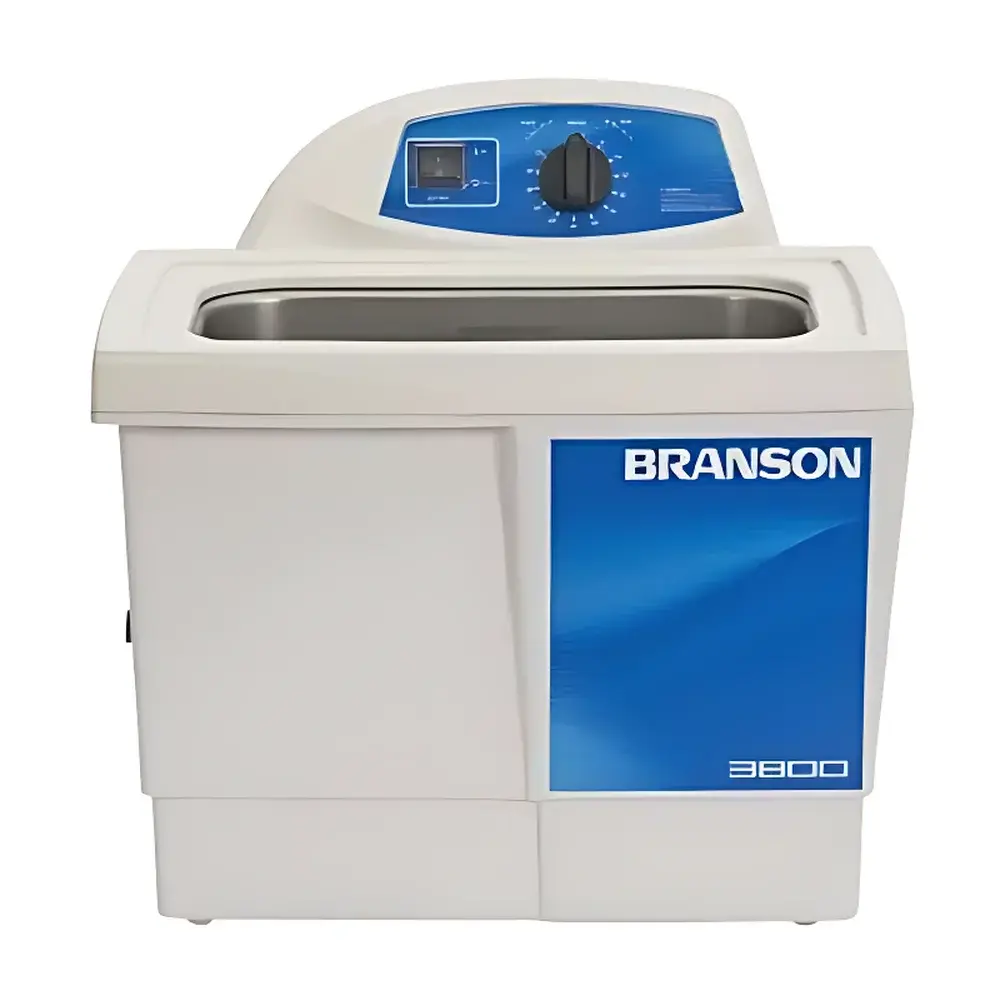
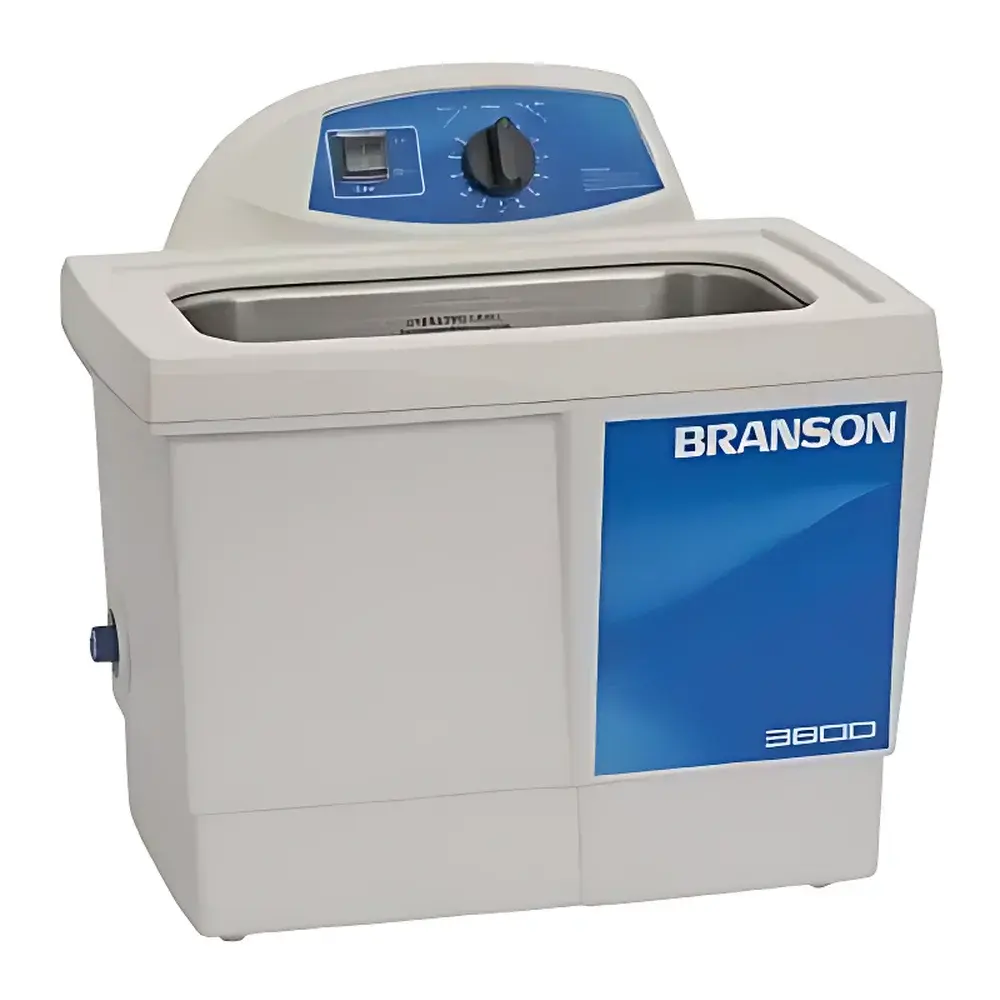
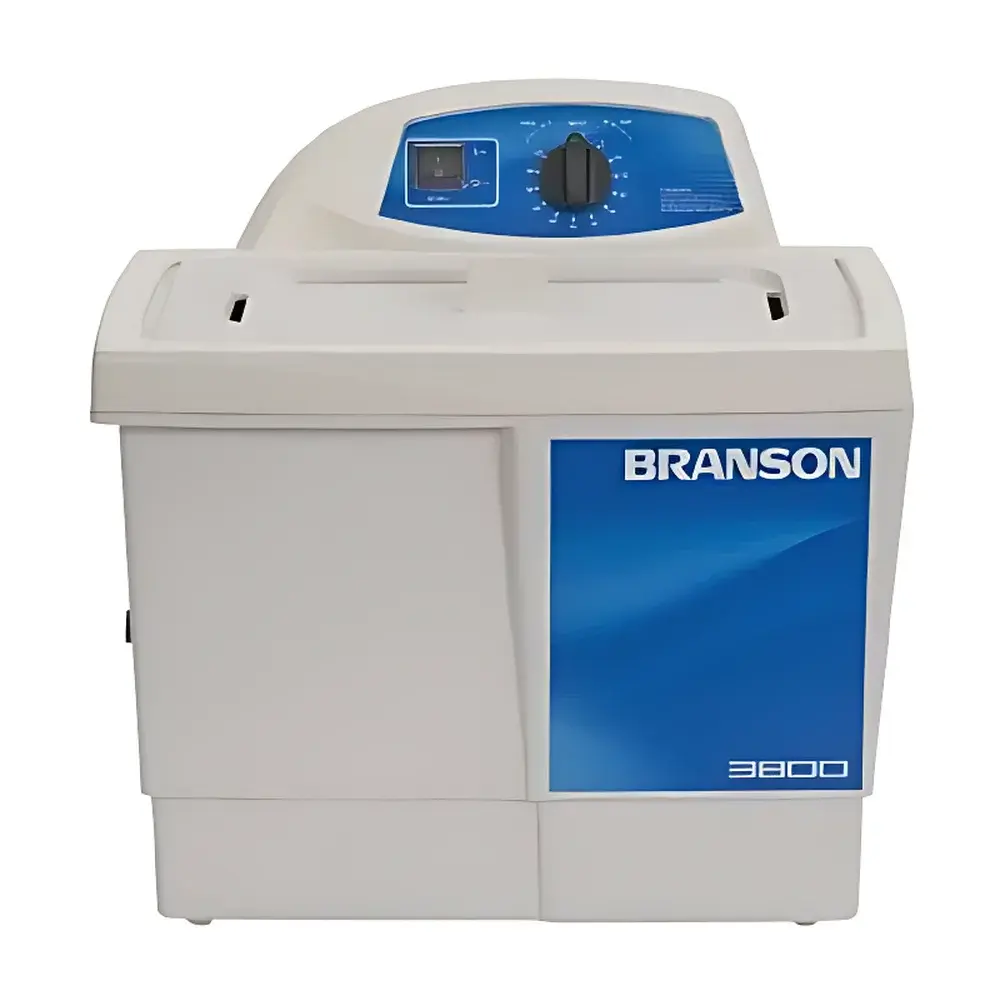
Branson M3800H-C Benchtop Ultrasonic Cleaner
| Brand | Branson |
|---|---|
| Origin | USA |
| Model | M3800H-C |
| Frequency | 40 kHz |
| Internal Tank Capacity | 5.7 L |
| Internal Dimensions (L×W×D) | 290 × 150 × 150 mm |
| External Dimensions (L×W×D) | 397 × 317 × 377 mm |
| Weight | 5.4 kg |
| Timer Range | 0–60 min or continuous mode |
| Max Heating Temperature | 69 °C |
| Heating Power | 205 W |
| Ultrasonic Power Output | 130 W |
| Drain Port | Yes |
| Construction Material | Polypropylene (PP) tank and housing |
| Safety Certifications | CE, UL, CSA, FCC, TÜV |
Overview
The Branson M3800H-C is a precision-engineered benchtop ultrasonic cleaner designed for reproducible, high-efficiency cleaning of delicate laboratory components—including glassware, pipette tips, filtration membranes, microfluidic devices, and analytical sample holders. It operates on the principle of acoustic cavitation: high-frequency (40 kHz) ultrasonic energy generates controlled micro-bubbles in the cleaning solution; their implosive collapse produces localized shear forces and micro-jets that dislodge particulate matter, organic residues, and biofilms without mechanical abrasion. Unlike generic cleaners with fixed power delivery, the M3800H-C integrates real-time power tracking and professional sweep-frequency modulation—ensuring consistent energy coupling into the bath regardless of load variation, solution composition, or temperature drift. This architecture delivers stable cavitation intensity across operational cycles, a critical requirement for method transfer in regulated environments such as ISO/IEC 17025-accredited labs or GLP-compliant quality control workflows.
Key Features
- Intelligent power-tracking circuitry maintains constant ultrasonic output amplitude—even when multiple users operate the unit sequentially or when cleaning protocols shift between aqueous, solvent-based, or enzymatic solutions.
- Sweep-frequency technology dynamically modulates the drive signal across a narrow band centered at 40 kHz, eliminating standing wave nodes and ensuring uniform cavitation distribution throughout the entire tank volume—critical for consistent cleaning of multi-position racks or stacked sample trays.
- Langevin-type transducer assembly combines a robust metal housing with high-dielectric ceramic elements, delivering superior electromechanical conversion efficiency and extended service life (>10,000 hours MTBF under standard duty cycles).
- Chemically resistant polypropylene (PP) tank and chassis resist corrosion from common lab solvents (e.g., acetone, isopropanol), dilute acids (up to 10% HCl), and alkaline detergents—eliminating metal leaching risks that compromise trace analysis.
- Vertical PCB orientation and elevated control panel design prevent condensation ingress and electrolytic creep; all electronics are conformally coated for humidity resilience in ambient lab conditions (20–80% RH).
- Dual-mode operation: mechanical timer (0–60 min) with audible end-of-cycle alert, or continuous ultrasonic mode for extended degassing or solvent recovery applications.
- Integrated heating system (205 W) enables precise thermal activation of cleaning chemistries—programmable up to 69 °C with ±1.5 °C stability—supporting ASTM F2792-22 validated protocols for residue removal from stainless-steel surfaces.
Sample Compatibility & Compliance
The M3800H-C accommodates standard laboratory vessels up to 140 mm in height and 120 mm in diameter. Its 5.7 L tank supports immersion of up to six 50 mL centrifuge tubes or four 100 mL volumetric flasks simultaneously. The unit complies fully with electromagnetic compatibility (EMC) and electrical safety standards including IEC 61000-6-3 (emissions), IEC 61000-6-1 (immunity), UL 61010-1, CSA C22.2 No. 61010-1, and EN 61000-3-2. Independent verification by TÜV Rheinland confirms conformity with low-voltage directive 2014/35/EU and RoHS 2011/65/EU. All units ship with full Declaration of Conformity and test reports traceable to NIST-traceable calibration sources.
Software & Data Management
While the M3800H-C features a dedicated analog interface (no embedded firmware or network connectivity), its operational parameters—timer setting, heating activation, and power-on state—are fully auditable via mechanical switch position and front-panel LED indicators. For laboratories requiring electronic recordkeeping, optional external data loggers (e.g., Omega OM-DAQPRO-5300) can monitor bath temperature and cycle duration via PT100 input. The device supports 21 CFR Part 11–aligned SOP documentation when integrated into validated cleaning processes—particularly where cleaning validation follows USP or ISO 15883-4 guidelines.
Applications
- Routine decontamination of HPLC vials, GC autosampler syringes, and electrophoresis combs prior to trace-metal analysis.
- Removal of photoresist residues from semiconductor wafers and MEMS substrates during R&D prototyping.
- Pre-cleaning of filter housings and sterilization-grade membrane filters used in bioprocess fluid path validation.
- Disassembly-free cleaning of optical components (lenses, cuvettes) and microelectrode arrays without surface pitting.
- Supporting ASTM D4488-23 and ISO 14644-1 cleanroom garment laundering validation through repeatable particle shedding reduction.
FAQ
Is the M3800H-C suitable for cleaning aluminum or soft metal parts?
Yes—when operated with non-alkaline, low-surface-tension cleaning solutions (e.g., Branson EC, Alconox Liquinox) and limited exposure time (<10 min), it effectively removes oils and oxides without etching or hydrogen embrittlement.
Can the unit be used with flammable solvents?
No—this model lacks explosion-proof certification and must only be operated with aqueous or water-miscible solutions per UL 61010-1 Clause 12.3.1.
Does the drain port support connection to a waste collection system?
Yes—the standard 8 mm BSP-threaded outlet accepts flexible PVC tubing (ID 6 mm) and connects directly to floor drains or secondary containment vessels.
What maintenance is required for long-term reliability?
Monthly inspection of transducer bonding integrity, quarterly descaling of heater elements using 5% citric acid solution, and annual verification of timer accuracy against a calibrated stopwatch.
Is the unit compatible with automated lab management systems?
Not natively—but its discrete ON/OFF and heater status signals can be interfaced via optional relay modules (e.g., Branson RC-100) for integration into PLC-controlled cleaning workflows.



