
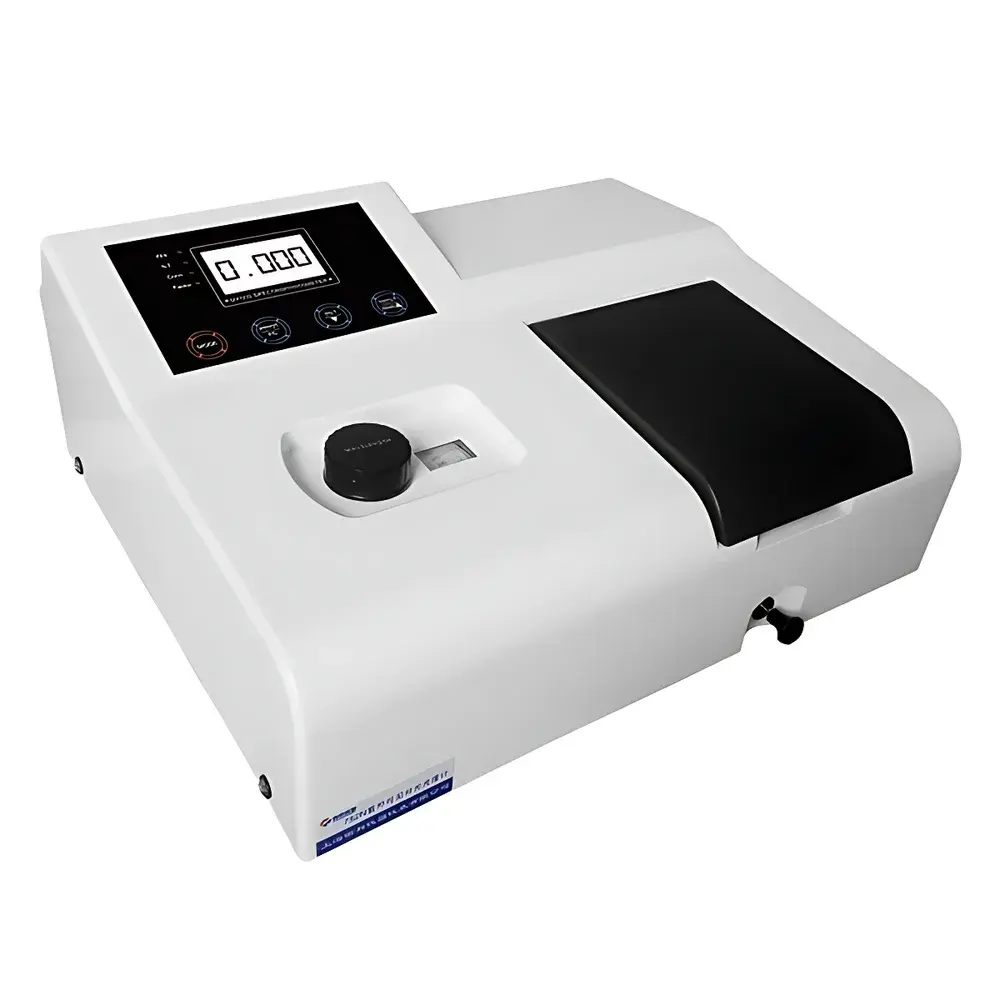
Yoke VIS-722 Single-Beam Visible Spectrophotometer
| Brand | Yoke |
|---|---|
| Origin | Shanghai, China |
| Manufacturer Type | Direct Manufacturer |
| Instrument Architecture | Single-Beam |
| Detector Type | Silicon Photocell |
| Wavelength Range | 320–1020 nm |
| Wavelength Selection | Manual (Knob-Actuated) |
| Spectral Bandwidth | 5 nm |
| Wavelength Accuracy | ±2 nm |
| Stray Light | ≤0.3% T at 360 nm |
| Photometric Accuracy | ±0.5% T |
| Wavelength Repeatability | ≤1 nm |
| Baseline Stability | ±0.004 A/h at 500 nm |
| Drift | ≤0.1% T |
| Noise | ≤0.2% T |
| Photometric Modes | Transmittance (%T), Absorbance (A), Concentration (C) |
| Light Source | Imported Tungsten-Halogen Lamp |
| Sample Compartment Dimensions | Accommodates up to 10 cm pathlength cuvettes |
| Interface Options | Optional RS-232 Serial Port for Printer or PC Connectivity |
| Net Weight | 8 kg |
| Optical System | Achromatic Czerny-Turner Monochromator with 1200 lines/mm Grating |
Overview
The Yoke VIS-722 is a precision-engineered single-beam visible spectrophotometer designed for routine quantitative and qualitative analysis in academic teaching laboratories, quality control environments, and industrial process support settings. Operating on the principle of Beer-Lambert law-based absorbance measurement, the instrument employs a fixed-wavelength monochromator architecture to isolate specific spectral bands within the visible and near-UV range (320–1020 nm). Its optical core features an achromatic Czerny-Turner configuration with a 1200 lines/mm holographic grating, optimized to deliver consistent spectral resolution and minimal chromatic aberration across the operational range. The use of a stabilized tungsten-halogen lamp ensures long-term radiometric stability and predictable spectral output—critical for reproducible photometric measurements over extended usage cycles. As a manually tuned instrument, the VIS-722 prioritizes mechanical robustness and operational transparency over automated wavelength scanning, making it especially suitable for pedagogical applications where fundamental spectroscopic concepts are emphasized.
Key Features
- Manual wavelength adjustment via calibrated vernier scale—enables precise, tactile selection and reinforces user understanding of spectral positioning
- Dual-mode digital display showing simultaneous %T and A values, with real-time update during zeroing and calibration
- Integrated automatic zero and 100% transmittance calibration routines—reducing operator-induced error and accelerating measurement workflow
- Expanded sample compartment accommodating standard 10 mm to 100 mm pathlength cuvettes—supporting both high-sensitivity trace analysis and dilute solution work
- High-stability tungsten-halogen light source with thermal management—delivering >2,000 hours of rated lamp life under normal operating conditions
- Optional RS-232 serial interface—enabling direct connection to dot-matrix printers for GLP-compliant hardcopy reporting or to legacy laboratory PCs for basic data logging
Sample Compatibility & Compliance
The VIS-722 accepts all standard rectangular quartz, glass, or plastic cuvettes with optical path lengths from 10 mm to 100 mm. It is compatible with aqueous, organic, and mildly corrosive solvent-based samples when appropriate cell materials are selected. While not certified for regulated GMP environments, its photometric accuracy (±0.5% T), wavelength repeatability (≤1 nm), and baseline drift performance (≤0.1% T over 30 min) align with common educational and internal QC requirements outlined in ISO/IEC 17025 Clause 5.9 and ASTM E275-21 Annex A1 for visible-range spectrophotometer verification. The instrument meets general electrical safety standards per GB 4793.1 (equivalent to IEC 61010-1) and electromagnetic compatibility per GB/T 18268.1.
Software & Data Management
The VIS-722 operates as a standalone instrument with no embedded operating system or proprietary software dependency. When equipped with the optional RS-232 port, it transmits ASCII-formatted photometric data (e.g., “T=87.2,A=0.060”) at 9600 bps, 8N1 protocol. This allows integration with custom LabVIEW VIs, Python-based serial loggers, or spreadsheet macros for batch data capture. No FDA 21 CFR Part 11 compliance features (e.g., electronic signatures, audit trails) are implemented—consistent with its classification as a non-GxP primary measurement tool. Data export supports basic traceability: timestamped readings can be appended with operator ID and sample ID via external scripting.
Applications
- Quantitative determination of dye concentrations in textile effluent monitoring per APHA Standard Method 8025B
- Enzyme kinetics assays (e.g., NADH oxidation at 340 nm) in undergraduate biochemistry labs
- Pharmaceutical excipient purity screening using reference absorption maxima in USP monographs
- Water quality testing—including nitrate (at 355 nm) and phosphate (via molybdenum blue complex at 880 nm)
- Calibration of secondary standards against NIST-traceable reference materials (e.g., potassium dichromate in 0.005 M H2SO4)
- Teaching spectral calibration, baseline correction, and matrix interference evaluation
FAQ
Is the VIS-722 compliant with ISO 9001 or GLP documentation requirements?
It supports GLP-aligned practices (e.g., manual logbook entries, printed reports via RS-232), but lacks built-in audit trail, user access control, or electronic signature capabilities required for formal GLP or ISO 9001 certification.
Can this instrument measure below 320 nm?
No—the optical design, detector response, and lamp emission profile are optimized for 320–1020 nm; UV-C and deep-UV measurements require deuterium lamps and fused silica optics not present in this model.
What cuvette materials are recommended for measurements at 320 nm?
For reliable transmission at the lower end of its range, use quartz or high-transmission UV-grade glass cuvettes; standard borosilicate glass exhibits significant absorption below 350 nm.
Does the VIS-722 include wavelength calibration verification tools?
Yes—a set of certified holmium oxide and didymium glass filters is recommended (sold separately) for periodic wavelength accuracy verification per ASTM E387.
How often should the tungsten lamp be replaced?
Under typical usage (4–6 hrs/day), replacement is advised every 18–24 months or upon observed intensity drop exceeding 15% at 550 nm during daily startup checks.
Related Products






