
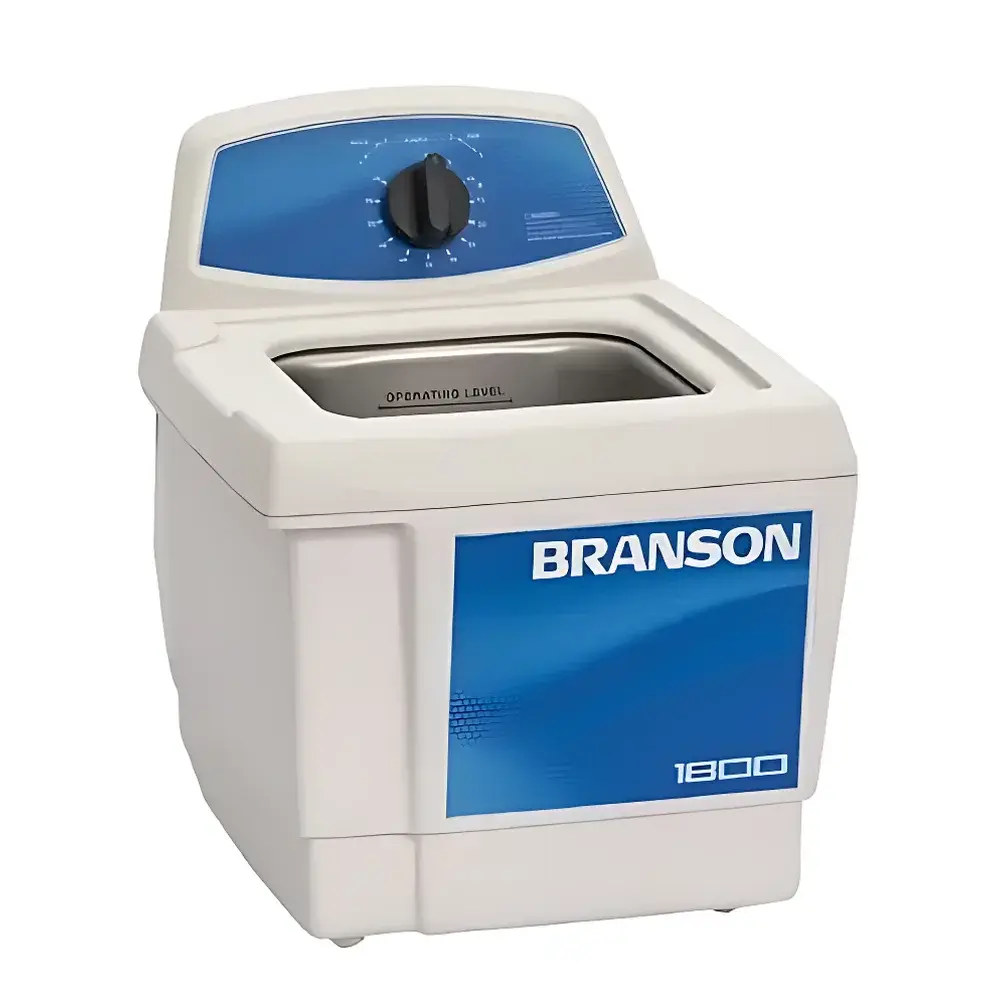
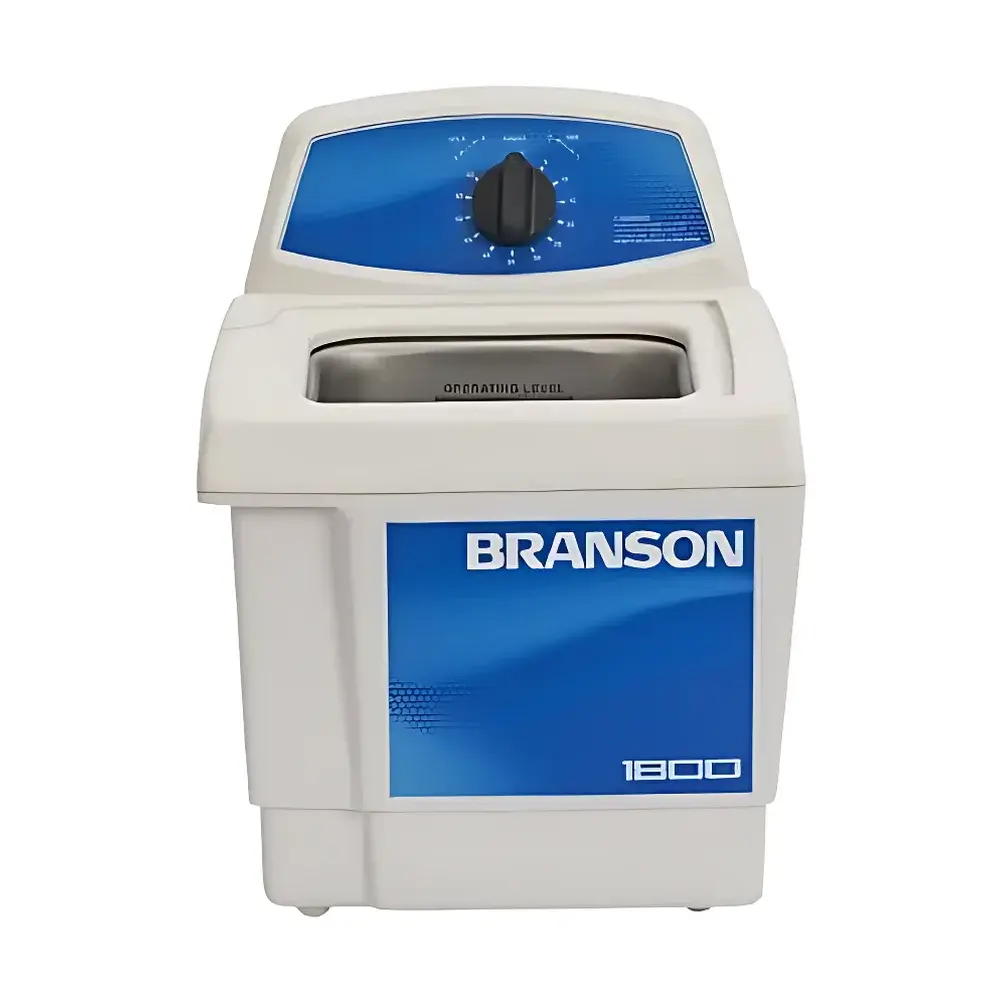
Branson M1800-C Benchtop Ultrasonic Cleaner
| Brand | Branson |
|---|---|
| Origin | USA |
| Model | M1800-C |
| Frequency | 40 kHz |
| Tank Capacity | 1.9 L (0.5 gal) |
| Internal Dimensions (L×W×D) | 150 × 140 × 100 mm |
| External Dimensions (L×W×D) | 251 × 304 × 302 mm |
| Weight | 3.2 kg |
| Tank Material | 304 Stainless Steel |
| Housing Material | Polypropylene (PP) |
| Power Output | 90 W |
| Timer Range | 0–60 min or continuous mode |
| Drain Port | Not equipped |
| Safety Certifications | CE, UL, CSA, FCC, TÜV |
Overview
The Branson M1800-C Benchtop Ultrasonic Cleaner is an entry-level, high-reliability ultrasonic cleaning system engineered for precision laboratory applications requiring consistent cavitation energy delivery in small-volume samples. Operating at a fixed frequency of 40 kHz, the unit leverages piezoelectric transduction based on Langevin-type metal-ceramic transducers bonded directly to the stainless-steel tank base—ensuring mechanical robustness and long-term acoustic coupling stability. The device employs automatic power tracking and professional sweep-frequency modulation to maintain stable acoustic output regardless of load variation, liquid level fluctuations, or changes in solution composition—critical for reproducible cleaning performance across QC/QA workflows, sample preparation for SEM/TEM, microfluidic device decontamination, and pre-analytical instrumentation maintenance. Its compact footprint (251 × 304 × 302 mm), lightweight polypropylene housing, and corrosion-resistant 304 stainless-steel tank make it suitable for benchtop deployment in regulated environments including GLP-compliant labs and ISO 17025-accredited testing facilities.
Key Features
- Automatic power tracking circuitry maintains consistent ultrasonic energy output across varying operational conditions—including temperature drift, solvent viscosity changes, and partial tank loading.
- Sweep-frequency technology (±1 kHz around 40 kHz center frequency) eliminates standing wave nodes and ensures uniform cavitation distribution throughout the tank volume—optimized via spherical wave propagation design.
- Langevin-type transducers integrate high-density ceramic elements with titanium alloy front mass for enhanced electromechanical conversion efficiency and extended service life under continuous duty cycles.
- Vertical PCB orientation and elevated control panel placement minimize moisture ingress risk; all electronics are conformally coated for humidity resistance in high-humidity lab environments.
- Polypropylene (PP) housing provides chemical resistance against common laboratory solvents, acids, and alkaline solutions—complementing the 304 stainless-steel tank’s durability and cleanability.
- Factory-calibrated water level indicator ensures optimal acoustic coupling and energy transfer efficiency—critical for achieving maximum cavitation intensity without unnecessary power waste.
- Mechanical timer offers precise 1-minute increments from 1 to 60 minutes, with optional continuous operation mode for extended cleaning protocols requiring uninterrupted sonication.
Sample Compatibility & Compliance
The M1800-C supports a wide range of sample types—including glassware, metal parts, optical components, printed circuit boards, surgical instruments, and microtiter plates—when used with compatible aqueous or mild solvent-based cleaning solutions. Its 1.9 L tank volume is optimized for discrete batch processing of small-diameter vials, cuvettes, and precision components where localized contamination removal is essential. All units comply with electromagnetic compatibility (EMC) and electrical safety standards mandated for laboratory equipment in North America and the EU: UL 61010-1, CSA C22.2 No. 61010-1, EN 61000-6-3/-4, and FCC Part 15 Subpart B. Full TÜV Rheinland certification confirms compliance with IEC 61010-1:2010 for protection against electric shock, fire hazard, and mechanical instability—making it suitable for use in FDA-regulated environments where audit readiness is required.
Software & Data Management
As a standalone analog-controlled instrument, the M1800-C does not incorporate digital firmware, network connectivity, or data logging capabilities. Its mechanical timer and fixed-frequency architecture eliminate software-related validation complexity—aligning with ALCOA+ principles for simplicity in GxP environments where traceability is maintained through procedural documentation rather than electronic records. For laboratories requiring 21 CFR Part 11-compliant audit trails, integration with external environmental monitoring systems (e.g., temperature/humidity loggers) or process execution platforms is recommended. Calibration verification can be performed using standard ultrasonic intensity measurement methods per ASTM E1734–18 (Standard Practice for Measurement of Ultrasonic Power Output).
Applications
- Pre-analytical cleaning of HPLC vials, GC autosampler needles, and ICP-MS sample introduction components.
- Removal of organic residues, particulates, and biofilm from microfluidic chips and lab-on-a-chip devices prior to surface characterization.
- Routine decontamination of pipette tips, forceps, tweezers, and other reusable stainless-steel tools in microbiology and cell culture labs.
- Cleaning of delicate optical lenses, mirrors, and photomasks without mechanical abrasion or surface scratching.
- Supporting ASTM D2601 and ISO 14040-compliant lifecycle assessments by enabling repeatable, low-energy cleaning protocols that reduce solvent consumption and waste generation.
FAQ
Is the M1800-C suitable for use with flammable solvents?
No. This model is designed exclusively for aqueous or non-flammable, low-volatility cleaning solutions. Use of flammable solvents requires explosion-proof ultrasonic systems certified to ATEX or IECEx standards.
Does the unit include a degassing function?
No. Degassing must be performed manually prior to initiating ultrasonic cleaning, or via external vacuum degassing stations.
Can the M1800-C be rack-mounted or installed in a fume hood?
Yes—its compact dimensions and lack of heat-generating ventilation requirements allow safe installation inside Class II biosafety cabinets or chemical fume hoods when operated with compatible non-volatile solutions.
What is the expected service life of the transducers?
Under normal operating conditions (≤4 hrs/day, ambient temperature ≤35°C), Branson specifies ≥5 years of functional integrity for the Langevin transducer assembly, supported by field reliability data from accelerated lifetime testing per MIL-HDBK-217F.
Is calibration documentation provided with shipment?
Yes—each unit ships with a Factory Certificate of Conformance verifying compliance with specified electrical, dimensional, and acoustic performance parameters per Branson Manufacturing Specification B-ULTRASONIC-M-SPEC-2023.



