
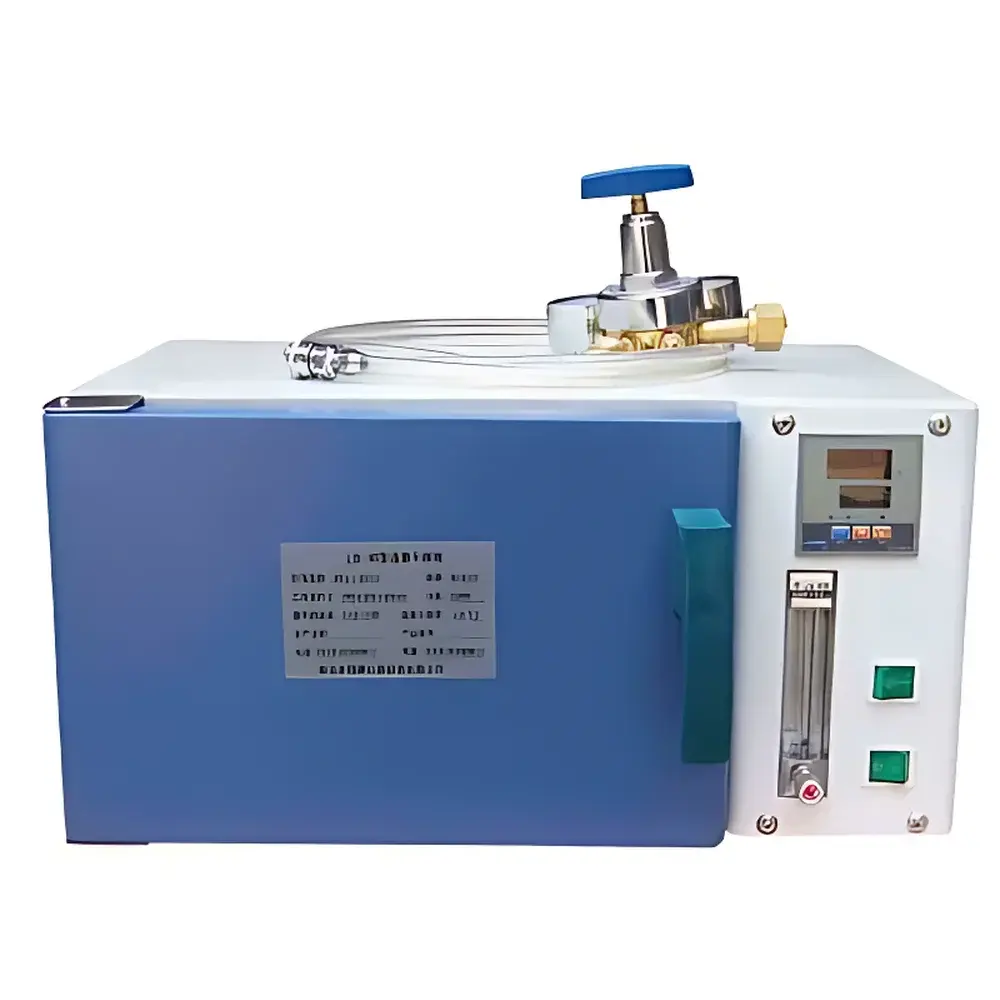
LB-90 Nitrogen-Purged Drying Oven
| Origin | Jiangsu, China |
|---|---|
| Manufacturer Type | Authorized Distributor |
| Origin Category | Domestic (PRC) |
| Model | LB-90 |
| Instrument Type | High-Temperature Forced-Air Drying Oven |
| Temperature Range | RT+10°C to 250°C |
| Temperature Uniformity | ±1°C |
| External Dimensions | 450 × 400 × 300 mm (W×D×H) |
| Internal Chamber Dimensions | 250 × 320 × 80 mm (W×D×H) |
| Power Supply | 220 V ±10%, 50 Hz |
| Rated Power | 500 W |
| Net Weight | ~20 kg |
| Air Exchange Rate | 15 cycles/hour |
| Chamber Material | 304 Stainless Steel |
| Heating Element | Embedded Stainless Steel Sheathed Tubular Heater |
| Door Seal | High-Temperature Silicone Gasket with Mechanical Compression Lock |
Overview
The LB-90 Nitrogen-Purged Drying Oven is a compact, precision-engineered thermal processing system designed for moisture-sensitive sample drying under inert atmospheric conditions. It operates on the principle of controlled convective heating combined with continuous nitrogen gas purging to eliminate ambient oxygen and water vapor—critical for applications requiring oxidation suppression, residual solvent removal, or moisture content determination per standardized gravimetric protocols (e.g., ASTM D229, ISO 554, USP <921>). Unlike conventional forced-air ovens, the LB-90 integrates an integrated gas flow management subsystem that enables stable, low-flow nitrogen displacement (15 air changes per hour) within its sealed 6.4 L chamber. This architecture minimizes nitrogen consumption while ensuring rapid atmosphere equilibration and uniform thermal distribution across the working volume—key prerequisites for high reproducibility in quantitative drying procedures.
Key Features
- Compact chamber design (250 × 320 × 80 mm) optimized for low nitrogen consumption and rapid inerting—ideal for small-batch analytical workflows.
- Double-walled construction with high-density ceramic fiber insulation (silicon aluminum wool) between outer mild steel casing and inner 304 stainless steel chamber, achieving thermal efficiency and minimizing external surface temperature rise.
- Hermetic door sealing system featuring high-temperature silicone gasket and mechanical compression latch, validated to maintain <1.5 mL/min leakage rate at 100 kPa differential pressure.
- Embedded stainless steel-sheathed heating elements mounted on chamber walls ensure uniform heat flux distribution and eliminate hot-spot formation.
- Dual-function ventilation port with automatic solenoid valve: opens during initial purge phase for rapid O₂ evacuation, then closes to sustain nitrogen blanket during dwell period.
- Front-panel digital controller with PID algorithm, real-time temperature display, and adjustable setpoint resolution of 0.1°C—calibration traceable to NIST-traceable reference thermocouples.
Sample Compatibility & Compliance
The LB-90 accommodates standard laboratory glassware including up to twelve Φ70 × 35 mm moisture weighing bottles (per ASTM D1557 and GB/T 2922–2020), Petri dishes, crucibles, and polymer film substrates. Its chamber geometry supports both horizontal and stacked configurations without impeding airflow or nitrogen dispersion. The unit complies with IEC 61010-1:2010 safety requirements for electrical equipment used in laboratory environments. All internal surfaces meet USP Class VI biocompatibility criteria for indirect food/pharma contact. While not certified for explosion-proof operation, its oxygen-depleted operating mode inherently reduces fire risk during drying of volatile organics—making it suitable for QC labs conducting residual solvent analysis under GLP-aligned SOPs.
Software & Data Management
The LB-90 operates as a standalone instrument with no embedded software stack or network interface. Temperature logging requires external data acquisition via its analog 0–5 V output (corresponding to 0–300°C) or optional RS485 Modbus RTU port (available upon request). When integrated into regulated environments (e.g., pharmaceutical stability testing), users may connect third-party compliant recorders supporting 21 CFR Part 11 audit trails—including electronic signatures, user access levels, and immutable timestamped event logs. Calibration certificates include as-found/as-left data, uncertainty budgets per ISO/IEC 17025, and traceability to national metrology institutes.
Applications
- Gravimetric moisture content determination in pharmaceutical excipients, active ingredients, and herbal powders (aligned with EP 2.2.32 and JP 2.07).
- Drying of lithium-ion battery electrode coatings under inert atmosphere to prevent Li₂CO₃ formation and electrolyte decomposition.
- Thermal conditioning of hygroscopic polymers (e.g., polyamide, PVA) prior to tensile or DSC characterization.
- Pre-treatment of catalyst supports and metal-organic frameworks (MOFs) to remove physisorbed water without structural collapse.
- Low-oxygen annealing of thin-film photovoltaic precursors (e.g., CZTS, perovskites) where ambient oxidation degrades stoichiometry.
FAQ
What nitrogen purity is recommended for optimal performance?
For most analytical applications, ≥99.99% (4.0 grade) nitrogen is sufficient. Higher purity (>99.999%) offers diminishing returns unless handling ultra-sensitive materials such as alkali metals or single-crystal semiconductors.
Can the LB-90 be used with argon instead of nitrogen?
Yes—the gas control manifold is chemically agnostic and compatible with any non-reactive, non-corrosive inert gas, including argon and helium, provided inlet pressure is regulated to 0.02–0.05 MPa via external减压阀.
Is the temperature uniformity specification verified at load or no-load conditions?
The ±1°C uniformity rating is measured at no-load steady state per IEC 60068-3-5 using nine calibrated PT100 sensors positioned per ISO 17025-compliant mapping protocol.
Does the oven support programmable ramp-hold profiles?
No—the LB-90 features only single-setpoint temperature control. For multi-stage thermal protocols, integration with external programmable controllers or PLC-based sequencers is required.
How often should the door seal be replaced?
Under normal use (≤4 h/day at ≤150°C), the silicone gasket maintains integrity for ≥24 months; visual inspection for cracking or compression set is recommended every 6 months.



