
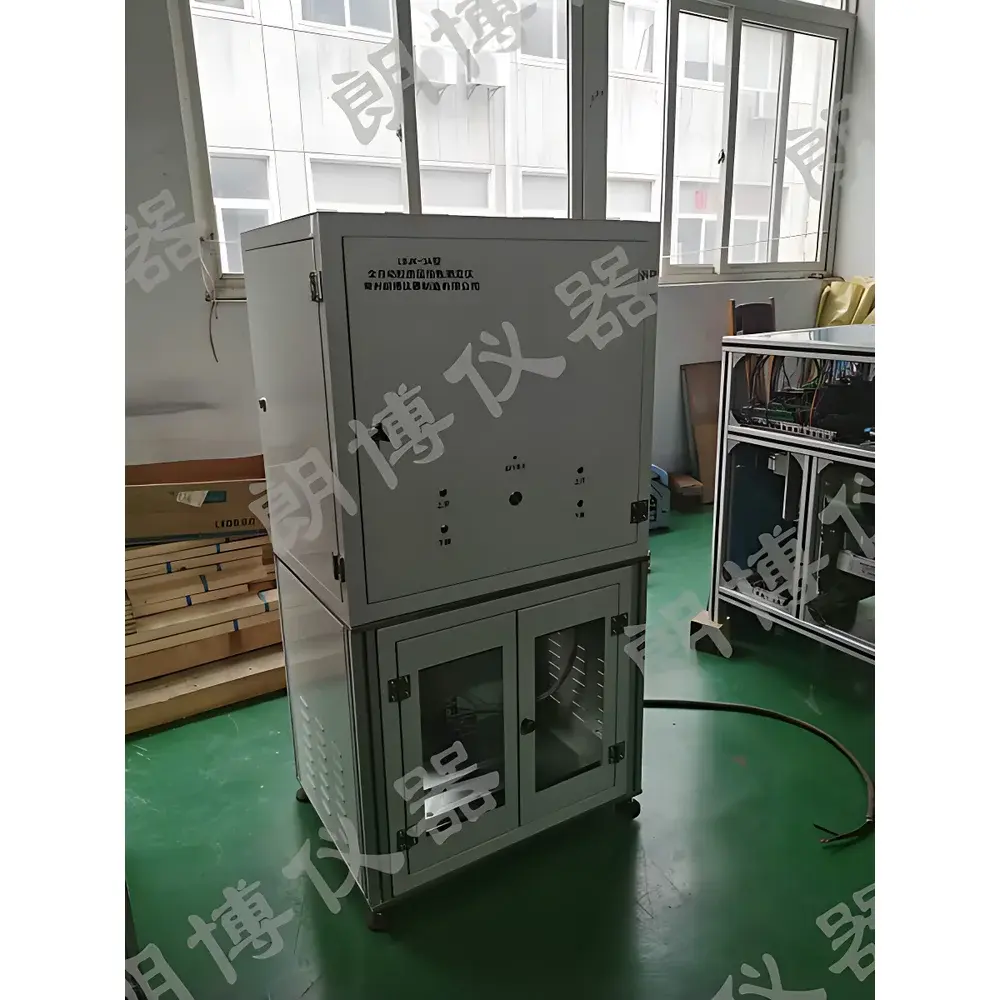
Langbo LBJK-3A Automated Ventilated Gieseler Plastometer
| Brand | Langbo Instruments |
|---|---|
| Origin | Jiangsu, China |
| Manufacturer Type | Authorized Distributor |
| Region | Domestic (China) |
| Model | LBJK-3A |
| Price | USD 40,200 (FOB Jiangsu) |
| Temperature Range | 0–800 °C (Resolution: 0.1 °C |
| Control Accuracy | ±0.5 °C) |
| Heating Program | 0–250 °C @ 8 °C/min (30 min), 250–800 °C @ 3 °C/min (160 min) |
| Y-value Repeatability | ±2 mm (Y > 20 mm), ±1 mm (Y ≤ 20 mm) |
| X-value Repeatability | ±3 mm |
| Thermocouple | Armored K-type, Class 0.5 |
| Load Cell Accuracy | 0.02 % FS |
| Volume Sensor Accuracy | 0.05 % FS |
| Probe Displacement Sensor Accuracy | 0.01 % FS |
| Exhaust Motor Power | 60 W |
| Push Rod Max Force | 800 N |
| Dimensions | 600 × 450 × 1150 mm |
| Power Supply | 220 V, 50 Hz, 8 kW (dual furnace) |
Overview
The Langbo LBJK-3A Automated Ventilated Gieseler Plastometer is a fully computer-controlled instrument engineered for precise determination of the plastic properties of bituminous coals in accordance with GB/T 479–2016, the Chinese national standard equivalent to ISO 501 and ASTM D720. It implements the classical Gieseler plastometry principle—measuring the fluidity of thermally softened coal under controlled heating and mechanical shear—by continuously monitoring the rotational resistance of a standardized paddle immersed in the developing plastic layer. Unlike conventional manual or semi-automated systems, the LBJK-3A integrates real-time temperature regulation, automated probe positioning, dynamic volume curve acquisition, and intelligent mechanical actuation to eliminate operator-dependent variability while maintaining strict compliance with standardized test protocols.
Key Features
- Fully automated dual-furnace architecture supporting independent or synchronized single/dual sample testing, enhancing laboratory throughput without compromising measurement integrity.
- Integrated ventilation and exhaust system (60 W high-efficiency fan) eliminates dependency on external fume hoods—reducing facility infrastructure requirements and operational overhead.
- Motorized砝码 (weight) loading/unloading mechanism replaces traditional lever-based manual weight application, ensuring consistent 100 g torque application per ASTM/ISO conventions and eliminating mechanical hysteresis.
- Self-aligning probe carriage automatically adjusts angular orientation between the stainless-steel measuring probe and the calibrated paper tube, guaranteeing perpendicular insertion and minimizing lateral stress on the plastic layer.
- Non-contact volumetric displacement sensing with 0.01 % FS resolution enables continuous, unattended tracking of upper and lower plastometric boundaries—eliminating manual sensor attachment/removal errors.
- Intelligent mechanical arm replicates human tactile probing behavior: during lower-layer measurement, the probe rotates at low torque to prevent extrusion or structural disruption of the gelatinous phase.
- Robust thermal control system featuring armored K-type thermocouples (Class 0.5 accuracy) and adaptive PID algorithms maintains ±0.5 °C stability across the full 0–800 °C ramp profile defined in GB/T 479–2016.
- Comprehensive fault diagnostics—including heating element failure, temperature deviation, probe stall detection, and power interruption recovery—trigger audible/visual alerts and automatic safety shutdown.
Sample Compatibility & Compliance
The LBJK-3A is validated for use with all bituminous coal types meeting GB/T 477 particle size specifications (≤1.5 mm, air-dried). Its mechanical design conforms to the geometric constraints of ISO 501 Annex A and ASTM D720 Figure 1 for paddle geometry, crucible dimensions, and probe travel range. All electronic subsystems comply with IEC 61000-6-3 (EMC emissions) and IEC 61010-1 (safety for laboratory equipment). Data acquisition and storage meet GLP traceability requirements: timestamps, raw sensor outputs, and intermediate calculations are immutably logged with user ID, sample ID, and environmental metadata. Optional audit trail configuration supports FDA 21 CFR Part 11–compliant electronic records when deployed in regulated QA/QC environments.
Software & Data Management
The embedded Windows-based control software provides real-time visualization of dual-channel temperature profiles, volumetric expansion curves (X-value), and plastic layer thickness evolution (Y-value). All data—including raw thermocouple voltages, load cell outputs, and probe displacement signals—are sampled at 10 Hz and archived in vendor-neutral CSV format. The software supports retrospective analysis via overlay comparison of historical runs, statistical repeatability assessment (per GB/T 479–2016 Section 9.3), and automatic report generation compliant with CNAS-CL01:2018 documentation requirements. Data export includes ISO/IEC 17025–aligned uncertainty statements derived from sensor calibration certificates traceable to NIM (National Institute of Metrology, China).
Applications
- Coal blending optimization in coking plant operations, where Y-value prediction directly correlates with coke oven wall pressure and charge density uniformity.
- Quality assurance of washed metallurgical coal shipments, verifying conformance to contractual Gieseler fluidity bands (e.g., Y = 16–22 mm).
- R&D screening of low-rank coal upgrading processes, quantifying plasticity loss following oxidative pretreatment or binder addition.
- Interlaboratory proficiency testing programs requiring cross-site reproducibility within ±1.5 mm for Y-value (as verified in 2023 CNAS PT Scheme No. CNAS PT0037).
- Academic research on coal maceral reactivity, where synchronized X/Y curve inflection points inform kinetic models of vitrinite softening.
FAQ
Does the LBJK-3A support ASTM D720 or ISO 501 test protocols?
Yes—the instrument’s heating rate profile, probe geometry, and torque application mechanism are functionally equivalent to ASTM D720 and ISO 501; full method equivalence documentation is provided with each unit.
Can raw sensor data be exported for third-party statistical analysis?
Yes—CSV exports include time-stamped voltage readings from all transducers (thermocouple, load cell, LVDT), enabling independent uncertainty propagation modeling per GUM (JCGM 100:2008).
What maintenance intervals are recommended for the exhaust system?
The axial fan requires biannual inspection of bearing lubrication and filter mesh cleaning; replacement interval is 15,000 operating hours under continuous lab use.
Is remote diagnostic support available outside China?
Yes—via encrypted TeamViewer session with Langbo’s ISO 9001-certified technical team; firmware updates and calibration validation files are distributed through secure FTP with SHA-256 checksum verification.
How is thermal drift compensated during extended 160-minute high-temperature ramps?
The system employs dual-point thermocouple offset correction using reference junction monitoring and real-time ambient compensation algorithms embedded in the FPGA-based controller firmware.
Related Products





