
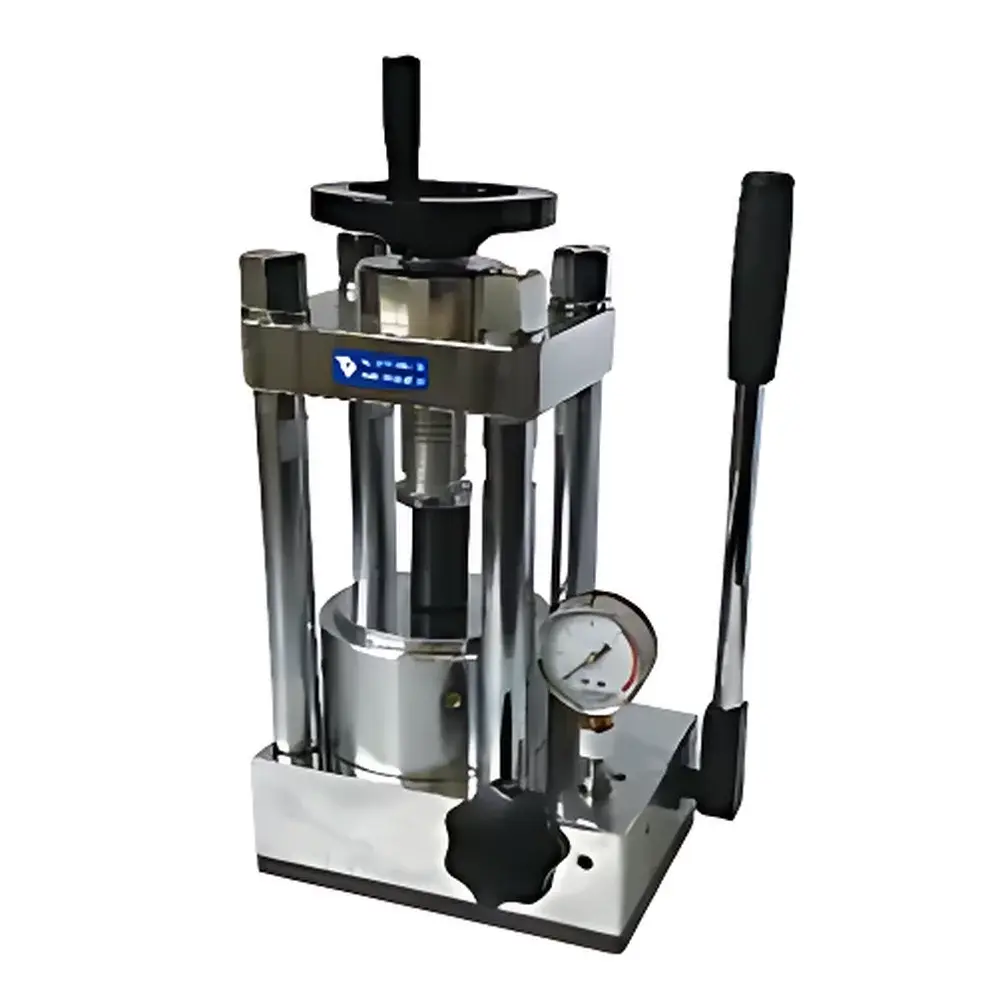
Topo FW-30T Manual Hydraulic Pellet Press
| Brand | Topo |
|---|---|
| Model | FW-30T |
| Type | Manual Hydraulic Pellet Press |
| Maximum Pressure | 0–30 t (294 kN) |
| Piston Diameter | 110 mm |
| Max Stroke | 20 mm |
| Working Chamber Dimensions | 110 mm × 120 mm |
| Oil Reservoir Capacity | 600 mL |
| Overall Dimensions | 220 mm × 150 mm × 420 mm |
Overview
The Topo FW-30T Manual Hydraulic Pellet Press is a compact, precision-engineered laboratory instrument designed for reproducible sample compaction of powdered materials into uniform, free-standing pellets—primarily for spectroscopic analysis (e.g., FTIR, XRF, XRD) and mechanical property evaluation. It operates on a manually actuated hydraulic principle: force is generated via hand-pump-driven oil displacement, transmitting pressure through an incompressible fluid medium to a single-acting piston. This architecture ensures high mechanical advantage, stable load retention during dwell, and minimal thermal drift—critical for achieving consistent green density and interparticle bonding without external power or complex control systems. The press is optimized for routine, low-throughput preparation where operator control, process transparency, and equipment reliability outweigh automation requirements.
Key Features
- Robust cast-iron frame with precision-machined cylinder bore and hardened steel piston assembly, engineered for long-term dimensional stability under repeated 30-ton loading cycles.
- Manually operated two-stage hydraulic pump with integrated pressure relief valve, enabling fine-grained, stepwise pressure application and safe overpressure protection.
- Large-diameter (110 mm) piston and generous working chamber (110 mm × 120 mm) accommodate standard die sets—including 13 mm, 16 mm, and 25 mm diameter stainless-steel dies—as well as custom geometries for specialized applications.
- 20 mm maximum stroke provides sufficient travel for both shallow-die compression and deep-die filling protocols, while maintaining full rated force across the usable range.
- 600 mL oil reservoir ensures extended operational intervals between maintenance checks and minimizes air entrainment risk during repeated pumping cycles.
- Compact footprint (220 mm × 150 mm × 420 mm) enables seamless integration into fume hoods, gloveboxes, or benchtop analytical workstations without spatial compromise.
Sample Compatibility & Compliance
The FW-30T supports a broad spectrum of inorganic and organic powders—including metal oxides, pharmaceutical APIs, geological samples, catalysts, and polymer blends—provided they exhibit adequate flowability and compressibility. Die compatibility extends to standard ASTM E1781-compliant IR pellet dies and ISO 21047-certified XRF fusion cup assemblies. While the unit itself carries no CE or UL certification (as a Class I manual mechanical device), its design conforms to general laboratory safety principles outlined in ISO/IEC 17025:2017 Annex A.3 (equipment suitability) and supports GLP-compliant documentation when used with calibrated pressure gauges and standardized SOPs for pellet thickness/density verification.
Software & Data Management
As a fully manual hydraulic system, the FW-30T does not incorporate embedded electronics, digital displays, or data logging functionality. Pressure application is monitored externally using a calibrated analog or digital pressure gauge mounted on the hydraulic line (optional accessory). Users are expected to record applied force, dwell time, and resulting pellet dimensions manually—or integrate with third-party load cells and data acquisition systems via mechanical coupling. This architecture aligns with environments requiring electromagnetic interference (EMI)-free operation, such as near NMR spectrometers or electron microscopes, and facilitates straightforward validation per FDA 21 CFR Part 11 when paired with audit-trail-enabled lab notebooks or LIMS entries.
Applications
- Preparation of KBr or polyethylene matrix pellets for transmission-mode FTIR spectroscopy.
- Compaction of mineral powders into flat, homogeneous discs for wavelength-dispersive X-ray fluorescence (WDXRF) quantitative analysis.
- Forming ceramic green bodies for sintering trials and shrinkage characterization.
- Consolidation of battery electrode slurries onto current collectors for electrochemical testing.
- Creating reference standards with controlled density gradients for calibration of powder rheometers or densitometers.
- Low-force consolidation of heat-sensitive biomaterials where thermal degradation from hot-press methods must be avoided.
FAQ
What is the actual force resolution achievable with the manual pump?
Force resolution depends on operator technique and pump lever ratio; typical repeatable increments are ±0.5 t within the 0–10 t range and ±1.0 t above 10 t, assuming consistent stroke depth and dwell stabilization.
Can the FW-30T be used with heated dies?
No—the base unit lacks temperature control or electrical interfaces; heated die operation requires external heating mantles or ovens compatible with ambient-pressure compaction workflows.
Is die alignment adjustable?
Yes—upper and lower die holders feature concentricity-adjustable mounting slots and locking screws to ensure axial alignment and minimize eccentric loading during compression.
What maintenance is required for long-term hydraulic integrity?
Biannual inspection of O-rings, periodic replacement of hydraulic oil (ISO VG 32 mineral oil), and cleaning of the pump check valves are recommended per manufacturer guidelines.
Does Topo supply certified calibration certificates for the press?
Topo provides factory-assembled verification reports; third-party traceable calibration (e.g., to NIST standards) requires engagement with an accredited metrology lab using a calibrated load cell in situ.



