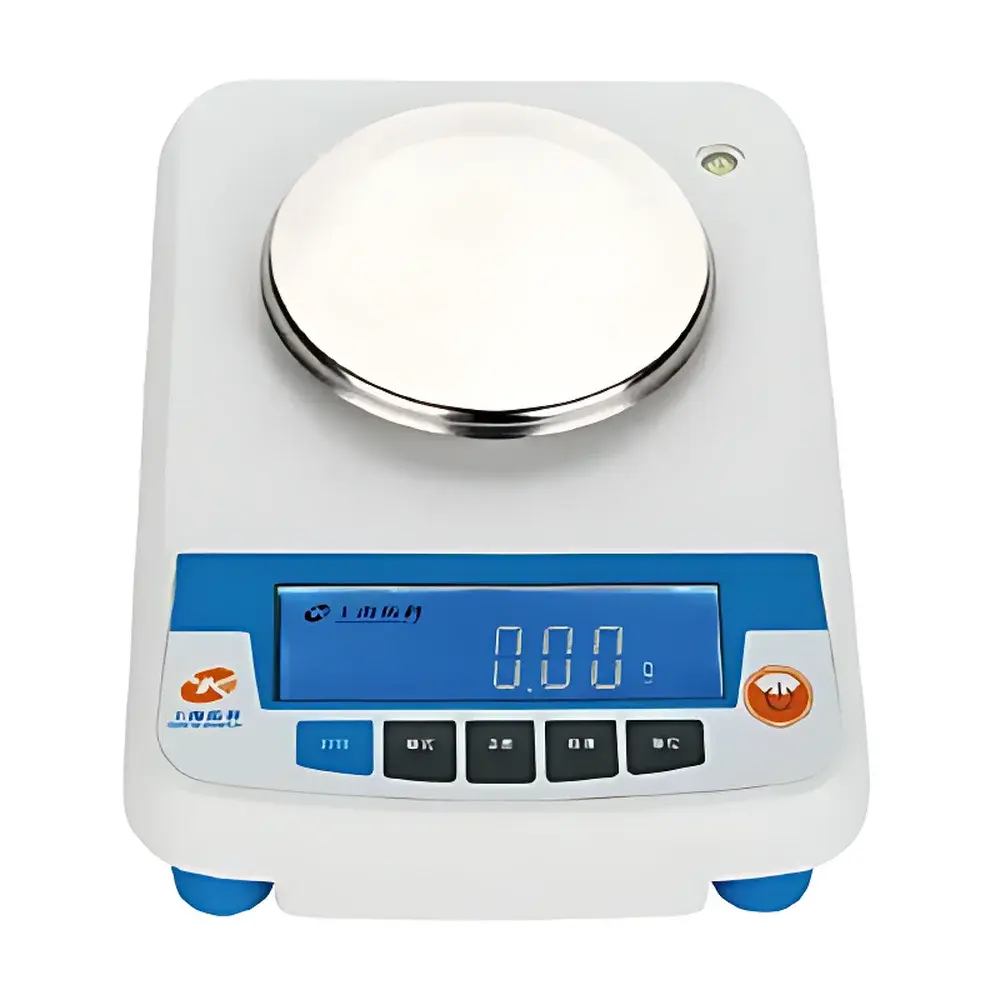
Yoke YP30002 Precision Balance
| Brand | Yoke |
|---|---|
| Origin | Shanghai, China |
| Manufacturer Type | Direct Manufacturer |
| Country of Origin | China |
| Model | YP30002 |
| Instrument Category | General-Purpose Laboratory Balance |
| Maximum Capacity | 3000 g |
| Readability | 10 mg |
| Weighing Range | 0–3000 g |
| Pan Diameter | 130 mm |
| Dimensions (W×D×H) | 320 × 280 × 150 mm |
| Power Supply | AC/DC Dual Mode |
| Interface | RS232C |
| Unit Conversion | g, oz, ct, pcs, lb, etc. |
| Special Functions | Piece Counting, Animal Weighing, Zero Tracking, Auto-Calibration Support |
Overview
The Yoke YP30002 Precision Balance is an entry-level yet rigorously engineered laboratory balance designed for routine mass measurement tasks in quality control laboratories, educational institutions, pharmaceutical production support areas, and light industrial settings. It operates on electromagnetic force compensation (EMFC) principle — the industry-standard method for high-stability analog-to-digital conversion in analytical and precision balances — ensuring consistent repeatability and minimal drift under ambient environmental fluctuations. With a maximum capacity of 3000 g and readability of 10 mg (0.01 g), the YP30002 meets the performance requirements for Class II and III weighing applications per OIML R76 and ASTM E898-20 standards. Its 10 mg resolution corresponds to a relative precision of ±0.0033% at full scale — sufficient for formulation checks, raw material verification, sample preparation, and packaging weight audits where sub-gram accuracy is required but microgram-level sensitivity is not mandated.
Key Features
- Robust all-metal base and reinforced mechanical frame enhance structural rigidity, minimizing vibration-induced instability and improving resistance to lateral load disturbances.
- Optimized electromagnetic sensor architecture enables rapid stabilization time (<2 seconds typical) and improved zero-point recovery after loading/unloading cycles.
- Integrated RS232C serial interface supports direct data transmission to PCs, LIMS, or Excel-based logging systems — compliant with basic GLP documentation workflows when paired with timestamped output software.
- Multi-unit display capability includes grams (g), ounces (oz), carats (ct), pounds (lb), and piece count (pcs), facilitating cross-functional use across chemistry, biology, and manufacturing departments.
- Dual power operation (AC adapter + internal rechargeable battery option) ensures uninterrupted operation during brief power outages or field deployment scenarios.
- Animal weighing mode employs dynamic averaging over 3–5 seconds to suppress motion artifacts from live specimens; counting mode applies statistical averaging to determine average piece weight prior to batch enumeration.
Sample Compatibility & Compliance
The YP30002 accommodates samples up to 3000 g placed on its 130 mm diameter stainless steel weighing pan. Its open-top design allows easy handling of beakers, flasks, trays, and irregularly shaped objects common in QC labs and teaching labs. The balance complies with CE marking requirements for electromagnetic compatibility (EMC Directive 2014/30/EU) and low-voltage safety (LVD Directive 2014/35/EU). While not certified for ISO/IEC 17025 accredited calibration services or USP critical weighing, it satisfies general-purpose verification protocols referenced in ISO 9001:2015 clause 7.1.5 and FDA 21 CFR Part 211.68(a) for non-critical mass measurements. Routine verification using Class M2 or M3 test weights is recommended before each shift or daily, depending on usage intensity.
Software & Data Management
The YP30002 does not include proprietary software but outputs ASCII-formatted weight data via RS232C at 9600 baud, 8N1 configuration. This native protocol enables seamless integration with third-party data acquisition tools such as LabVIEW, MATLAB Serial Interface Toolboxes, or custom Python scripts using PySerial. When connected to validated PC systems, the balance supports audit-trail-ready recording when combined with time-stamped logging applications that meet ALCOA+ principles (Attributable, Legible, Contemporaneous, Original, Accurate, Complete, Consistent, Enduring, Available). No built-in memory or internal storage is provided — data persistence relies entirely on external host systems.
Applications
- Raw material receipt inspection and batch release verification in dietary supplement and cosmetic manufacturing.
- Student experiments in general chemistry and physics labs requiring repeatable 0.01 g measurements.
- Preparation of standard solutions and buffer formulations where volumetric error dominates over mass uncertainty.
- Inventory management via piece counting of uniform components (e.g., tablets, capsules, screws).
- Live animal monitoring in preclinical research support facilities (e.g., rodent weighing during dosing studies).
- Calibration verification of lower-tier instruments using traceable reference weights.
FAQ
What is the calibration procedure for the YP30002?
Internal calibration requires a certified 2000 g or 3000 g Class M2 weight. Initiate calibration mode via front-panel key sequence; follow on-screen prompts. External calibration may be performed using adjustable external weights if internal calibration fails verification.
Is the YP30002 suitable for GMP-regulated environments?
It may be used for non-critical weighing tasks under GMP, provided documented procedures for periodic verification, environmental monitoring, and operator training are in place. It is not intended for USP critical weighing or final product release testing.
Can the balance operate on battery power alone?
Yes — when equipped with the optional rechargeable battery pack, it provides up to 8 hours of continuous operation at room temperature with backlight enabled.
Does the YP30002 support automatic tare or auto-zero functions?
Yes — it features programmable auto-zero tracking within ±2 digits and manual/auto tare with memory retention across power cycles.
How often should verification be performed?
Per ISO/IEC 17025 guidance, verification frequency depends on usage intensity: high-use environments require pre- and post-shift checks; moderate use warrants daily verification before first use.