
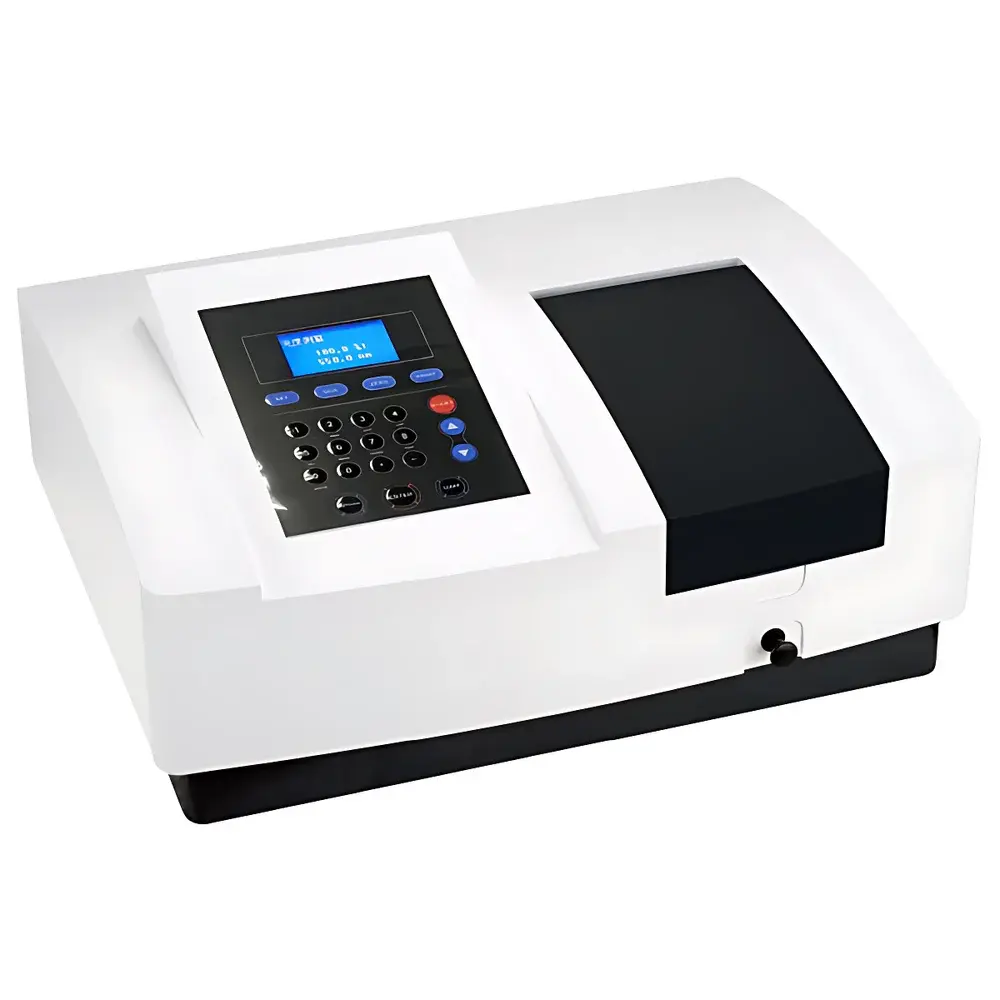
Yoke UV754N Ultraviolet-Visible Spectrophotometer
| Brand | Yoke |
|---|---|
| Origin | Shanghai, China |
| Manufacturer Type | Direct Manufacturer |
| Instrument Architecture | Single-Beam |
| Detector Type | Photocell |
| Wavelength Range | 190–1100 nm |
| Wavelength Drive | Automatic |
| Spectral Bandwidth | 4 nm |
| Wavelength Accuracy | ±2 nm |
| Wavelength Repeatability | 0.5 nm |
| Photometric Accuracy (Transmittance) | ±0.5% T |
| Photometric Repeatability (Transmittance) | 0.2% T |
| Transmittance Range | 0.0–200% T |
| Absorbance Range | −0.030 to 3.0 A |
| Stray Light | ≤0.3% T at 220 nm and 360 nm |
| Baseline Stability | ±0.002 A/h |
| Display | 128 × 64 dot-matrix LCD |
| Interface | RS-232 serial port |
| Printer Support | Standard parallel printer interface |
| Data Storage | Onboard microcontroller with curve & measurement data retention |
| Self-Diagnostic Function | Yes |
| Power Failure Protection | Yes |
| Built-in Quantitative Analysis Software | Yes |
Overview
The Yoke UV754N Ultraviolet-Visible Spectrophotometer is a single-beam, microprocessor-controlled analytical instrument engineered for routine quantitative and qualitative analysis in academic laboratories, quality control environments, and industrial R&D settings. It operates on the fundamental principle of Beer–Lambert law-based absorption spectroscopy, measuring the attenuation of ultraviolet and visible light as it passes through a sample solution. With a spectral coverage from 190 nm to 1100 nm—spanning deep UV through near-infrared—the UV754N supports common applications including nucleic acid/protein quantification, dye concentration determination, enzyme kinetics monitoring, and pharmaceutical assay validation. Its fixed 4 nm spectral bandwidth ensures adequate resolution for standard compliance testing while maintaining optical throughput and signal-to-noise performance suitable for routine laboratory use. The instrument employs a stable tungsten-halogen lamp for the visible/NIR region and a deuterium lamp for the UV region, with automatic lamp switching synchronized to wavelength selection.
Key Features
- Integrated 51-series microcontroller architecture enabling onboard storage of up to 20 standard calibration curves and 100 individual measurement datasets—retained during power cycling via non-volatile memory.
- Automated wavelength scanning with precision stepper-motor-driven monochromator; wavelength positioning accuracy of ±2 nm and repeatability of ±0.5 nm across the full 190–1100 nm range.
- Real-time self-diagnostic system continuously monitors lamp status, detector response, optical alignment, and power supply integrity—displaying error codes and guiding users toward corrective actions.
- Power-failure protection mechanism preserves unsaved measurements and active method parameters, resuming operation seamlessly upon restoration of AC power without data loss.
- Dedicated quantitative analysis module supporting single-point, multi-point, and linear regression calibration modes; results exportable via RS-232 to external PCs or LIMS systems.
- Robust mechanical design with thermally stabilized optical bench and sealed monochromator housing to minimize drift and maintain baseline stability at ±0.002 A/h over extended operation.
Sample Compatibility & Compliance
The UV754N accommodates standard 10 mm pathlength quartz or glass cuvettes (including matched pairs for reference/blank compensation), as well as optional microvolume adapters and flow cells for specialized workflows. Its photometric performance meets key requirements outlined in ISO 6223 (spectrophotometer verification), ASTM E275 (description of ultraviolet and visible spectrophotometric methods), and USP (Spectrophotometry and Light-Scattering). While not validated for 21 CFR Part 11 compliance out-of-the-box, its RS-232 interface supports integration into validated laboratory networks when paired with compliant third-party data acquisition software featuring audit trail, electronic signature, and user access control functionality. The instrument satisfies general GLP and GMP documentation needs for non-regulated QC testing and educational use.
Software & Data Management
The UV754N includes embedded firmware with an intuitive menu-driven interface displayed on its 128 × 64 pixel monochrome LCD. All quantitative operations—including blank subtraction, absorbance/transmittance conversion, concentration calculation, and kinetic time-scan setup—are executed locally without external PC dependency. Measurement data and calibration curves are stored in internal EEPROM. Raw spectral or kinetic data can be transmitted in ASCII format via the RS-232 port (configured at 9600 bps, 8N1) for post-processing in Excel, MATLAB, or dedicated spectroscopy platforms. A standard Centronics-compatible parallel port allows direct connection to impact or thermal printers for hard-copy reporting—ideal for labs operating under paper-based SOPs.
Applications
- Quantification of DNA (260 nm), RNA, and proteins (280 nm) using established extinction coefficients.
- Colorimetric assays such as Bradford, Lowry, and BCA with customizable calibration protocols.
- Stability testing of pharmaceutical formulations via UV absorbance monitoring at specified wavelengths.
- Water quality analysis—including nitrate, phosphate, and heavy metal complex detection—using EPA-approved colorimetric methods.
- Educational instruction in analytical chemistry, where reproducibility, ease of operation, and hardware transparency support pedagogical objectives.
- Raw material verification in food, cosmetic, and chemical manufacturing per internal specifications.
FAQ
What type of detector is used in the UV754N?
A silicon photocell provides broadband detection across the 190–1100 nm range, optimized for linearity and long-term responsivity stability.
Does the instrument support kinetic or time-scan measurements?
Yes—the onboard firmware enables time-based absorbance monitoring at a user-defined wavelength, with up to 200 data points recordable internally.
Can the UV754N be connected to modern Windows or macOS systems?
Via RS-232, yes—with appropriate USB-to-serial adapters and terminal emulation software (e.g., Tera Term, PuTTY) or custom Python/Node.js scripts for automated data ingestion.
Is quartz cuvette compatibility confirmed for the full UV range?
Yes—standard 1 cm quartz cuvettes are required for measurements below 350 nm; optical grade fused silica is recommended for extended UV durability.
How is wavelength accuracy verified during routine maintenance?
Using traceable holmium oxide or didymium oxide filters per ISO 6223 Annex B; peak wavelength positions at 241.5 nm, 279.4 nm, 287.5 nm, 333.7 nm, and 360.9 nm serve as primary verification references.






