
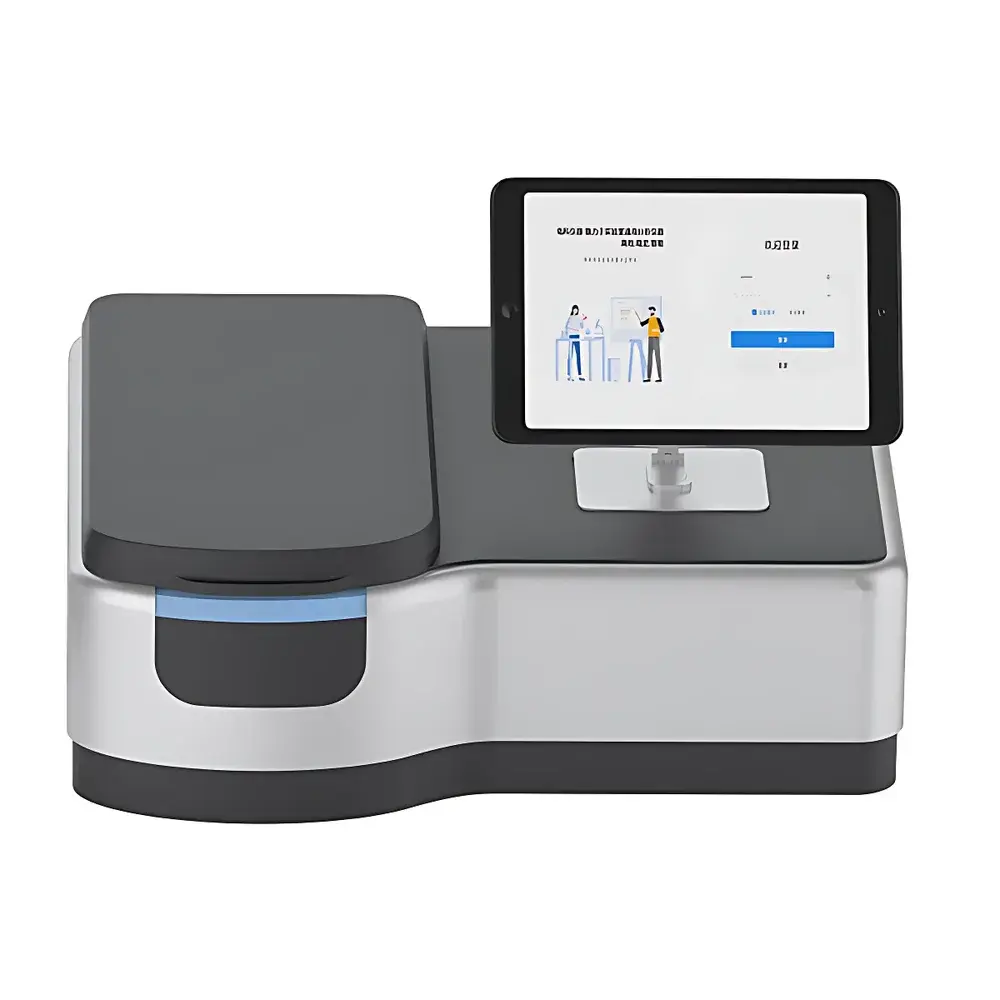
Luban Instruments M5 Ultraviolet-Visible Spectrophotometer
| Brand | Yoke |
|---|---|
| Origin | Shanghai, China |
| Manufacturer Type | Direct Manufacturer |
| Region of Origin | Domestic (China) |
| Model | M5 |
| Quotation | Upon Request |
| Optical Design | Pseudo-Double-Beam |
| Detector Type | Photodiode Array (PDA) |
| Wavelength Range | 190–1100 nm |
| Automation Level | Automatic Wavelength Scanning |
| Display | 11-inch 2.8K Resolution Tablet PC |
| Optical System | Dual-Beam Ratio Monitoring |
| Light Sources | Deuterium Lamp + Tungsten Halogen Lamp |
| Spectral Bandwidth | 2 nm |
| Photometric Resolution | 0.00001 Abs |
Overview
The Luban Instruments M5 Ultraviolet-Visible Spectrophotometer is a high-performance, pseudo-double-beam spectrophotometric platform engineered for precision absorbance, transmittance, and reflectance measurements across the ultraviolet, visible, and near-infrared spectral regions (190–1100 nm). Its optical architecture employs dual-beam ratio monitoring to continuously correct for source intensity drift and environmental fluctuations—ensuring high baseline stability and measurement reproducibility without requiring manual reference repositioning. The instrument integrates a deuterium lamp for UV-range excitation (190–350 nm) and a tungsten-halogen lamp for visible-to-NIR coverage (350–1100 nm), both optimized for extended operational lifetime and configurable on-demand activation. Unlike conventional single-beam systems, the M5’s real-time beam-ratio compensation enables robust quantification under variable ambient conditions—critical for routine QC labs, academic research, and regulatory-compliant environments.
Key Features
- Integrated 11-inch 2.8K-resolution tablet PC with capacitive touchscreen, supporting automatic bilingual UI switching (English/Chinese) via embedded firmware—no external computer required.
- Pseudo-double-beam optical path with photodiode array (PDA) detection, delivering simultaneous multi-wavelength acquisition and eliminating mechanical wavelength scanning delays.
- Photometric resolution of 0.00001 Abs—enabling trace-level analyte detection in high-dilution biological or environmental samples.
- Spectral bandwidth fixed at 2 nm, compliant with ISO 9001 calibration traceability requirements for spectral purity and stray light control.
- Intelligent self-diagnostic software suite that executes automated performance verification (e.g., wavelength accuracy, photometric linearity, stray light, baseline flatness) and logs results with timestamped audit trails.
- Configurable alarm protocol supporting SMS and email notifications upon detection of abnormal absorbance deviation, hardware fault codes, or calibration expiry.
- Multi-tier user access control (administrator, analyst, viewer) with role-based permissions, password protection, and encrypted local data storage—aligned with GLP and FDA 21 CFR Part 11 principles for electronic records integrity.
Sample Compatibility & Compliance
The M5 accommodates a broad range of sample formats via standardized 10-mm cuvette holders and optional accessories including automated 8-position cuvette changers, temperature-controlled cell holders (±0.1 °C stability), integrating spheres for diffuse reflectance, solid-sample stages with adjustable incidence angles (0°–90°), and variable-pathlength cells (0.1–10 cm). It supports nucleic acid and protein quantification using preloaded A260/A280 algorithms per standard protocols (e.g., Bradford, Lowry, BCA). All optical components comply with IEC 61000-4 electromagnetic compatibility standards and meet CE safety directives. Instrument validation documentation—including factory calibration certificates traceable to NIM (National Institute of Metrology, China) and optional IQ/OQ/PQ support packages—is available for GMP-regulated laboratories.
Software & Data Management
The embedded software platform provides full-featured spectral acquisition and analysis: photometric mode, quantitative analysis with multi-point calibration curves (linear, quadratic, cubic), kinetic time-scan profiling, wavelength scanning with peak identification and derivative processing, 3D contour mapping, multi-wavelength quantitation, and nucleic acid/protein concentration calculation. Data export conforms to ASTM E1381-22 and ISO/IEC 17025:2017 requirements—supporting CSV, TXT, and XML formats with metadata embedding (operator ID, date/time, instrument serial number, method name). Audit trail functionality records all user actions, parameter modifications, and calibration events with immutable timestamps—satisfying GLP data integrity mandates.
Applications
The M5 serves as a versatile analytical workhorse in pharmaceutical QC (excipient assay, dissolution testing), environmental monitoring (COD, nitrate, phosphate, heavy metal chelate quantification), food safety (colorant analysis, antioxidant capacity assays), life sciences (enzyme kinetics, ligand-binding studies, oligonucleotide purity assessment), and materials science (thin-film transmittance, pigment dispersion characterization). Its 2 nm spectral bandwidth and sub-10 µAbs photometric resolution make it suitable for low-concentration biomolecular work—particularly in academic core facilities where flexibility, ease of training, and compliance-ready operation are prioritized.
FAQ
Is the M5 compliant with FDA 21 CFR Part 11 for electronic signatures and audit trails?
Yes—the system supports user authentication, electronic signature capture, and tamper-evident audit logging with configurable retention policies.
Can the instrument be integrated into a LIMS environment?
Yes—via TCP/IP and RS-232 interfaces; raw data and metadata are exportable in ASTM-compliant formats compatible with major LIMS platforms.
What is the typical warm-up time required before achieving photometric stability?
Less than 15 minutes for full thermal and lamp stabilization under standard lab conditions (20–25 °C, <60% RH).
Does the M5 support third-party accessory integration (e.g., flow cells, fiber-optic probes)?
Yes—through standardized analog/digital I/O ports and programmable TTL triggers, enabling synchronization with HPLC detectors or automated sampling systems.
How is wavelength accuracy verified and maintained over time?
Using built-in holmium oxide and didymium oxide filters; automated wavelength validation routines generate calibration reports with pass/fail status per ISO 8579-1:2021 criteria.




