
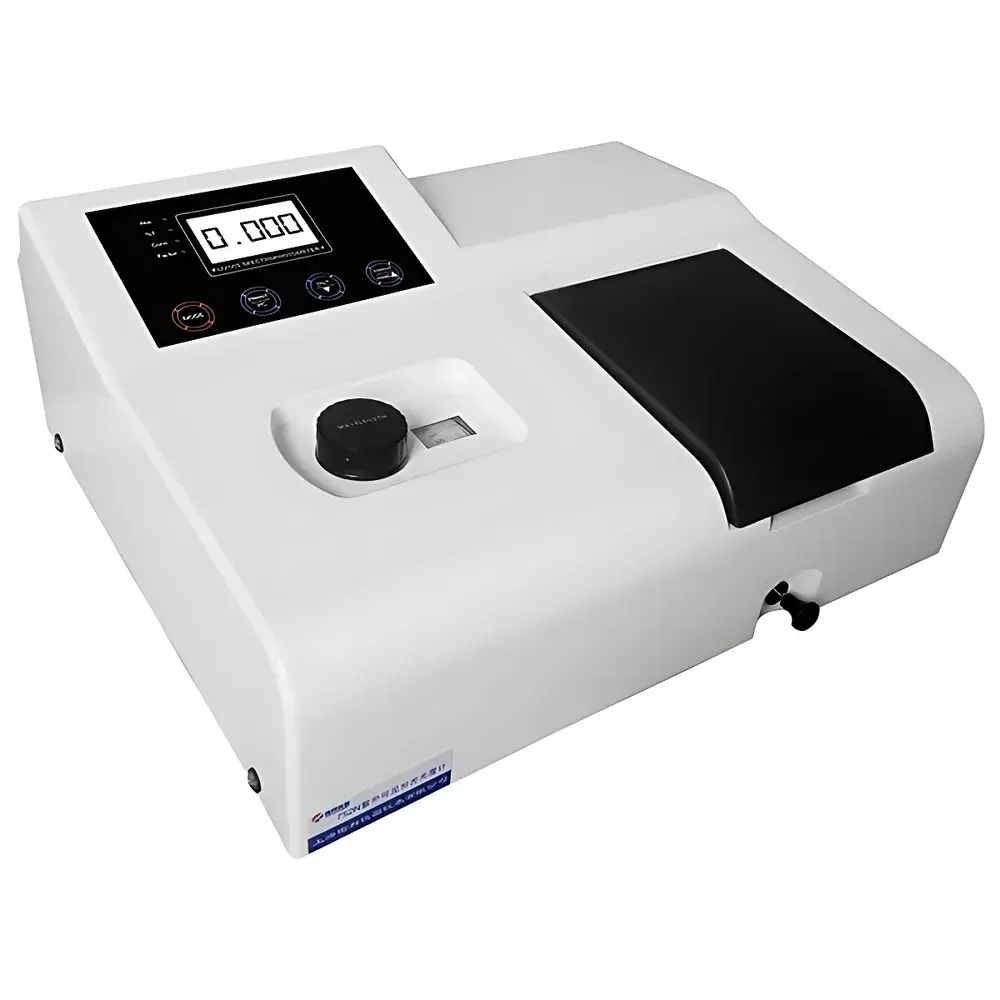
Yoke 721 Visible Spectrophotometer
| Brand | Yoke |
|---|---|
| Origin | Shanghai, China |
| Manufacturer Type | Direct Manufacturer |
| Product Category | Domestic |
| Model | 721 |
| Optical System | Czerny-Turner with 1200 L/mm grating |
| Wavelength Range | 350–1020 nm |
| Wavelength Accuracy | ±2 nm |
| Spectral Bandwidth | 6 nm |
| Wavelength Repeatability | ≤1 nm |
| Photometric Accuracy (Transmittance) | ±1% T |
| Stray Light | ≤0.3% T @ 360 nm |
| Baseline Stability | ±0.004 A/h @ 500 nm |
| Noise Level | ≤0.3% T |
| Photometric Range | 0–200% T, –0.3–3 A, 0–9999 C |
| Measurement Modes | Transmittance (T), Absorbance (A), Concentration (C) |
| Zero Adjustment | Automatic |
| Light Source | Tungsten Halogen Lamp |
| Detector | Photodiode Array |
| Beam Type | Single-beam |
| Wavelength Selection | Manual |
| Sample Chamber Dimensions | Accommodates up to 10 cm pathlength cuvettes |
| Interface Options | RS-232 (optional) |
| Net Weight | 8 kg |
| Compliance | Designed for routine laboratory use in accordance with general principles of ISO/IEC 17025-compliant analytical practice |
Overview
The Yoke 721 Visible Spectrophotometer is a precision-engineered single-beam optical instrument designed for quantitative and qualitative analysis in the visible spectral region. Operating on the principle of Beer-Lambert law-based absorbance measurement, it employs a Czerny-Turner monochromator configuration with a 1200 lines/mm holographic grating to deliver consistent wavelength dispersion across its operational range of 350–1020 nm. The system utilizes a stabilized tungsten halogen lamp as its broadband light source and a photodiode array detector for reliable signal acquisition. With a fixed spectral bandwidth of 6 nm and wavelength accuracy of ±2 nm, the 721 provides reproducible photometric data suitable for educational laboratories, quality control environments, and routine industrial testing where robustness and operational simplicity are prioritized over high-throughput automation.
Key Features
- Single-beam optical architecture optimized for stability and cost-effective maintenance
- Manual wavelength selection via calibrated dial—engineered for intuitive operation without software dependency
- Automatic zero and 100% transmittance calibration routines to minimize operator-induced drift
- Large sample compartment accommodating standard 10 mm to 100 mm pathlength cuvettes—including rectangular quartz, glass, and plastic cells
- Digital LED display showing real-time transmittance (%T), absorbance (A), or concentration (C) values with three-digit resolution
- Integrated microprocessor control enabling consistent baseline correction and signal averaging
- Optional RS-232 serial interface for external data logging, printer output, or integration into legacy lab networks
- Compact benchtop footprint (W × D × H: ~350 × 320 × 180 mm) and lightweight design (8 kg net) for flexible placement in teaching labs or production QC stations
Sample Compatibility & Compliance
The Yoke 721 supports conventional liquid-phase spectroscopic analysis using standard cuvette formats. Its wide sample chamber allows direct insertion of 10 cm pathlength cells for low-concentration applications requiring extended optical paths. While not certified to specific regulatory standards such as FDA 21 CFR Part 11 or ISO 17025 accreditation out-of-the-box, the instrument’s design aligns with foundational metrological requirements for routine spectrophotometric measurements under GLP and GMP-aligned workflows. Its ±1% T photometric accuracy and ≤0.3% T stray light specification at 360 nm meet typical acceptance criteria for visible-range instruments used in pharmaceutical excipient testing, dye concentration assays, and water quality parameter evaluation per ASTM D1209 and ISO 7027 methodologies.
Software & Data Management
The Yoke 721 operates independently of proprietary software; all core functions—including auto-zero, auto-100%T, and mode switching—are executed via front-panel controls. When equipped with the optional RS-232 interface, the instrument outputs ASCII-formatted data packets compatible with generic terminal emulators, spreadsheet applications (e.g., Microsoft Excel via serial-to-USB adapters), or custom LabVIEW-based acquisition modules. No embedded audit trail, user access control, or electronic signature functionality is provided—consistent with its classification as a basic-class educational and industrial support tool rather than a regulated-data-capture platform. Data integrity relies on manual recording protocols or externally validated third-party logging systems.
Applications
- Quantitative determination of colored analytes (e.g., nitrate, phosphate, iron complexes) in environmental water samples
- Enzyme kinetics monitoring via NADH/NADPH absorbance at 340 nm
- Colorimetric assay validation in food safety testing (e.g., sulfite, formaldehyde)
- Teaching fundamental spectroscopic concepts including Beer’s law verification, calibration curve construction, and wavelength-dependent absorption profiling
- Routine QC checks of dyes, pigments, and cosmetic formulations in manufacturing settings
- Verification of filter performance and optical component transmission characteristics
FAQ
What is the maximum cuvette pathlength supported by the Yoke 721?
The instrument accommodates cuvettes up to 100 mm in optical pathlength due to its expanded sample chamber geometry.
Does the 721 require wavelength calibration with external standards?
No routine recalibration is required; the mechanical wavelength drive is factory-aligned and maintains ±2 nm accuracy across its lifetime under normal operating conditions.
Can the 721 measure absorbance below 350 nm?
No—the optical design and tungsten lamp emission profile limit reliable operation to the visible and near-NIR range (350–1020 nm); UV measurements require deuterium-lamp-equipped instrumentation.
Is the RS-232 interface included by default?
No—it is an optional accessory; units shipped without this interface lack serial communication capability.
What maintenance is recommended for long-term stability?
Annual verification of lamp intensity and detector linearity using neutral density filters or NIST-traceable reference standards is advised for critical applications.






