
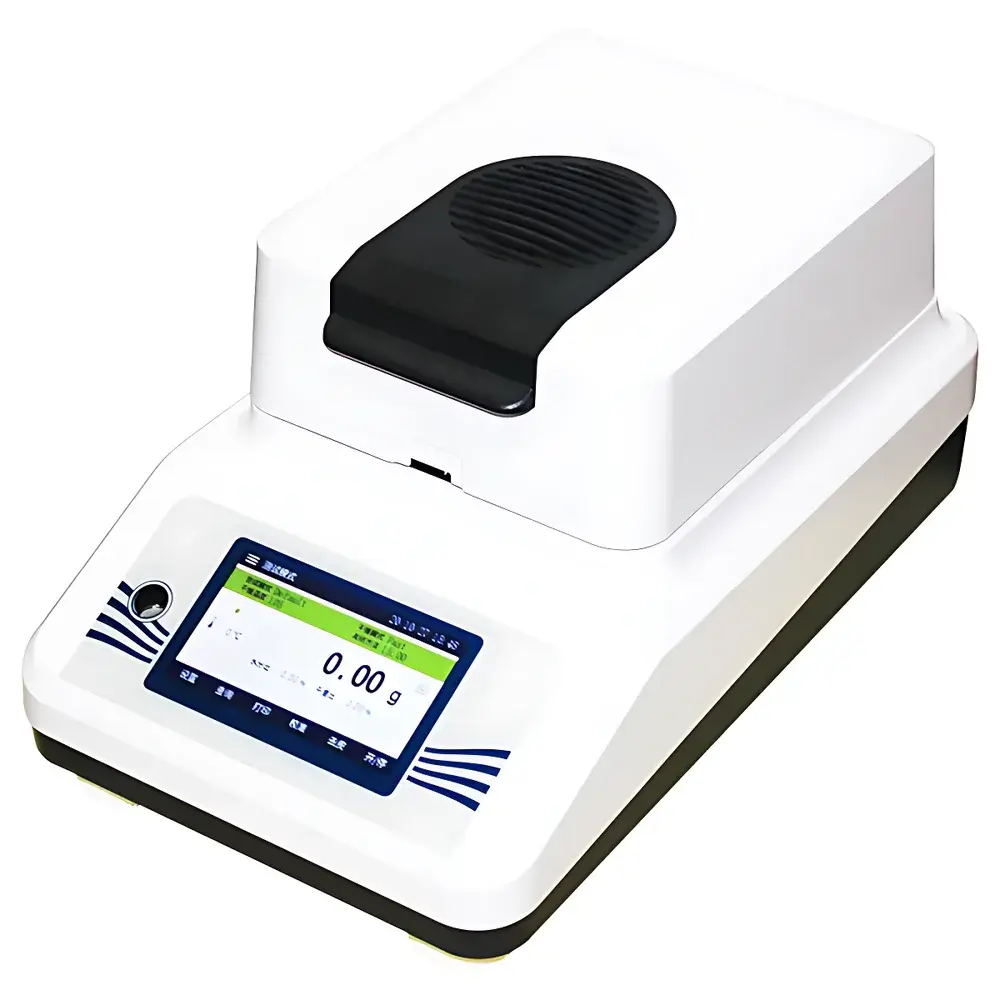
Yoke TSF-50A-1 Touchscreen Halogen Moisture Analyzer
| Brand | Yoke |
|---|---|
| Origin | Shanghai, China |
| Manufacturer | Yoke Instrument Co., Ltd. |
| Model | TSF-50A-1 |
| Heating Source | Halogen Lamp |
| Weighing Range | 0–50 g |
| Readability | 1 mg |
| Moisture Readability | 0.01% |
| Repeatability (3 g sample) | ±0.2% |
| Sample Capacity | 0.5–10 g (recommended: 3–10 g) |
| Temperature Range | 50–160 °C (1 °C increments) |
| Drying Time | 1–99 min (1 min increments) |
| Drying Modes | Standard & Rapid |
| Auto-termination | Yes |
| Display | 4.3" TFT LCD touchscreen |
| Interface | USB |
| Pan Diameter | 80 mm |
| Dimensions (L×W×H) | 340 × 210 × 180 mm |
| Net Weight | 3.6 kg |
| Operating Environment | 10–30 °C, ≤75% RH |
| Compliance | GB/T 29249–2012 |
Overview
The Yoke TSF-50A-1 Touchscreen Halogen Moisture Analyzer is a precision laboratory instrument engineered for rapid, gravimetric moisture determination in solid and semi-solid samples. It operates on the loss-on-drying (LOD) principle: a halogen lamp provides uniform, controllable thermal energy to dehydrate the sample; an integrated high-stability weighing system continuously monitors mass loss in real time until equilibrium is reached. Unlike conventional oven drying methods requiring hours, the TSF-50A-1 achieves reliable results in minutes—typically 3–10 minutes depending on sample type and selected drying profile—while maintaining metrological equivalence to reference ASTM E1447 and ISO 12373-1 methodologies. Its design centers on thermal isolation between heating and weighing modules, minimizing drift caused by thermal expansion or convection currents—a critical factor for achieving 1 mg readability and ±0.2% repeatability with 3 g test samples.
Key Features
- Halogen heating system: Delivers rapid, homogeneous heat distribution with precise digital temperature control (50–160 °C, adjustable in 1 °C steps), ensuring consistent drying kinetics across diverse matrices.
- Thermally isolated weighing module: Utilizes a proprietary shielded load cell architecture to decouple thermal stress from the measurement path, preserving accuracy throughout extended heating cycles.
- 4.3-inch capacitive touchscreen interface: Enables intuitive parameter configuration—including drying mode (Standard/Rapid), target temperature, duration, and auto-termination criteria—without external software or keyboard input.
- Real-time multi-parameter visualization: Simultaneously plots moisture %, dry weight %, sample mass (g), temperature (°C), and elapsed time—supporting immediate assessment of drying behavior and endpoint detection.
- USB connectivity: Supports direct data export to PC-based spreadsheet applications or LIMS environments; also enables connection to USB-compatible thermal printers for GLP-compliant hard-copy reporting.
- Compliance-ready operation: Meets GB/T 29249–2012 requirements for electronic moisture analyzers based on thermogravimetric principles, including verification protocols for temperature uniformity, mass stability, and repeatability under defined environmental conditions (10–30 °C, ≤75% RH).
Sample Compatibility & Compliance
The TSF-50A-1 accommodates a broad range of non-volatile, thermally stable materials—including pharmaceutical excipients, granules, and tablets; food powders (e.g., starch, flour, milk powder); agricultural commodities (grains, seeds, feed pellets); chemical catalysts and polymers; and environmental soil/sediment extracts. Samples must be representative, homogenous, and free of volatile solvents beyond water to ensure LOD validity. The instrument supports method development per USP , Ph. Eur. 2.2.32, and AOAC 952.09 guidelines. While not FDA 21 CFR Part 11–certified out-of-the-box, its audit-trail-capable USB data logs—when paired with validated lab procedures—meet basic GMP/GLP documentation requirements for routine QC testing in regulated environments.
Software & Data Management
No proprietary software installation is required. All operational parameters, measurement curves, and final results are stored internally and exported via USB as plain-text CSV files compatible with Excel, MATLAB, or laboratory information management systems (LIMS). Each record includes timestamp, operator ID (manually entered), sample ID, drying mode, set temperature, duration, initial/final mass, moisture content (%), and dry residue weight. For laboratories requiring electronic signatures or change control, external validation of the USB export workflow—including file integrity checks and user access logging—is recommended during IQ/OQ/PQ qualification.
Applications
- Pharmaceutical: Quantification of residual moisture in active pharmaceutical ingredients (APIs), lyophilized products, and tablet coatings per ICH Q5C stability guidance.
- Food & Beverage: Routine quality control of moisture in snacks, cereals, coffee beans, and dairy powders to ensure shelf-life compliance and prevent microbial growth.
- Agriculture & Feed: Rapid assessment of grain moisture prior to storage or milling—critical for preventing aflatoxin formation and optimizing drying energy use.
- Chemicals & Polymers: Verification of drying efficacy in resins, catalysts, and battery electrode materials where trace water compromises performance or safety.
- Environmental Testing: Determination of moisture content in soil, sludge, and compost samples per EPA Method 9095B equivalents.
FAQ
What calibration standards are required for daily verification?
External calibration using certified weights (e.g., Class M2, 10 g and 50 g) is mandatory before first use and after any relocation or mechanical shock. Temperature calibration requires a NIST-traceable probe; factory calibration is valid for 12 months under normal operating conditions.
Can the TSF-50A-1 be used for volatile organic compound (VOC) analysis?
No. This instrument measures total volatile loss interpreted as moisture only. Samples containing ethanol, acetone, or other low-boiling solvents will yield erroneously high moisture values and are outside its intended scope.
Is the halogen lamp replaceable by the user?
Yes. The lamp assembly is a field-serviceable component with standardized mounting; replacement kits and torque specifications are provided in the technical manual.
How does the “Rapid” drying mode differ from “Standard”?
“Rapid” applies full-power heating to reach set temperature faster but may induce surface crust formation in sensitive samples; “Standard” uses ramped heating for gentler, more uniform dehydration—preferred for regulatory submissions.
What environmental conditions affect measurement stability?
Ambient drafts, direct sunlight, and vibration sources degrade repeatability. The unit must be placed on a level, rigid bench within the specified 10–30 °C / ≤75% RH envelope; leveling feet are adjustable via front/rear screw columns.
Related Products





