
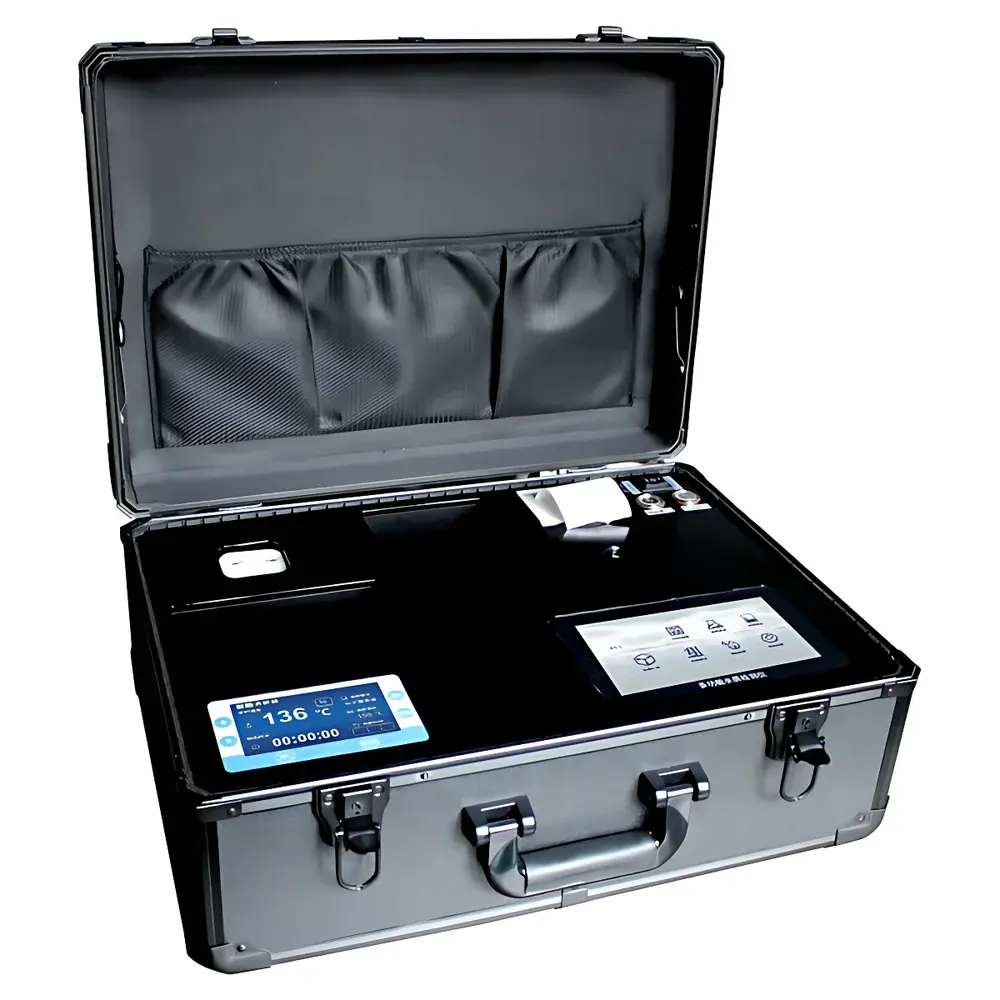
Yoke MIT-1000 Series Portable Water Quality Analyzer
| Brand | Yoke |
|---|---|
| Origin | Shanghai, China |
| Manufacturer Type | Direct Manufacturer |
| Regional Classification | Domestic (China) |
| Model | MIT-1000 |
| Instrument Type | Portable / Handheld Water Quality Analyzer |
| Measurable Parameters | COD, Ammonia Nitrogen, Total Phosphorus, Total Nitrogen, Turbidity, Color, Suspended Solids, Hexavalent Chromium, Lead, Cadmium, Copper, Zinc, Iron, Nickel, Manganese, Arsenic, Aluminum, Cyanide, Nitrite, Nitrate, Sulfate, Phosphate, Chloride, Fluoride, Hardness, Residual Chlorine, Total Chlorine, Chlorine Dioxide, Formaldehyde (in air/water/textiles), Sulfide, Volatile Phenols |
| Detection Methodology | Multiple Standardized Spectrophotometric Methods (e.g., Dichromate Digestion for COD, Nessler’s Reagent for NH₃-N, Molybdate Blue for TP, etc.) |
| Display | Dual Touchscreen (7.6″ + 5.6″), Chinese UI |
| Power Supply | Dual-mode — Rechargeable Li-ion Battery (≥12 h runtime) + AC Adapter |
| Data Storage | ≥5000 test records, 200 user-defined calibration curves, built-in standard curves |
| Optical System | Cold LED Light Source with Narrow-band Interference Filters, Lifetime ≥100,000 h |
| Processor | ARM9 Core, 512 MB Internal Memory |
| Connectivity | Integrated Thermal Printer (timestamped reports with parameter labels) |
| Reagent Compatibility | Pre-filled Lab-YY Vial Kits (shelf-stable, no manual preparation required) |
| Compliance Support | Designed to align with ISO 7027 (turbidity), ISO 6060 (COD), ISO 7150-1 (NH₃-N), ISO 8242 (TP), EPA 365.4 (phosphorus), ASTM D1253 (residual chlorine), and relevant Chinese national standards (e.g., HJ/T 399–2007, HJ 535–2009, HJ 636–2012) |
Overview
The Yoke MIT-1000 Series Portable Water Quality Analyzer is an integrated field-deployable spectrophotometric platform engineered for on-site quantification of over 40 critical water quality parameters. It operates on the principle of standardized colorimetric and spectrophotometric detection—leveraging narrow-band interference filter optics, cold LED illumination, and precise wavelength-selective photometry to ensure high reproducibility across diverse matrices (surface water, wastewater, drinking water, industrial effluents, and groundwater). Unlike benchtop analyzers requiring laboratory infrastructure, the MIT-1000 embeds digestion and measurement in a single instrument with dual-zone thermal control—enabling rapid, standardized oxidation reactions (e.g., dichromate-based COD digestion at 165 °C, 15 min) followed by immediate absorbance readout without sample transfer or optical alignment. Its ARM9-based architecture supports real-time signal processing, multi-point calibration validation, and automatic blank correction—critical for minimizing operator-induced variability in uncontrolled environments.
Key Features
- Dual touchscreen interface (7.6″ main display + 5.6″ auxiliary control panel) with intuitive Chinese-language GUI optimized for field technicians and environmental inspectors.
- Integrated digestion module with programmable temperature ramping and dwell control—compliant with HJ/T 399–2007 (COD), HJ 535–2009 (ammonia nitrogen), and HJ 636–2012 (total nitrogen).
- Cold LED light source with spectral bandwidth <5 nm and lifetime exceeding 100,000 hours—eliminating lamp drift and reducing recalibration frequency.
- Dual power architecture: High-capacity rechargeable lithium-ion battery (≥12 h continuous operation) plus universal AC adapter—auto-switching ensures uninterrupted measurement during extended surveys.
- Built-in thermal printer generating timestamped, parameter-labeled reports compliant with internal QA documentation requirements; supports GLP-style audit trails when paired with optional data export modules.
- Onboard memory stores ≥5000 test results and up to 200 user-defined calibration curves; factory-loaded reference curves cover all major EPA and Chinese standard methods.
- Automatic power-loss recovery and non-volatile data retention—preserves intermediate results and calibration states during unexpected shutdowns.
Sample Compatibility & Compliance
The MIT-1000 accepts liquid samples ranging from clarified surface water to moderately turbid wastewater (up to 1000 NTU after optional filtration). Its optical path design accommodates both cuvette-based (10–50 mm pathlength) and vial-based measurements using Lab-YY pre-filled reagent kits—eliminating manual reagent handling, volumetric errors, and exposure hazards. All analytical methods implemented are traceable to internationally recognized protocols: COD per ISO 6060 and EPA 410.4; ammonia nitrogen per ISO 7150-1 and HJ 535–2009; total phosphorus per ISO 8242 and EPA 365.4; turbidity per ISO 7027; residual chlorine per ASTM D1253; and heavy metals (Cr⁶⁺, Pb, Cd, Cu, Ni) per ISO 11969 and GB/T 5750.6–2023. The instrument’s firmware architecture supports method versioning and user-accessible method logs—facilitating regulatory readiness for ISO/IEC 17025-accredited laboratories conducting field verification.
Software & Data Management
Firmware includes embedded data management tools supporting CSV export via USB host port, time-stamped result logging with operator ID tagging, and curve validation reporting (linearity R², intercept, slope, % recovery). Calibration curve storage adheres to ALCOA+ principles: attributable, legible, contemporaneous, original, accurate, complete, consistent, enduring, and available. While not natively 21 CFR Part 11 compliant, the system supports integration with external LIMS via serial or USB CDC mode—enabling electronic signature capture, audit trail archiving, and role-based access control when deployed within GxP-aligned workflows. Firmware updates are delivered via signed binary packages verified against Yoke’s secure OTA repository.
Applications
The MIT-1000 serves as a primary field tool for municipal water utilities performing routine distribution system monitoring; environmental consultancies conducting watershed assessments and effluent compliance checks; industrial EHS teams verifying pretreatment discharge limits; and academic researchers collecting spatially resolved water chemistry datasets. Its portability and dual-screen workflow reduce per-sample analysis time by >40% compared to conventional portable kits—particularly for multi-parameter campaigns (e.g., simultaneous COD/NH₃-N/TP measurement in stormwater outfalls). The inclusion of textile and air formaldehyde modules extends utility beyond aquatic matrices into occupational hygiene and product safety screening—subject to method-specific validation per ISO 16000-23 and GB/T 2912.1–2009.
FAQ
Does the MIT-1000 require daily calibration?
No—factory-loaded calibration curves remain stable for ≥30 days under normal field conditions; however, a blank verification and one-point standard check are recommended before each sampling session.
Can custom calibration curves be imported from external lab data?
Yes—users may upload CSV-formatted calibration data (wavelength, concentration, absorbance) directly via USB; the system validates curve fit statistics prior to activation.
Is the digestion module compatible with EPA-approved digestion protocols?
Yes—the heating block meets temperature uniformity and ramp rate specifications outlined in EPA Method 410.4 for COD and Method 350.1 for total Kjeldahl nitrogen (TKN) surrogate applications.
What is the optical path length for vial-based measurements?
10 mm fixed-pathlength geometry optimized for Lab-YY 16-mm round vials; cuvette mode supports 10, 20, and 50 mm pathlengths via mechanical adapter.
How is data integrity ensured during battery replacement?
Non-volatile FRAM memory retains all calibration coefficients, test history, and user settings—even during full battery removal or firmware reset.
Related Products







