
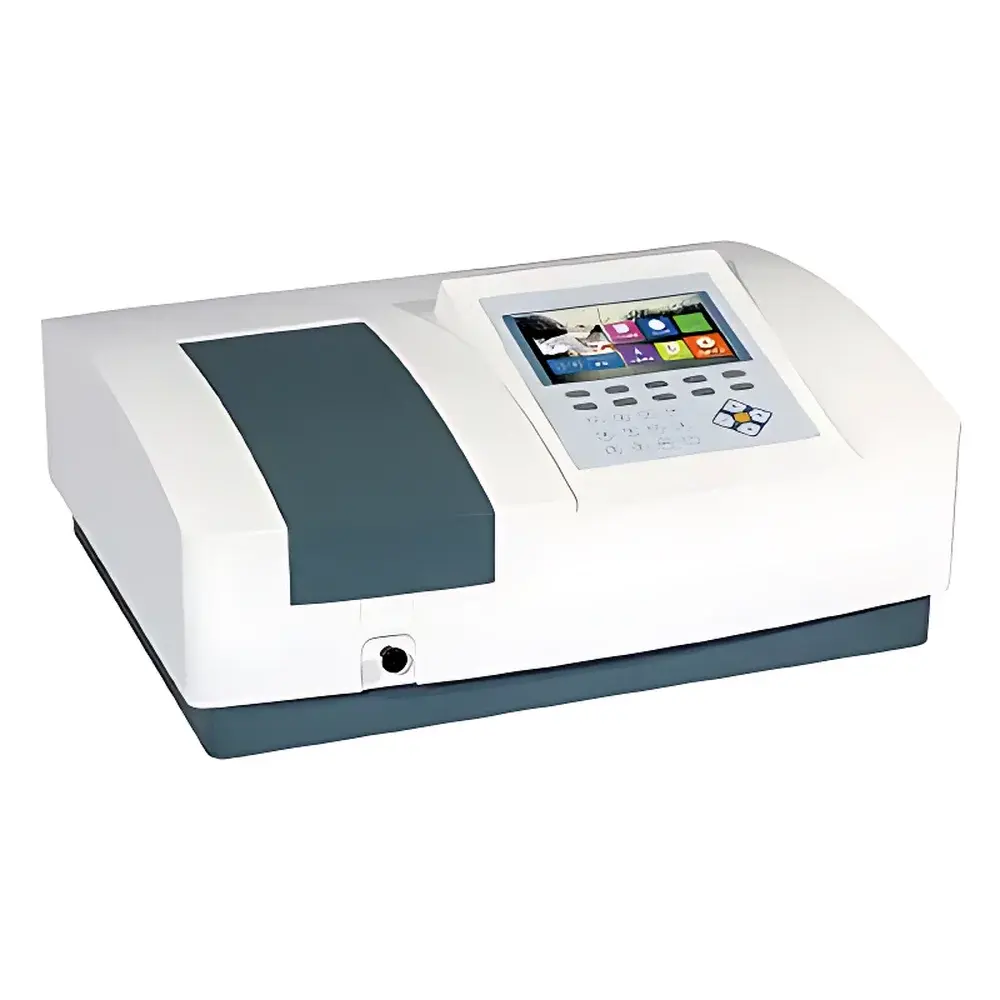
Yoke N5000 Dual-Beam UV-Vis Spectrophotometer with 7-inch TFT Color Display
| Brand | Yoke |
|---|---|
| Origin | Shanghai, China |
| Manufacturer Type | Direct Manufacturer |
| Instrument Architecture | Dual-Beam (Ratio Monitoring) |
| Detector Type | Silicon Photocell |
| Wavelength Range | 190–1100 nm |
| Wavelength Scanning | Manual (Motorized Wavelength Drive Not Included) |
| Spectral Bandwidth | 1.8 nm |
| Wavelength Accuracy | ±0.3 nm (Full Range), ±0.1 nm at D₂ Line (656.1 nm) |
| Stray Light | ≤0.03% T |
| Baseline Flatness | ±0.0015 A |
| Photometric Accuracy | ±0.002 A (0–0.5 A), ±0.004 A (0.5–1.0 A), ±0.2% T (0–100% T) |
| Photometric Repeatability | ≤0.001 A |
| Drift | ±0.0005 A/h at 500 nm |
| Data Storage | Internal Flash Memory + USB Mass Storage Support |
| Interface | USB 2.0, RS-232 |
| Power Supply | AC 110/220 V, 50/60 Hz |
| Dimensions (L×W×H) | 545 × 468 × 245 mm |
| Weight | 18 kg |
Overview
The Yoke N5000 is a dual-beam UV-Vis spectrophotometer engineered for precision quantitative and qualitative analysis in routine laboratory environments. It operates on the principle of ratio-based dual-beam photometry—splitting light from a stabilized deuterium/tungsten source into sample and reference paths, then continuously comparing their intensities to compensate for lamp intensity drift and electronic baseline variation. This architecture ensures high photometric stability and long-term measurement reproducibility without requiring frequent zeroing or recalibration. Designed to meet core performance criteria outlined in pharmacopoeial standards—including USP , EP 2.2.25, and ChP IV—this instrument delivers reliable absorbance, transmittance, concentration, and kinetic data across the full 190–1100 nm spectral range. Its fixed 1.8 nm spectral bandwidth satisfies the resolution requirements for most regulatory-compliant assays, including those specified in the Chinese Pharmacopoeia and general quality control protocols in chemical, pharmaceutical, and environmental testing laboratories.
Key Features
- Dual-beam optical design with real-time ratio monitoring for inherent compensation of source fluctuation and thermal drift
- 7-inch high-resolution TFT color LCD display with intuitive graphical interface and capacitive-touch membrane keypad
- ARM7-based embedded control system with high-speed 24-bit ADC and optimized firmware for low-noise signal acquisition
- Optical bench constructed with reinforced aluminum baseplate and precision-machined optical mounts; key optical components sourced from international suppliers
- Low-stray-light optical path (<0.03% T at 220 nm and 340 nm) achieved via optimized monochromator design and high-efficiency holographic grating
- Comprehensive photometric validation suite: baseline flatness ±0.0015 A, drift ≤±0.0005 A/h at 500 nm, wavelength repeatability ≤0.1 nm
- Integrated USB host port enabling direct data export to FAT32-formatted USB drives; RS-232 interface for legacy LIMS integration
Sample Compatibility & Compliance
The N5000 accommodates standard 10 mm square cuvettes (glass, quartz, or plastic) and supports optional accessories such as variable-pathlength cells, micro-volume adapters, and temperature-controlled holders. Its optical configuration complies with ISO 9001 manufacturing practices and meets essential metrological requirements defined in ISO/IEC 17025 for calibration laboratories. While not pre-certified for FDA 21 CFR Part 11, the instrument’s audit-ready data logging—timestamped absorbance spectra, method parameters, and operator ID (via manual entry)—supports GLP/GMP documentation workflows when deployed with validated SOPs. The system is routinely used in QC labs performing raw material identification, dissolution testing, purity assessment, and excipient compatibility studies per ICH Q5, Q6A, and USP general chapters.
Software & Data Management
The N5000 operates autonomously via its onboard firmware—no PC dependency required for basic operation. All spectral scans, kinetic runs, and multi-point calibrations are stored internally in non-volatile flash memory (≥10,000 spectra). Data export is supported in CSV format for post-processing in Excel, Origin, or MATLAB. Optional PC software (Yoke UVWinPro) provides extended functionality: spectral overlay, derivative analysis, peak search, and customizable report generation with embedded instrument metadata. Audit trails—including date/time stamps, user-defined method names, and version-controlled calibration logs—are retained locally and transferable via USB. The system supports traceable calibration using NIST-traceable neutral density filters and holmium oxide reference standards.
Applications
- Pharmaceutical QC: Active pharmaceutical ingredient (API) assay, excipient screening, and cleaning validation swab analysis
- Environmental testing: Nitrate/nitrite, phosphate, COD, and heavy metal quantification via colorimetric methods
- Food & beverage: Color index measurement (e.g., AOAC methods), antioxidant capacity (DPPH assay), and preservative concentration
- Academic research: Ligand-binding kinetics, enzyme activity (e.g., LDH, ALP), and nanoparticle size estimation via surface plasmon resonance
- Chemical synthesis: Reaction monitoring, stoichiometric endpoint detection, and polymer degradation profiling
FAQ
Does the N5000 support automatic wavelength scanning?
No—the N5000 uses manual wavelength selection via keypad input. It does not include motorized scanning hardware or built-in spectral scanning capability.
Is the instrument compliant with pharmacopoeial bandwidth requirements?
Yes—its 1.8 nm spectral bandwidth satisfies the ≤2 nm requirement specified in USP , EP 2.2.25, and ChP IV for most identity and assay procedures.
Can the N5000 be connected to a laboratory information management system (LIMS)?
Yes—via RS-232 serial output (ASCII protocol) or USB virtual COM port; integration requires middleware or custom driver development per site-specific LIMS architecture.
What is the recommended calibration frequency?
We recommend wavelength calibration using holmium oxide (241, 279, 287, 333, 360, 418, 480, 536 nm peaks) and photometric calibration with neutral density filters every 3 months—or before critical batch release testing.
Are quartz cuvettes required for measurements below 240 nm?
Yes—standard glass or plastic cuvettes absorb strongly below 350 nm; fused silica (quartz) cuvettes are mandatory for measurements in the far-UV region (190–240 nm).




