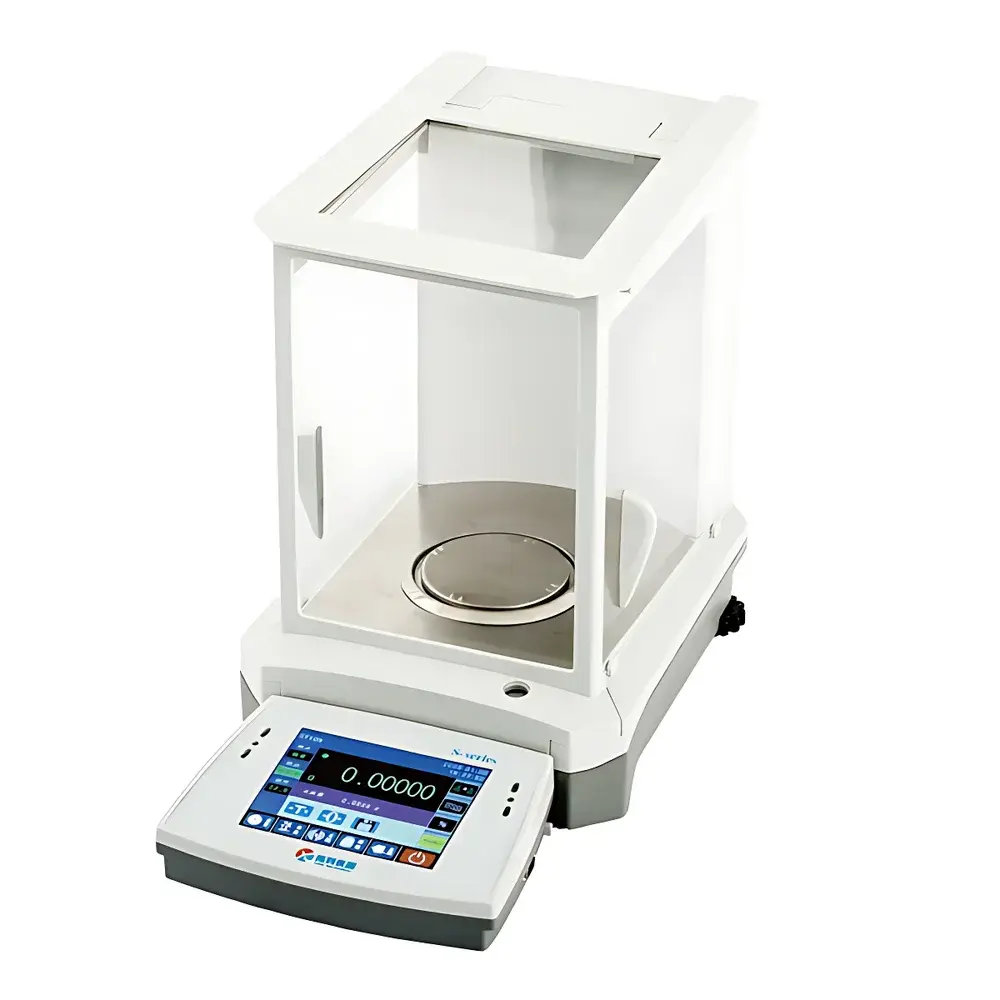
Yoke SY-C Series High-Precision Touchscreen Analytical Balance
| Brand | Yoke |
|---|---|
| Origin | Shanghai, China |
| Manufacturer Type | Direct Manufacturer |
| Instrument Type | Analytical Balance |
| Model | SY-C |
| Maximum Capacity | 220 g |
| Readability | 0.1 mg |
| Repeatability | 0.1 mg |
| Internal Calibration | Yes |
| Display | 5.6″ TFT Color LCD (262K colors) |
| Power Supply | DC 18 V / 3 A |
| Connectivity | RS-232 & USB |
| Construction | Stainless steel weighing pan, removable glass draft shield, stainless steel top cover, metal base, plastic dust cover |
| Data Storage | Built-in non-volatile memory |
| Software | SUPERTEXT 1.0 (supports animal, density, formulation, accumulation, checkweighing, percentage, counting, and target weighing modes) |
| Compliance | Designed for GLP/GMP environments |
Overview
The Yoke SY-C Series High-Precision Touchscreen Analytical Balance is an entry-level yet rigorously engineered analytical balance designed for routine laboratory quantification tasks requiring 0.1 mg readability and high operational reliability. Based on electromagnetic force compensation (EMFC) transduction technology, the SY-C delivers stable, drift-compensated mass measurement across its full capacity range (up to 220 g), with thermal and mechanical isolation between sensor, digital processing, and display modules ensuring minimal cross-interference. Its architecture adheres to fundamental metrological principles defined in OIML R76 and ISO/IEC 17025–compliant operation, making it suitable for quality control laboratories, academic teaching labs, and pharmaceutical pre-formulation workflows where traceable, repeatable mass determination is required—but without the complexity or cost of high-end research-grade balances.
Key Features
- 5.6-inch TFT color touchscreen (262,144 colors) with intuitive graphical user interface supporting multi-language operation (English, Spanish, French, German, Chinese); no physical buttons reduce wear and contamination risk.
- Fully isolated modular design: electromagnetic sensor assembly, CPU-based digital signal processing unit, and display electronics are physically separated by internal shielding and dedicated power regulation—minimizing thermal drift and electrical noise coupling.
- Internal calibration system activated automatically at user-defined intervals or manually via touchscreen; eliminates need for external weights during daily verification.
- Robust mechanical construction: corrosion-resistant stainless steel weighing pan (90 mm diameter), removable double-glass draft shield for rapid airflow stabilization, and integrated plastic dust cover for storage protection.
- Dual serial interfaces (RS-232 and USB Type-B) enable direct connection to PCs, LIMS, or PLC systems; compatible with Yoke’s SUPERTEXT 1.0 software for real-time data logging, report generation, and method-driven workflows.
Sample Compatibility & Compliance
The SY-C accommodates standard laboratory samples including powders, granules, liquids in tared vessels, and small solid components up to 220 g. Its draft shield geometry complies with ISO 9001 and USP guidelines for environmental disturbance mitigation during microgram-level measurements. The balance meets Class I accuracy requirements per OIML R76-1 (2021) for Class II analytical balances (0.1 mg readability). When deployed with SUPERTEXT 1.0 under controlled validation protocols—including electronic signature implementation, audit trail activation, and secure user role assignment—the system supports compliance with FDA 21 CFR Part 11, EU Annex 11, and GLP/GMP documentation standards.
Software & Data Management
SUPERTEXT 1.0 is a Windows-based PC application certified for bidirectional communication with the SY-C via RS-232 or USB. It provides validated, timestamped data capture with optional electronic signatures, configurable auto-save intervals, and CSV/PDF export formats traceable to instrument ID and operator credentials. The software implements eight preconfigured weighing modes: animal (dynamic averaging), density (with auxiliary density kit), formulation (multi-step ingredient addition), accumulation (batch totalization), checkweighing (tolerance band pass/fail), percentage (relative to reference mass), counting (parts-per-unit weight), and target weighing (guided incremental dosing). All operations generate structured metadata—including date/time stamp, ambient temperature/humidity (if external sensor connected), calibration status, and user ID—for full data integrity.
Applications
The SY-C serves as a primary mass measurement tool in multiple regulated and non-regulated settings: raw material receipt inspection in chemical manufacturing; tablet weight uniformity testing in pharmaceutical QC; sample preparation for HPLC or ICP-MS analysis; gravimetric standard solution preparation per ISO/IEC 17025; educational demonstrations of uncertainty propagation and repeatability assessment; and routine calibration verification of pipettes and volumetric glassware. Its 0.1 mg resolution and ≤0.1 mg repeatability meet minimum performance thresholds for USP Method 1 testing and ASTM E898–22 for analytical balance qualification.
FAQ
What is the maximum permissible error (MPE) for the SY-C at full capacity?
Per OIML R76-1, the MPE at 220 g is ±0.2 mg for Class II balances; actual factory-tested values are documented in the included calibration certificate.
Does the SY-C support external temperature/humidity sensors for environmental compensation?
No—environmental compensation is implemented internally via thermistor networks within the sensor housing; external sensor integration is not supported.
Can SUPERTEXT 1.0 be validated for 21 CFR Part 11 compliance?
Yes—when installed on a validated Windows OS platform with domain-level authentication, SUPERTEXT 1.0 supports ALCOA+ data integrity principles through audit trail logging, role-based access control, and electronic signature workflows.
Is the glass draft shield autoclavable?
No—the removable double-glass shield is designed for wipe-down cleaning only; autoclaving may compromise optical clarity and structural integrity.
What is the warm-up time required before first use?
Minimum 30 minutes at stable ambient temperature (20–25°C, ≤60% RH) is recommended to achieve thermal equilibrium and optimal repeatability.