
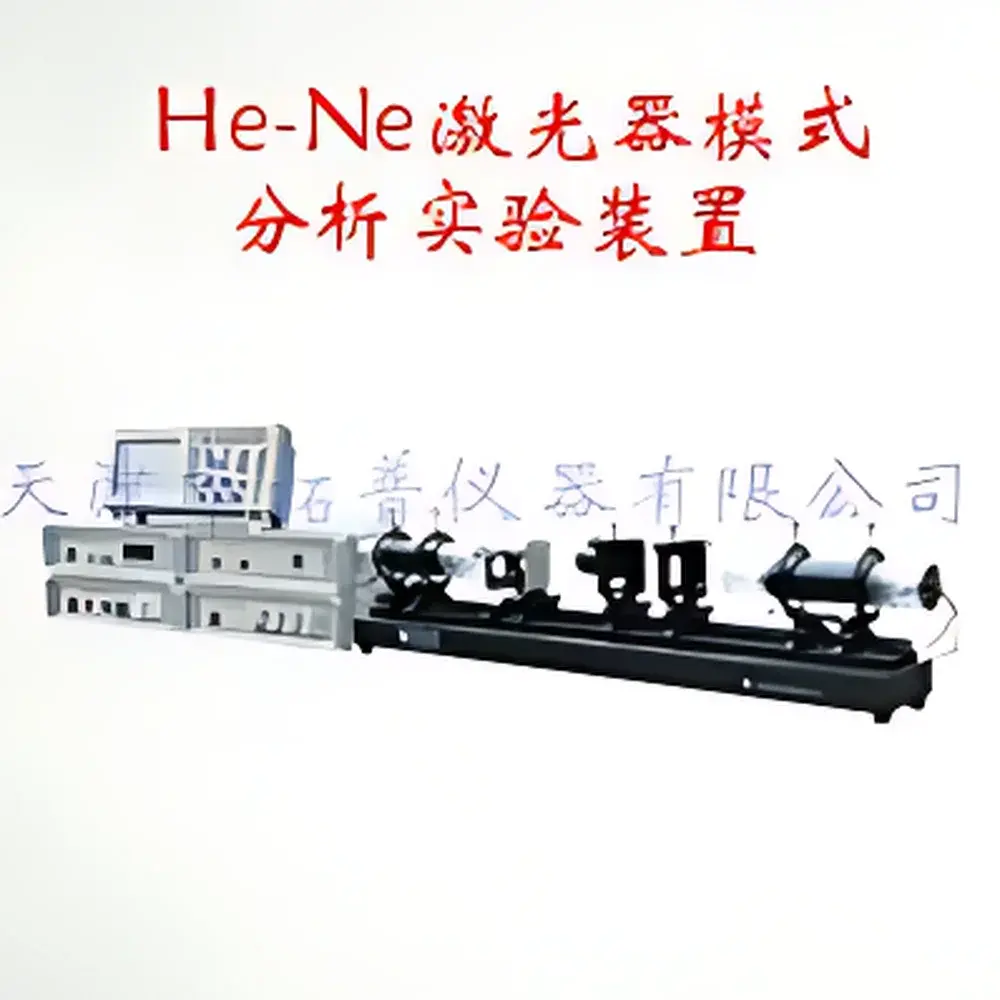
Topo XGL-3 He-Ne Laser Mode Analysis Experimental Setup
| Brand | Topo (TP) |
|---|---|
| Origin | Tianjin, China |
| Manufacturer Type | Direct Manufacturer |
| Product Origin | Domestic |
| Model | XGL-3 |
| Pricing | Upon Request |
Overview
The Topo XGL-3 He-Ne Laser Mode Analysis Experimental Setup is a pedagogically engineered optical instrumentation platform designed for undergraduate and graduate-level laser physics laboratories. It enables hands-on investigation of longitudinal and transverse mode structure in helium–neon (He-Ne) gas lasers through controlled cavity-length tuning and real-time spectral analysis. The system operates on the principle of confocal spherical Fabry–Pérot interferometry, leveraging the high finesse and free spectral range (FSR) of a scanning interferometer to resolve individual longitudinal modes (longitudinal mode spacing ≈ 1.5 GHz for typical 30 cm cavities) and their spatial intensity distribution across transverse electromagnetic (TEMmn) orders. Unlike commercial single-mode characterization tools, the XGL-3 emphasizes physical assembly, alignment sensitivity, and parameter-space exploration—allowing students to directly correlate mechanical cavity adjustments (e.g., mirror separation, tilt, curvature) with measurable shifts in mode spacing, mode competition, and beam divergence.
Key Features
- Modular optical rail-based architecture with precision-machined aluminum base and kinematic mounts for reproducible component positioning
- Dedicated half-external-cavity He-Ne laser tube (632.8 nm, TEM00-dominant output, typical power 0.5–2 mW) with adjustable rear mirror mount for active cavity-length variation
- Confocal spherical scanning Fabry–Pérot interferometer (FSR ≈ 1.5 GHz, finesse > 100) optimized for visible-wavelength mode discrimination
- Integrated sawtooth waveform generator synchronized to interferometer scan voltage for stable time-domain spectral acquisition
- Adjustable DC/low-noise current-regulated laser power supply supporting fine current tuning (±0.1 mA resolution) to modulate gain and observe threshold behavior
- Calibrated optical power meter (0.1 µW–5 mW range, ±3% accuracy) for quantitative output characterization and divergence measurement
- Collimated reference He-Ne source included for alignment verification and wavefront flatness assessment
Sample Compatibility & Compliance
The XGL-3 is specifically configured for standard commercial He-Ne laser tubes operating at 632.8 nm with Brewster or mirrored end configurations. It supports both internal-mirror (sealed-tube) and half-external-cavity geometries, permitting comparative study of stability, mode-hopping dynamics, and thermal drift effects. All optical components comply with ISO 10110 surface quality standards (scratch-dig 60–40), and mechanical mounts conform to DIN 3180 tolerance classes for laboratory-grade adjustability. While not certified for industrial QA/QC use, the setup meets academic laboratory safety requirements per IEC 60825-1:2014 Class 3R laser product classification when operated within specified current limits. No hazardous materials are incorporated; all electronics meet CE EMC Directive 2014/30/EU immunity thresholds.
Software & Data Management
The XGL-3 operates in analog signal acquisition mode and is intended for integration with user-supplied oscilloscopes (minimum bandwidth ≥ 50 MHz, dual-channel, XY mode capability). Spectral data from the interferometer photodetector output and laser power monitor are simultaneously displayed on the oscilloscope screen in real time—enabling direct visualization of mode envelope, free spectral range, and transverse mode beating patterns. For digital archiving and post-processing, users may digitize oscilloscope traces using standard USB/LAN interfaces and export to MATLAB, Python (NumPy/SciPy), or Origin for FFT-based linewidth estimation, mode spacing calculation, and beam profile reconstruction. The system supports GLP-aligned documentation workflows: all manual adjustments (e.g., cavity length, current setpoint, detector gain) are logged alongside timestamped oscilloscope screenshots to satisfy basic audit-trail requirements in teaching-lab accreditation contexts.
Applications
- Quantitative measurement of He-Ne laser divergence angle via far-field beam profiling and inverse Fourier transform relationship between aperture size and angular spread
- Observation of longitudinal mode competition under varying cavity lengths and discharge currents
- Identification of TEM00, TEM01*, and higher-order transverse modes via interferometric fringe contrast and spatial filtering techniques
- Characterization of mode-hopping phenomena induced by thermal expansion of cavity spacers
- Calibration of confocal interferometer FSR using known He-Ne transition wavelengths (e.g., 632.816 nm vs. 632.817 nm isotopic lines)
- Introduction to laser resonator theory, including ABCD matrix modeling, g-parameter analysis, and stability diagram interpretation
FAQ
Is an oscilloscope included with the XGL-3 system?
No—the oscilloscope is designated as user-supplied equipment per the system’s modular design philosophy. A dual-channel, 50 MHz minimum bandwidth oscilloscope with XY display mode and external trigger input is required for full functionality.
Can the XGL-3 be used with diode lasers or other gas lasers?
It is specifically optimized for 632.8 nm He-Ne sources. Diode lasers require wavelength-specific interferometer coatings and different alignment protocols; CO2 or argon-ion lasers fall outside its optical and mechanical design envelope.
What safety certifications apply to this educational apparatus?
The laser tube complies with IEC 60825-1:2014 Class 3R requirements when operated at nominal current. Full compliance documentation—including laser hazard analysis and interlock interface specifications—is provided in the technical manual for institutional laser safety officer review.
Is calibration traceability available for the optical power meter?
The built-in power sensor is factory-calibrated against NIST-traceable standards. A certificate of calibration (valid for 12 months) is supplied with each unit upon request.
Does the system support automated data logging or computer control?
No native USB/RS-232 interface is integrated. However, oscilloscope digitization outputs and external DAQ systems (e.g., National Instruments USB-6009) can be interfaced using standard BNC and TTL trigger signals for semi-automated experiments.




