
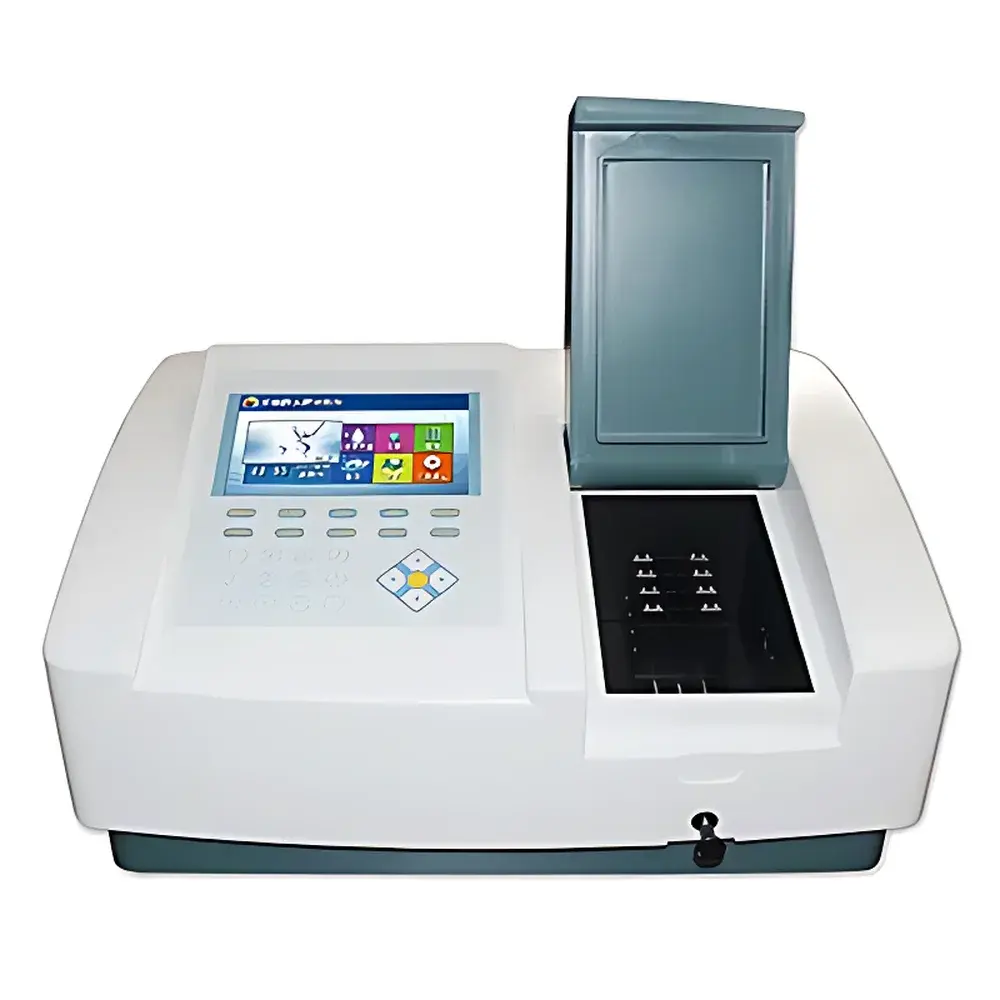
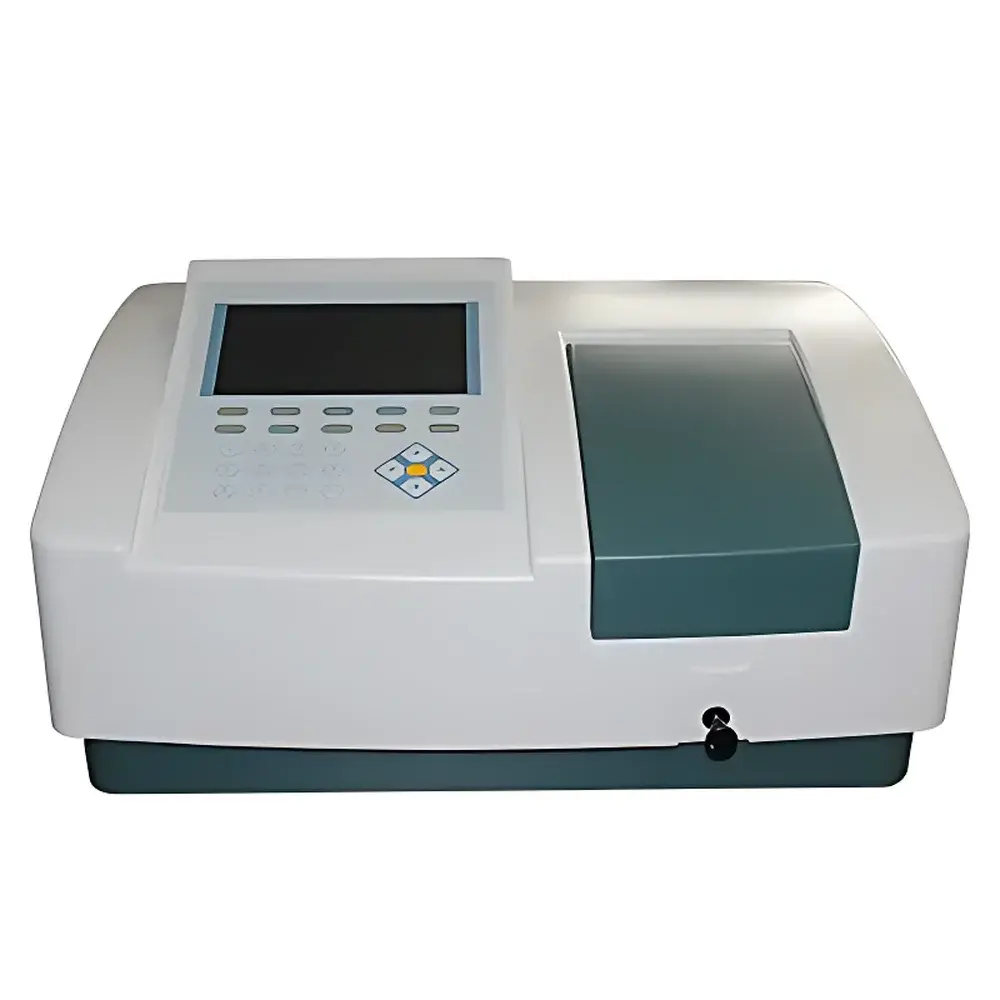
Yoke F-IT Multi-Parameter Heavy Metal Ion Analyzer
| Brand | Yoke |
|---|---|
| Origin | Shanghai, China |
| Manufacturer Type | Manufacturer |
| Product Category | Domestic |
| Model | F-IT |
| Instrument Type | Benchtop Laboratory Analyzer |
| Detection Principle | Photometric (Colorimetric) Method |
| Detectable Metals | Cr(VI), Total Cr, Ni, Cu, Zn, Fe, Pb (Multi-Parameter Simultaneous or Sequential) |
| Detection Time | 10–15 minutes per sample |
| Resolution | ≤ ±5% |
| Display | 7-inch 1024×600 TFT Color LCD |
| Optical System | Single-Beam with CT-Based Dual-Beam Ratio Correction |
| Pre-stored Calibration Curves | 2,000 built-in curves |
| Data Storage Capacity | 5 million measurement records |
| Stability | ±0.001 A/10 min |
| Repeatability | ≤ ±5% |
| Wavelength Range | 190–1100 nm (dual-lamp system: deuterium lamp + tungsten-halogen lamp) |
| Light Source Lifetime | >100,000 hours |
| Sample Cell | Fixed-pathlength cuvette holder (standard 10 mm or optional flow cell compatible) |
| Interfaces | RS-232C, USB-A (storage), USB-B (host), optional thermal printer port |
| Internal Memory | 8 GB flash storage |
| Export Formats | CSV, TXT, PNG/JPEG spectra and reports |
Overview
The Yoke F-IT Multi-Parameter Heavy Metal Ion Analyzer is a benchtop photometric analyzer engineered for rapid, reliable quantification of priority heavy metal ions in water matrices—including Cr(VI), total chromium, nickel, copper, zinc, iron, and lead—using standardized colorimetric reaction chemistries. It operates on a single-beam optical architecture enhanced by CT-based dual-beam ratio correction, which compensates for source intensity drift and improves long-term baseline stability without requiring mechanical beam splitters. The instrument integrates a dual-lamp system (deuterium and tungsten-halogen) with automatic lamp selection and runtime logging, enabling accurate absorbance measurements across the UV-Vis spectrum (190–1100 nm). Designed specifically for environmental laboratories, municipal water quality control units, and academic teaching labs, the F-IT delivers regulatory-compliant results within 10–15 minutes per analysis cycle, supporting routine compliance monitoring against national and international standards such as EPA Method 7196A (Cr(VI)), ISO 6636-1 (copper), and ISO 8288 (nickel and cobalt).
Key Features
- 7-inch high-resolution TFT color display (1024×600) with intuitive graphical interface for real-time spectral visualization, calibration curve plotting, and direct method selection—eliminating dependency on external PCs for routine operation.
- Dual-lamp optical system with socket-type modular design: deuterium lamp for UV-range measurements (e.g., Cr(VI) at 540 nm post-diphenylcarbazide reaction) and tungsten-halogen lamp for visible-range assays; automatic lamp switching and cumulative usage tracking ensure traceable maintenance scheduling.
- Onboard data management: 8 GB internal flash memory supports up to 5 million test records; export via USB-A drive in CSV (for Excel-compatible quantitative reports), TXT (raw absorbance/log data), and PNG/JPEG (spectra and calibration plots).
- Robust I/O architecture: RS-232C serial port for legacy printer integration, USB-B host port for peripheral control (e.g., barcode scanners), and standard USB-A port for mass storage—enabling seamless deployment in GLP/GMP-aligned workflows.
- Pre-loaded analytical methods: 2,000 validated calibration curves covering EPA, ISO, and Chinese HJ standard methods; user-customizable curve libraries with polynomial and linear regression options.
Sample Compatibility & Compliance
The F-IT accepts standard 10 mm pathlength glass or quartz cuvettes and supports optional flow-cell configurations for continuous monitoring integration. Sample preparation follows established wet-chemistry protocols: acid digestion for total metal determination (per ISO 11885 or EPA 200.7), chelation-based color development (e.g., 1,10-phenanthroline for Fe²⁺, dithizone for Pb²⁺), and masking agents where interferences are expected (e.g., EDTA for Ca²⁺/Mg²⁺ interference suppression). The analyzer meets ISO 9001:2015 and ISO 14001:2015 requirements; its firmware architecture supports audit-trail-enabled operation per FDA 21 CFR Part 11 when deployed with networked LIMS integration (via optional Ethernet module). All factory calibrations are traceable to NIST SRMs, and performance verification adheres to ISO/IEC 17025 validation guidelines for quantitative spectrophotometers.
Software & Data Management
Instrument control and data handling are managed through embedded firmware with no external software dependency. All calibration, measurement, and reporting functions execute locally. Data files include metadata headers (date/time, operator ID, method name, wavelength, pathlength, lot numbers of reagents) to satisfy GLP documentation requirements. USB exports retain full traceability: CSV files contain raw absorbance values, calculated concentrations, confidence intervals, and QC flag indicators (e.g., “out-of-linear-range”, “baseline-drift-warning”). Firmware updates are delivered via signed .bin files loaded from USB drive, with version rollback capability and SHA-256 integrity verification. Optional PC synchronization software (Yoke LabLink v3.x) enables centralized database aggregation, statistical process control (SPC) charting, and automated PDF report generation compliant with ISO/IEC 17025 clause 7.8.2.
Applications
- Regulatory wastewater discharge monitoring for industrial effluents (textile, electroplating, mining sectors)
- Drinking water safety verification in municipal treatment plants and distribution networks
- Environmental impact assessment (EIA) field lab support for surface and groundwater surveys
- Academic research and undergraduate analytical chemistry labs for method development and validation studies
- Third-party testing laboratories performing CNAS-accredited heavy metal analyses under HJ 484–2009, HJ 485–2009, and HJ 486–2009 standards
FAQ
Does the F-IT support simultaneous multi-metal detection in a single sample injection?
No—it performs sequential analysis using discrete, pre-programmed methods. Each metal requires a specific reagent addition step and wavelength selection; however, automated multi-step protocols minimize manual intervention.
Is the instrument compatible with EPA-certified test kits?
Yes—its optical specifications and calibration flexibility allow direct use of commercially available EPA-compliant colorimetric kits (e.g., Hach, Merck, Palintest), provided kit instructions align with F-IT’s defined wavelength and timing parameters.
Can calibration curves be imported from external sources?
Yes—users may upload custom calibration tables in CSV format via USB, with column headers specifying concentration (mg/L) and corresponding absorbance values; the system validates linearity and applies user-defined regression models.
What maintenance is required for the dual-lamp system?
Lamp replacement is tool-free due to socket-mount design; firmware logs operational hours and triggers service alerts at 95% of rated lifetime (≥100,000 h); no optical alignment is needed post-replacement.
How does the F-IT ensure measurement reproducibility across operators?
By enforcing method-locking: once a test protocol is selected, all parameters (wavelength, delay time, cuvette position, blanking sequence) are fixed; operator inputs are limited to sample ID entry and start confirmation—reducing procedural variability.
Related Products







