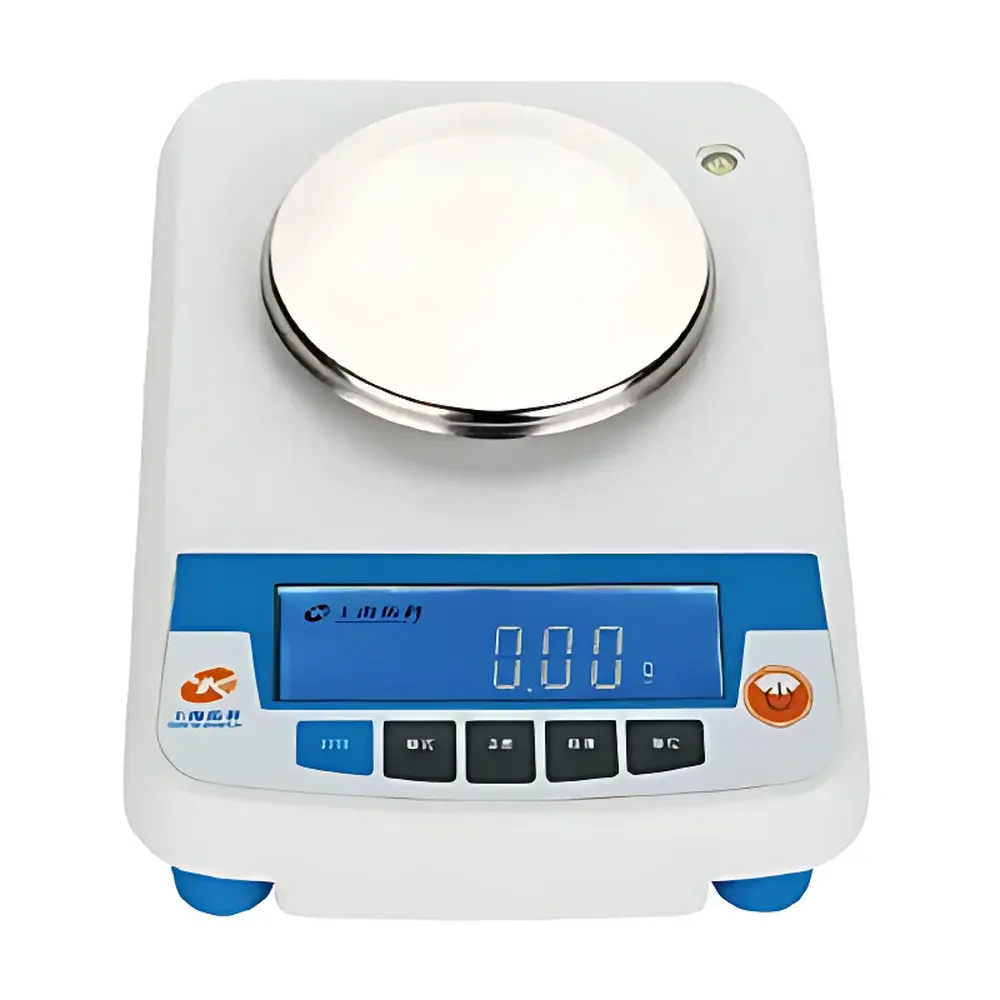
Yoke YP50001 0.1 g Precision Top-Loading Balance
| Brand | Yoke |
|---|---|
| Origin | Shanghai, China |
| Manufacturer Type | Direct Manufacturer |
| Country of Origin | China |
| Model | YP50001 |
| Instrument Type | General-Purpose Laboratory Top-Loading Balance |
| Maximum Capacity | 5000 g |
| Readability | 100 mg |
| Weighing Pan Dimensions | 165 × 165 mm |
| Overall Dimensions (W × D × H) | 320 × 280 × 150 mm |
| Power Supply | AC/DC dual-mode operation |
| Interface | RS-232C serial output |
| Unit Conversion | g, oz, ct, lb, pcs, % |
| Special Modes | Counting, Animal Weighing, Percent Weighing |
Overview
The Yoke YP50001 is a robust, entry-level top-loading laboratory balance engineered for routine mass measurement tasks in quality control laboratories, educational institutions, and light industrial environments. It operates on electromagnetic force restoration (EMFR) principle—where the load-induced displacement of the weighing pan is counteracted by a precisely regulated electromagnetic current, enabling stable and repeatable readings without mechanical levers or knife-edge suspensions. With a maximum capacity of 5000 g and readability of 100 mg (0.1 g), the YP50001 meets the performance requirements for applications demanding moderate precision but high operational reliability—such as bulk sample preparation, reagent dispensing, packaging verification, and educational demonstrations. Its compact footprint and dual-power design support flexible deployment across benchtops, field labs, or mobile workstations.
Key Features
- Sturdy all-metal base and reinforced mechanical architecture enhance structural rigidity and minimize drift under ambient vibration or air currents.
- Fast stabilization time (<2 seconds typical) achieved through optimized damping algorithms and low-inertia pan suspension.
- Intuitive LED display with backlight ensures legibility under variable lighting conditions; contrast and brightness are user-adjustable.
- Multi-function operation modes include piece counting (with automatic average piece weight calculation), animal/dynamic weighing (compensates for low-frequency motion), and percent weighing relative to a reference mass.
- RS-232C interface enables direct data transmission to PCs, LIMS, or statistical process control (SPC) software—compatible with standard terminal emulators and ASCII-based protocols.
- AC/DC dual-power capability supports uninterrupted operation during power fluctuations or portable use with optional rechargeable battery pack (not included).
Sample Compatibility & Compliance
The YP50001 accommodates a wide range of sample types—including powders, granules, liquids in containers, solid components, and small biological specimens—within its 165 × 165 mm stainless-steel weighing pan. The pan’s shallow profile and smooth surface facilitate rapid cleaning and reduce residue retention. While not certified for GLP/GMP-regulated environments requiring full audit trails or 21 CFR Part 11 compliance, the balance adheres to fundamental metrological principles outlined in OIML R76-1 and JJG 1036–2008 (Chinese national verification regulation for non-automatic weighing instruments). Its repeatability (≤ ±0.02 g at full scale) and linearity error (≤ ±0.03 g) are verified during factory calibration using traceable Class M2 weights. Users are advised to perform periodic verification per ISO/IEC 17025–recommended intervals when used in accredited testing workflows.
Software & Data Management
Data export via RS-232C follows standard asynchronous serial protocol (9600 baud, 8N1, no handshaking) and outputs ASCII-formatted strings containing net weight, unit symbol, and status flags (e.g., “5024.3 g” or “Stable”). No proprietary driver or software bundle is required; integration with Excel, LabVIEW, or custom Python scripts is straightforward using standard serial libraries (e.g., PySerial). Optional third-party middleware solutions can map incoming streams to database fields or trigger automated log entries. Though the device lacks onboard memory or timestamping, external logging systems may append date/time metadata during capture—supporting basic traceability for internal QA documentation.
Applications
- Educational laboratories: Demonstrating mass conservation, stoichiometric calculations, and density determinations in chemistry and physics curricula.
- Pharmaceutical preformulation: Weighing excipients and active ingredients prior to blending, where 100 mg resolution satisfies USP general chapter tolerances for non-critical batches.
- Food processing QA: Verifying fill weights of retail packages (e.g., snack bags, spice tins) against nominal net content declarations.
- Manufacturing receiving inspection: Confirming quantity-by-weight for raw material deliveries (e.g., metal shavings, plastic pellets, ceramic powders).
- Agricultural extension services: Conducting feed ration formulation and seed count calibration in resource-constrained field settings.
FAQ
What calibration standards are recommended for routine verification?
Class M2 stainless-steel weights certified to ISO 9001-accredited laboratories are recommended. Verification should cover at least 0%, 50%, and 100% of full scale (0 g, 2500 g, 5000 g) at ambient temperature (20 ± 5 °C) and relative humidity below 80% RH.
Is the balance suitable for use in fume hoods or high-humidity areas?
It is not IP-rated for dust or moisture ingress. Prolonged exposure to corrosive vapors or condensation may compromise sensor longevity; use within climate-controlled lab spaces is strongly advised.
Can the RS-232C output be configured for automatic print-to-file or real-time CSV generation?
Yes—when paired with compatible terminal emulation software or lightweight scripting tools, the serial stream can be redirected to text files or parsed into spreadsheet-ready formats without hardware modification.
Does the YP50001 support internal calibration or only external?
It supports external calibration only; no motorized internal weight or auto-calibration function is integrated.
What is the warm-up time required before first use after power-on?
A minimum of 30 minutes is recommended to achieve thermal equilibrium of the EMFR sensor assembly and ensure optimal stability and accuracy.