
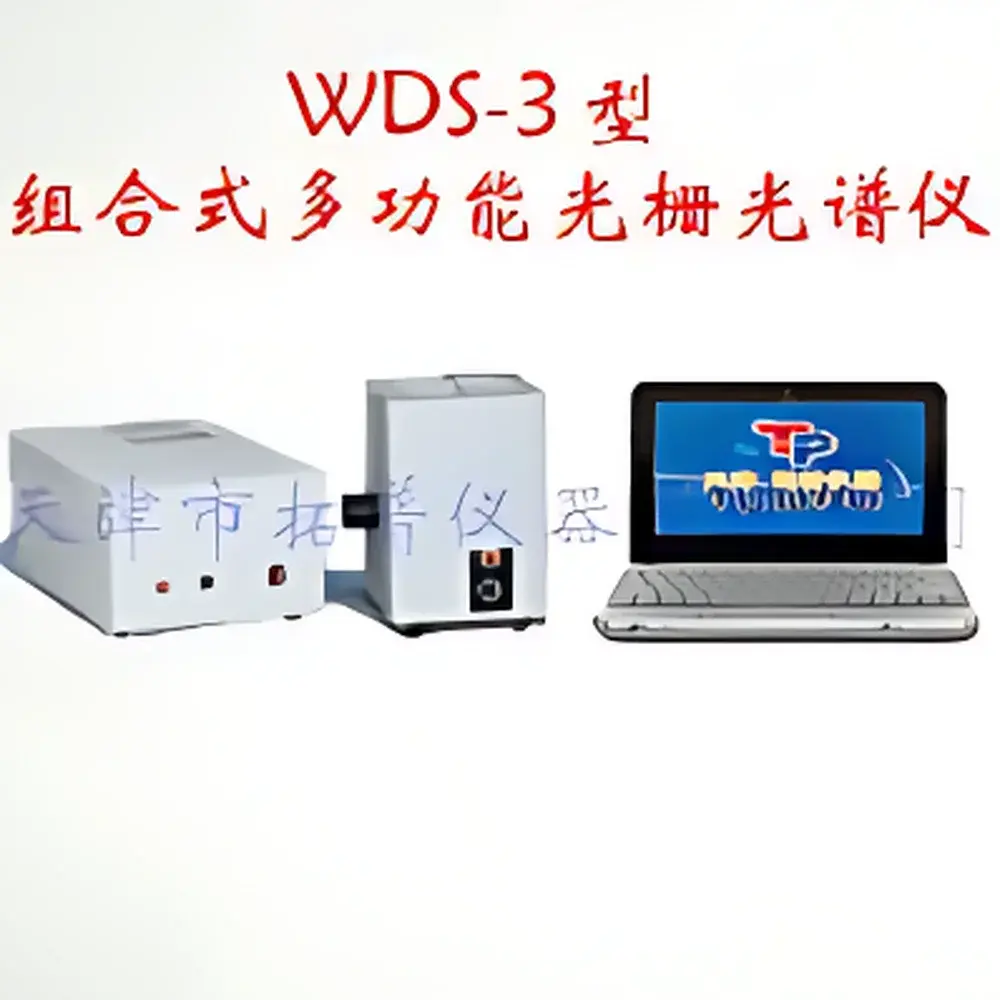
Topo WDS-3 Modular Multi-Functional Grating Spectrometer
| Brand | Topo (TP) |
|---|---|
| Origin | Tianjin, China |
| Manufacturer Type | Direct Manufacturer |
| Model | WDS-3 |
| Price | Upon Request |
| Focal Length | 300 mm |
| Wavelength Range | 200–800 nm |
| Relative Aperture | D/F = 1/7 |
| Grating Density | 600 or 1200 lines/mm |
| Stray Light | ≤0.3% T |
| Wavelength Accuracy | ±0.4 nm |
| Slit Width Adjustment | 0–2 mm (continuous), 0.01 mm/division, max 20 mm |
| Spectral Bandwidth (FWHM) | ≤0.2 nm at 589 nm (slit height 3 mm, width 0.2 mm) |
| Detector | Photomultiplier Tube (PMT) |
| Interface | USB |
Overview
The Topo WDS-3 Modular Multi-Functional Grating Spectrometer is a benchtop dispersive optical instrument engineered for high-resolution wavelength selection and spectral analysis in research and quality control laboratories. Based on Czerny–Turner optical architecture, it employs a precision ruled or holographic diffraction grating to separate polychromatic light into its constituent wavelengths. With a 300 mm focal length and f/7 relative aperture, the system balances throughput and resolution across the ultraviolet–visible (UV–Vis) spectrum (200–800 nm). Its modular design supports interchangeable gratings (600 or 1200 lines/mm), enabling users to optimize either spectral resolution (≤0.2 nm FWHM at 589 nm under defined slit conditions) or luminous efficiency depending on application requirements. The spectrometer operates as both a scanning monochromator and a fixed-wavelength selector, making it suitable for absorbance, fluorescence excitation, reflectance, and emission measurements where discrete wavelength isolation is critical.
Key Features
- Modular optical platform supporting rapid grating exchange between 600 and 1200 lines/mm configurations
- Precision-machined adjustable entrance and exit slits (0–2 mm continuous, calibrated to 0.01 mm/division; mechanical limit 20 mm)
- High-stability Czerny–Turner mount with kinematic mirror alignment and low-drift aluminum alloy housing
- Low-stray-light optical path (≤0.3% T) achieved via baffling, black-anodized internal surfaces, and optimized grating blaze angles
- Integrated photomultiplier tube (PMT) detector with high quantum efficiency in UV–Vis range and low dark current
- USB 2.0 interface compliant with standard HID protocols; no external power supply required beyond USB bus power
- Compact footprint (370 × 280 × 200 mm) designed for integration into optical tables, glove boxes, or OEM spectroscopic systems
Sample Compatibility & Compliance
The WDS-3 interfaces with standard cuvette holders, fiber-optic couplers (SMA 905), and custom sample chambers for transmission, reflection, or emission geometries. It is compatible with liquid, solid, and gaseous samples when used with appropriate accessories (e.g., integrating spheres, temperature-controlled stages, or gas cells). While not certified to ISO/IEC 17025 or ASTM E308 by default, its optical performance parameters align with foundational requirements of ISO 17025-accredited UV–Vis spectrophotometer calibration procedures. The instrument’s wavelength accuracy (±0.4 nm) and spectral bandwidth meet typical validation thresholds for method transfer in QC labs operating under GLP or GMP frameworks. Traceable calibration using NIST-traceable holmium oxide or didymium filters is supported via optional software routines.
Software & Data Management
The WDS-3 is operated via cross-platform PC software (Windows/macOS/Linux) that provides real-time wavelength scanning, point-and-shoot intensity measurement, and automated slit-width optimization. Data export is available in CSV, TXT, and XML formats, preserving metadata including timestamp, slit settings, grating ID, and detector gain. Audit trail functionality records all parameter changes with user ID and system time—supporting compliance with FDA 21 CFR Part 11 when deployed with validated electronic signatures and role-based access controls (available in enterprise license tier). Raw PMT output is digitized at 16-bit resolution with configurable integration times (1 ms–10 s), enabling signal averaging for improved SNR in low-light applications.
Applications
- UV–Vis absorption spectroscopy for chemical identification and concentration quantification (e.g., pharmaceutical active ingredients, dye solutions)
- Fluorescence excitation profiling of organic fluorophores, quantum dots, and biological probes
- Plasma emission line characterization in low-pressure discharge lamps and laser-induced breakdown spectroscopy (LIBS) setups
- Optical filter and coating transmittance/reflectance verification (with dual-beam accessory)
- Calibration source characterization for radiometric and photometric standards laboratories
- OEM integration into custom analytical platforms requiring tunable monochromatic illumination or detection
FAQ
What grating options are included with the WDS-3 standard configuration?
The base unit ships with one grating (user-selectable: 600 or 1200 lines/mm); additional gratings are available as optional accessories.
Is the photomultiplier tube replaceable or upgradeable?
Yes—the PMT module uses a standardized side-on socket (e.g., Hamamatsu R928 or equivalent) and can be exchanged without optical realignment.
Does the WDS-3 support external triggering or synchronization?
It provides TTL-compatible trigger input/output ports for synchronization with pulsed light sources or data acquisition systems.
Can the instrument operate in vacuum or inert gas environments?
The optical housing is sealed and rated for ambient air operation; for vacuum or purged environments, optional O-ring sealed front panels and quartz windows are available.
What is the minimum measurable intensity level with the standard PMT?
Under optimal conditions (1 s integration, 0.1 mm slit, 1200 L/mm grating), the system achieves a detection limit of approximately 1 × 10⁻¹⁴ W/cm² at 550 nm.





