
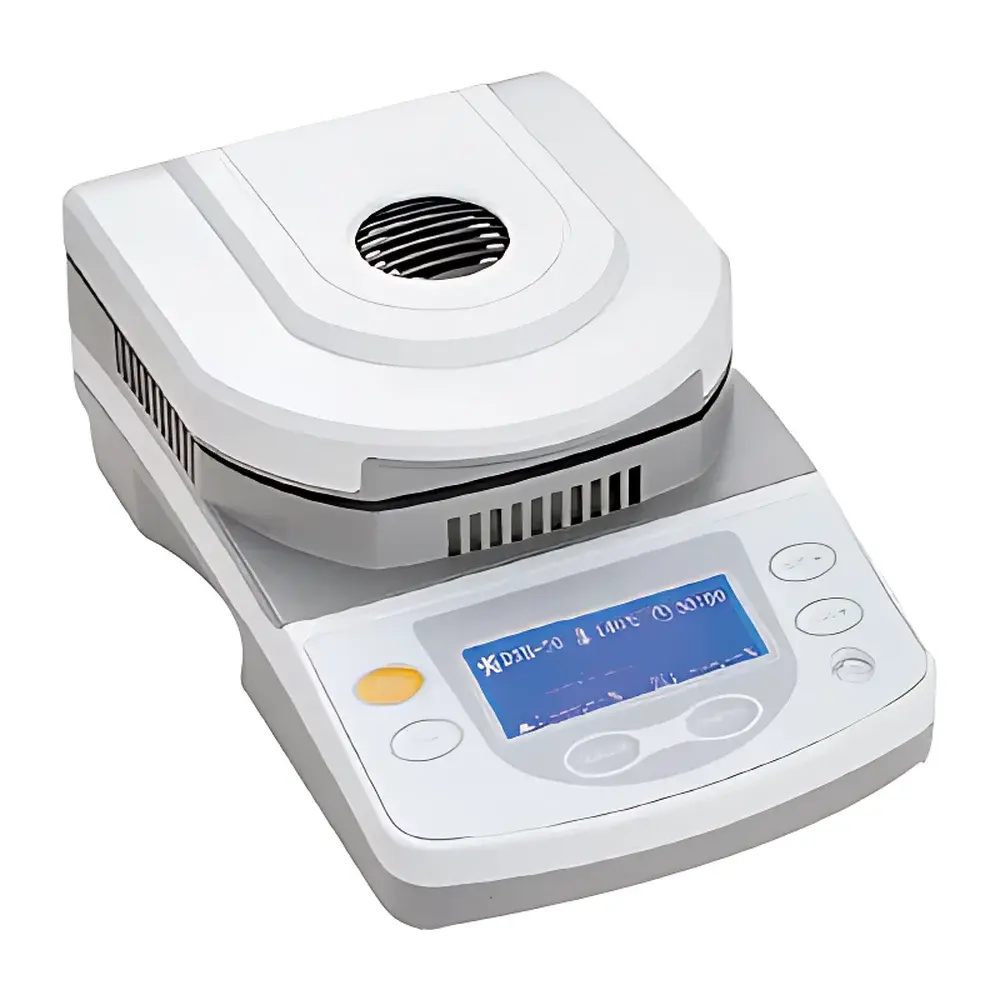
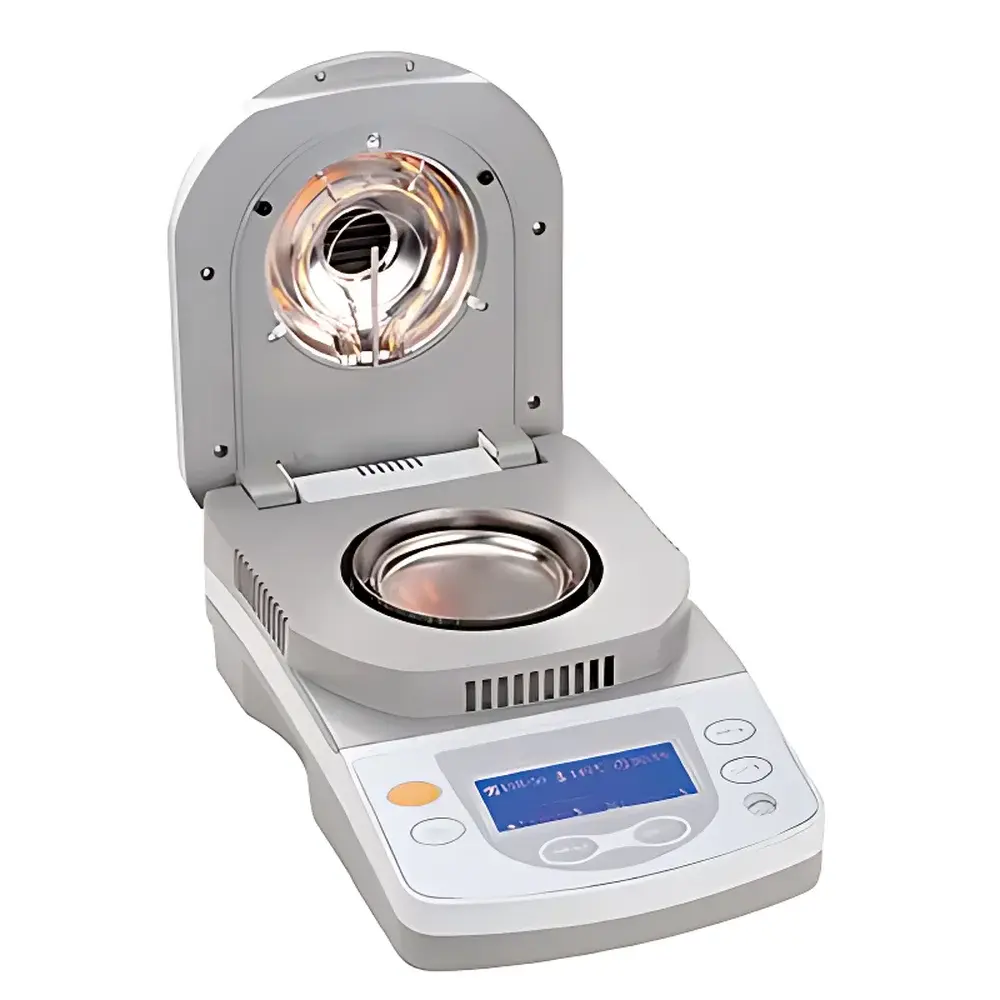
Yoke DSH-50A-10 Halogen Moisture Analyzer
| Max Capacity | 50 g |
|---|---|
| Readability | 10 mg |
| Repeatability (3 g sample) | ±0.5% |
| Minimum Sample Mass | 0.5 g |
| Recommended Sample Mass | 3–10 g |
| Heating Time Range | 1–99 min (1-min increments) |
| Temperature Range | 50–180 °C |
| Heating Source | Halogen Lamp |
| Pan Diameter | 100 mm |
| Dimensions (W×D×H) | 265 × 160 × 150 mm |
| Net Weight | 5 kg |
| Communication Interface | RS232 |
| End-Point Modes | Timed & Automatic |
| Display Parameters | Moisture %, Solid %, Weight (g), Elapsed Time, Date |
Overview
The Yoke DSH-50A-10 Halogen Moisture Analyzer is a precision thermogravimetric instrument engineered for rapid, reliable determination of moisture content in solid and semi-solid samples across quality control, pharmaceutical, food, chemical, and materials laboratories. It operates on the principle of loss-on-drying (LOD), wherein a pre-weighed sample is heated under controlled halogen lamp radiation, and the mass loss due to volatilization of water and other volatile components is measured in real time. Unlike conventional infrared or convection ovens, the halogen heating element delivers uniform, high-intensity radiant energy with fast thermal response—enabling rapid temperature ramping and improved measurement reproducibility. The analyzer integrates a high-stability electromagnetic force restoration balance with thermal isolation design, ensuring accurate mass tracking even during dynamic heating cycles. Its compact benchtop architecture complies with ISO 18847:2016 (Moisture analysis by thermogravimetry) and supports method development aligned with USP <921>, ASTM E1447, and AOAC 952.07 protocols.
Key Features
- Halogen lamp heating system: Provides rapid, uniform heating with precise temperature control from 50 °C to 180 °C in 1 °C increments; achieves target temperature in under 60 seconds.
- High-resolution graphical LCD display: Backlit dot-matrix screen with intuitive icon-based interface; optimized for low-ambient-light environments and ergonomic readability.
- Thermally isolated load cell: Electromagnetic force compensation sensor with integrated thermal shielding minimizes drift induced by heat transfer from the drying chamber.
- Dual end-point detection: Programmable timed mode for standardized protocols or automatic mode triggered by mass change rate (e.g., ≤0.1 mg/min over 60 s), enhancing method robustness.
- RS232 serial interface: Enables direct data export to LIMS, Excel, or custom QA software; supports ASCII output with timestamp, sample ID, moisture %, solid %, final weight, and runtime.
- Robust mechanical design: Stainless-steel weighing pan (Ø100 mm), sealed electronics compartment, and vibration-damped base ensure operational stability in shared lab environments.
Sample Compatibility & Compliance
The DSH-50A-10 accommodates a broad range of sample types—including powders (e.g., APIs, excipients), granules, pellets, pastes, slurries, and thin-film coatings—provided they are thermally stable below 180 °C and do not undergo significant decomposition or sublimation within the selected drying profile. Sample mass optimization (3–10 g recommended) ensures statistical representativeness while maintaining surface-area-to-volume ratio suitable for uniform drying kinetics. The instrument meets general requirements for GLP-compliant moisture testing when operated with documented SOPs, calibration logs (per ISO/IEC 17025), and audit-trail-capable data management. While not inherently 21 CFR Part 11 compliant, its RS232 output allows integration with validated third-party software for electronic signature and audit trail functionality.
Software & Data Management
Data acquisition and reporting are managed via the built-in firmware, which stores up to 99 user-defined methods—including temperature ramp profiles, hold times, endpoint criteria, and display preferences. Each measurement generates a timestamped record containing initial mass, final mass, moisture content (% w/w), dry residue (%), elapsed time, and operator ID (if entered). Raw data exports via RS232 include ASCII-formatted fields compatible with CSV ingestion, enabling traceability in regulated environments. Optional PC software (sold separately) provides graphical trend analysis, method validation reports (including repeatability and intermediate precision per ICH Q2(R2)), and PDF certificate generation with digital signature support.
Applications
- Pharmaceutical QC: Moisture verification of active pharmaceutical ingredients (APIs), excipients (e.g., lactose, microcrystalline cellulose), and finished dosage forms per USP <921>.
- Food & Agriculture: Rapid moisture assessment in grains, dairy powders, spices, and pet food to ensure shelf-life compliance and prevent microbial growth.
- Chemicals & Polymers: Monitoring residual solvent in resins, catalysts, and monomers; evaluating hygroscopicity of desiccants and silica gels.
- Materials Science: Quantifying bound vs. free water in clays, ceramics, and battery electrode slurries prior to sintering or coating processes.
- Academic Research: Method development for novel drying kinetics modeling and comparative LOD validation against Karl Fischer titration (ASTM D6304).
FAQ
What calibration standards are recommended for routine verification?
Certified moisture reference standards (e.g., sodium tartrate dihydrate, ~15.66% H₂O at 25 °C) or anhydrous sodium sulfate are advised for daily performance checks. Balance calibration requires certified weights traceable to NIST or equivalent national metrology institutes.
Can the instrument be used for non-aqueous volatile content determination?
Yes—provided the volatile component evaporates completely within the selected temperature range and does not chemically degrade the sample matrix. Validation against reference methods (e.g., GC or gravimetric solvent recovery) is required for regulatory submissions.
Is the halogen lamp replaceable by the user?
Yes—the lamp is a field-replaceable module with tool-free access; typical service life exceeds 5,000 hours under standard operating conditions.
How is temperature uniformity verified across the pan surface?
Uniformity is validated using calibrated thermocouple mapping per ASTM E2251, typically showing ±2 °C deviation across the central 80% of the pan area at 105 °C and 135 °C setpoints.




