
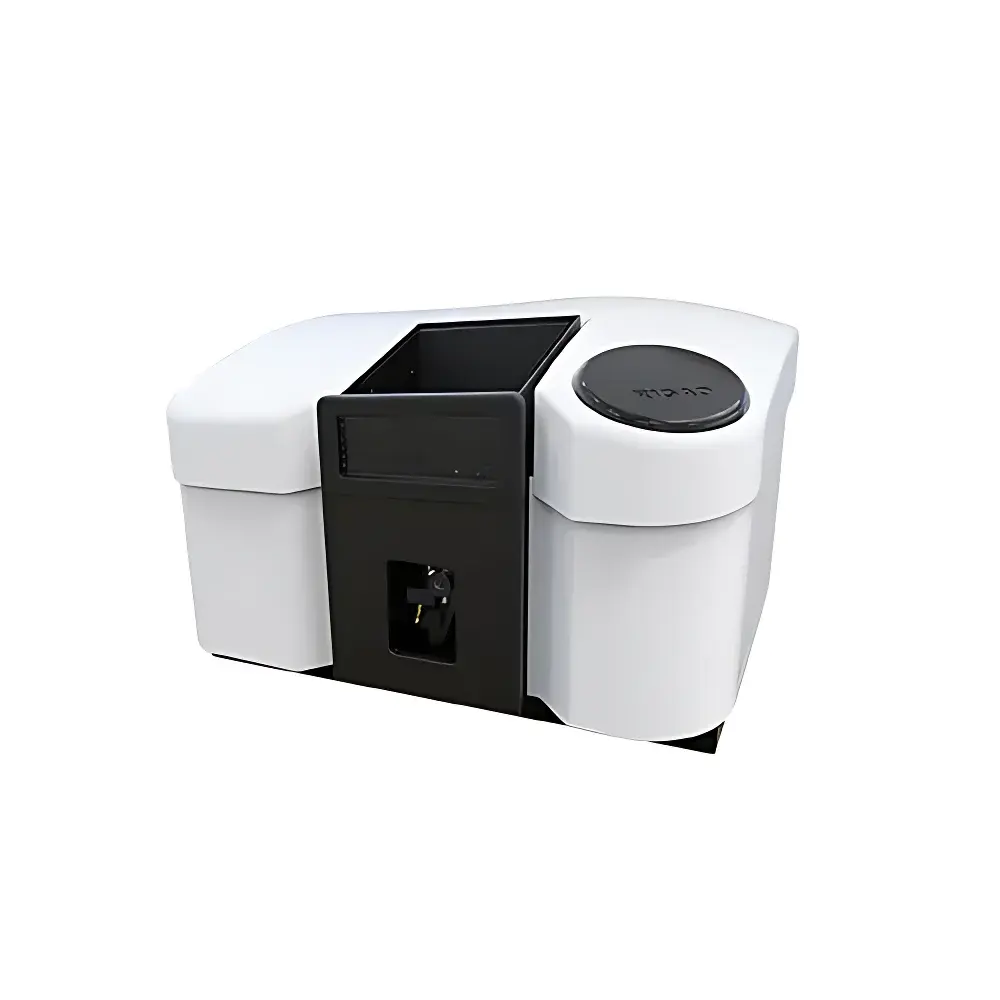
Yoke RG-3618AA Flame Atomic Absorption Spectrometer
| Brand | Yoke |
|---|---|
| Origin | Shanghai, China |
| Manufacturer Type | Direct Manufacturer |
| Instrument Type | Flame AAS |
| Model | RG-3618AA |
| Wavelength Range | 190–900 nm |
| Spectral Bandwidth | 0.1 / 0.2 / 0.7 / 1.4 / 2.0 nm (5-step automatic selection) |
| Wavelength Accuracy | ±0.15 nm |
| Lamp Positions | 8-slot rotating turret (360° motorized rotation) |
| Optical System | Single-beam with all-reflective optics |
| Monochromator | Plane grating |
| Detector | Solid-state photodiode array |
| Background Correction | Dual-mode — D₂-lamp and self-absorption (SA) methods |
| Detection Limit (Flame) | ≤0.004 µg/mL for Cu |
| Precision (RSD) | ≤0.5% (n=10, typical aqueous standards) |
| Atomization Modes | Air-acetylene flame |
Overview
The Yoke RG-3618AA Flame Atomic Absorption Spectrometer is a benchtop analytical instrument engineered for routine elemental quantification in environmental, pharmaceutical, food safety, and industrial quality control laboratories. It operates on the fundamental principle of atomic absorption spectroscopy (AAS), where ground-state free atoms in a flame absorb characteristic radiation emitted by a hollow cathode lamp (HCL) or electrodeless discharge lamp (EDL). The magnitude of absorption—measured at discrete wavelengths across the 190–900 nm spectral range—is directly proportional to analyte concentration, following the Beer–Lambert law. Designed as a flame-only system with optional external graphite furnace compatibility, the RG-3618AA delivers robust performance for trace metal analysis at sub-ppb levels in liquid samples. Its all-reflective optical path eliminates chromatic aberration and enhances signal stability, while the single-beam architecture ensures mechanical simplicity and long-term alignment integrity.
Key Features
- All-reflective optical system with high-efficiency plane grating monochromator, minimizing stray light and maximizing signal-to-noise ratio (SNR) across the full UV-Vis-NIR range.
- Dual background correction capability: simultaneous D₂-lamp and self-absorption (SA) methods enable accurate compensation for both structured and continuous molecular absorption—critical for complex matrices such as wastewater digests or biological extracts.
- Motorized 8-lamp turret with 360° rotational positioning and automatic lamp selection, supporting rapid multi-element analysis without manual intervention or realignment.
- Intelligent gas control module compliant with EN ISO 27013 and OSHA-compliant safety protocols, featuring real-time pressure monitoring, automatic flame-out detection, and interlocked fuel/oxidant shutoff.
- Automated wavelength scanning and spectral bandwidth selection (0.1–2.0 nm, five fixed steps), optimized per element to balance resolution and sensitivity per ASTM E1997 and ISO 11170 guidelines.
- RG-WinAAS software suite running natively on Windows OS, offering method development, calibration curve generation (linear/non-linear), QC flagging, audit trail logging, and export-ready reporting aligned with GLP/GMP documentation requirements.
Sample Compatibility & Compliance
The RG-3618AA supports aqueous and dilute acid-digested samples compatible with standard flame nebulization (e.g., 2% HNO₃ matrix). It accommodates common flame gases—air/acetylene (for alkali/alkaline earth elements) and nitrous oxide/acetylene (for refractory elements such as Al, Si, V)—via standardized CGA fittings. The system meets core regulatory expectations for elemental testing under USP , EPA Method 7000B, and ISO 11170. While not pre-certified for FDA 21 CFR Part 11, the RG-WinAAS software architecture supports user-defined electronic signatures, password-protected method locking, and time-stamped audit trails—enabling lab-specific validation for regulated environments.
Software & Data Management
RG-WinAAS provides a fully integrated, menu-driven interface for instrument control, data acquisition, and post-processing. Calibration functions include single-point, multi-point linear, and quadratic fitting with residual diagnostics. All raw absorbance/time traces, peak area integrations, and background-corrected signals are stored with metadata (lamp ID, slit width, gas flow rates, operator ID). Data export formats include CSV, TXT, and XML for LIMS integration. Software logs retain ≥180 days of operational history—including lamp usage hours, error codes, and parameter change timestamps—to support internal QA reviews and external audits.
Applications
The RG-3618AA is routinely deployed for quantification of essential and toxic metals including Ca, Mg, Fe, Zn, Cu, Pb, Cd, and Cr in drinking water (EPA 200.7), soil extracts (EPA 6010D), pharmaceutical excipients (USP ), and nutritional supplements (AOAC 984.27). Its ≤0.004 µg/mL detection limit for copper—verified using NIST SRM 1643e—ensures compliance with WHO guideline values for heavy metals in potable water. Laboratories performing contract testing for ISO/IEC 17025-accredited scopes utilize its RSD ≤0.5% repeatability to meet precision criteria for proficiency testing schemes.
FAQ
Is the RG-3618AA compatible with graphite furnace atomization?
Yes—while configured as a flame-only system by default, it supports integration with an external graphite furnace module via standardized electrical and pneumatic interfaces.
Does the software support 21 CFR Part 11 compliance?
RG-WinAAS includes foundational features required for Part 11 implementation (audit trail, electronic signatures, role-based access), though final validation must be performed by the end-user laboratory per their SOPs.
What maintenance intervals are recommended for the optical system?
The all-reflective path requires no wavelength recalibration; however, quarterly inspection of mirror cleanliness and annual verification of wavelength accuracy (using Holmium oxide or Didymium filters) are advised per ISO/IEC 17025 Clause 6.4.
Can the instrument operate with alternative lamp types beyond hollow cathode lamps?
Yes—it accepts standard 1/4-inch pin-base HCLs and electrodeless discharge lamps (EDLs) for As, Se, and Hg, provided they conform to IUPAC lamp voltage/current specifications.
How is background correction validated during method setup?
Dual-mode correction is verified by measuring certified reference materials (e.g., NIST SRM 1640a) with known spectral interference profiles, comparing corrected vs. uncorrected absorbance at overlapping wavelengths.





